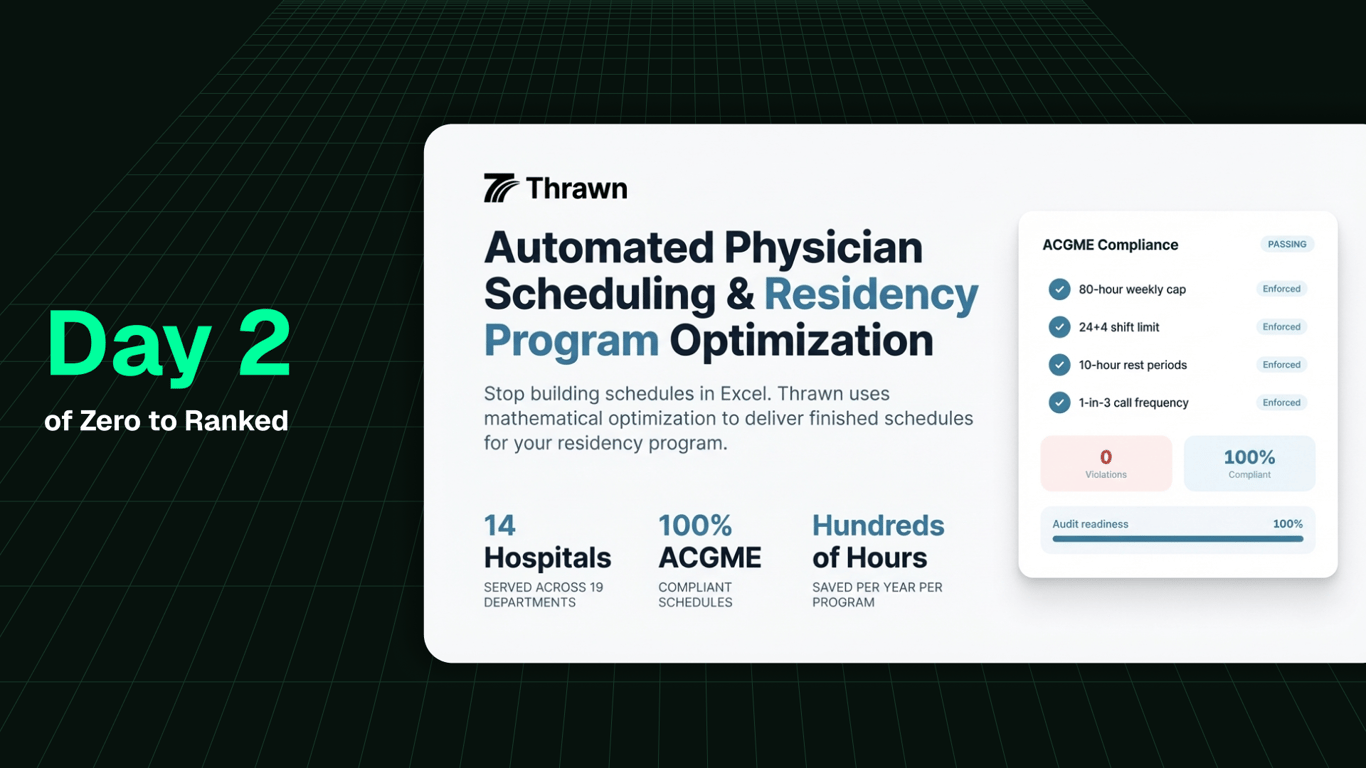
Day 2 — Launching a Medical Scheduling Startup in 5 Hours and Getting Leads from Hospitals in Week 3
Summary
A new medical scheduling site generated only nine clicks in three weeks but converted two high-value leads from hospital decision-makers.
Targeting high-intent, bottom-of-funnel keywords is more effective for B2B lead generation than chasing high traffic volume.
A critical lesson was the need for full attribution tracking from day one to understand user journeys and the impact of AI-powered search.
Building a customer pipeline from just a few high-intent clicks is the focus of a revenue-driven approach like Synscribe's SEO strategy.
Nine clicks. That's all Google Search Console showed us after three full weeks of a live site.
No flood of organic traffic. No viral moment. No signal that anything was working at all.
And yet, on the same day in week three, we received an inbound enquiry from a Chief Resident at a children's hospital managing 15–30 resident doctors — and another from a physician at a private practice with over 45 doctors enquiring on behalf of their entire organisation.
Both leads. Same day. Completely cold inbound.
This is the story of Day 2 in our Zero to Ranked series — where we launch one startup's go-to-market presence per day, using SEO and GEO (Generative Engine Optimisation) instead of boots-on-the-ground outreach. And medical scheduling? It turned out to be one of the most unexpected wins yet.
Why a Medical Scheduling Startup?
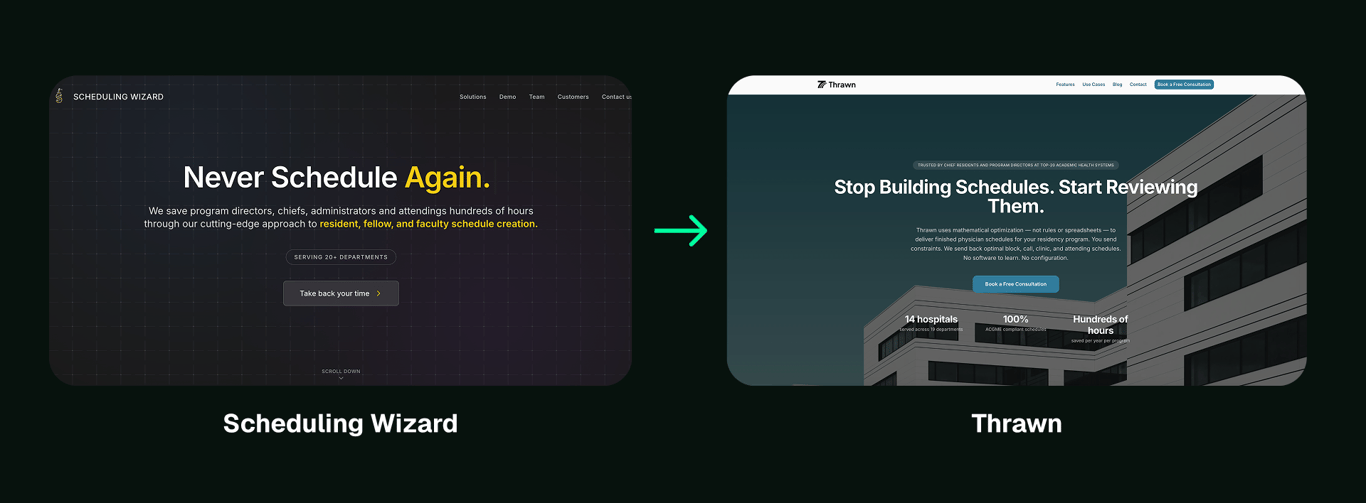 The product we targeted for Day 2 was a clinician-facing scheduling software — think Scheduling Wizard, a YC-backed tool built to manage the complex, shift-heavy world of hospital and clinic rostering.
We call our product Thrawn.
It's a crowded market. There are plenty of incumbents. Big players. Established names with years of domain authority baked in.
So why pick it?
Because it was the perfect test case.
This startup sits at the intersection of B2B SaaS and a done-for-you consultation model — a hybrid structure that's becoming increasingly common, and one that mirrors what we do here at Synscribe. The hybrid model is powerful because the service layer generates early insights and revenue while the SaaS layer scales. But the conventional wisdom says you grow it through outbound — SDRs, cold calls, LinkedIn sequences, and sales reps physically visiting hospitals.
We wanted to challenge that assumption.
Could content and GEO generate qualified inbound leads in a space where everyone assumes you need a human in the room to close?
Spoiler: Yes. But the path there was messier than we expected.
The Launch: From Lunch to Live in Under 5 Hours
Coming off a launch high from Day 1 — where we were already ranking on Google and seeing clicks within hours — the team sat down after lunch to do it all again.
The core challenges this time were different:
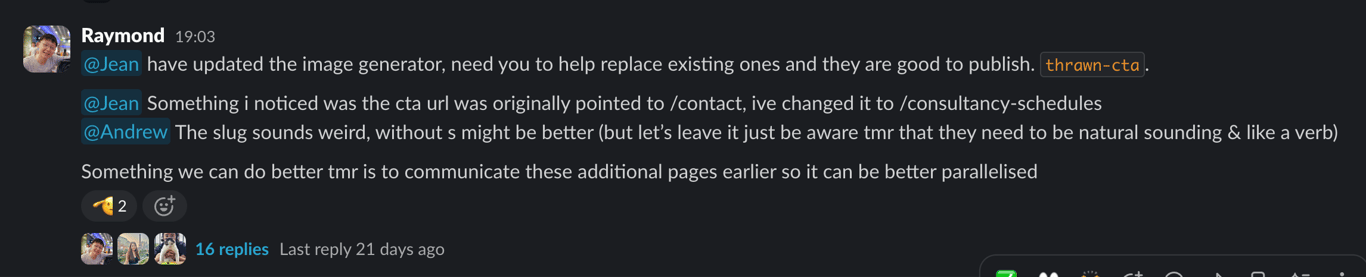
Better feature image generation. Day 1 taught us that visuals on a SaaS landing page have to hit a very specific sweet spot.
A significantly different homepage design. We didn't want to clone what worked. We wanted to learn what else could work.
Clocking a new team speed record. And getting every member hands-on with content generation.
The team split into parallel workstreams immediately.
Raymond handled research and landing page generation, with a final quality check gate at the end.
Andrew owned the main website architecture, technical SEO, and resolved a gnarly technical issue with the featured image generator for blog posts.
Jeff focused on micro UI — the small visual components that make a landing page feel premium rather than generic.
Jean was heads-down creating and publishing blogs directly onto wisp.
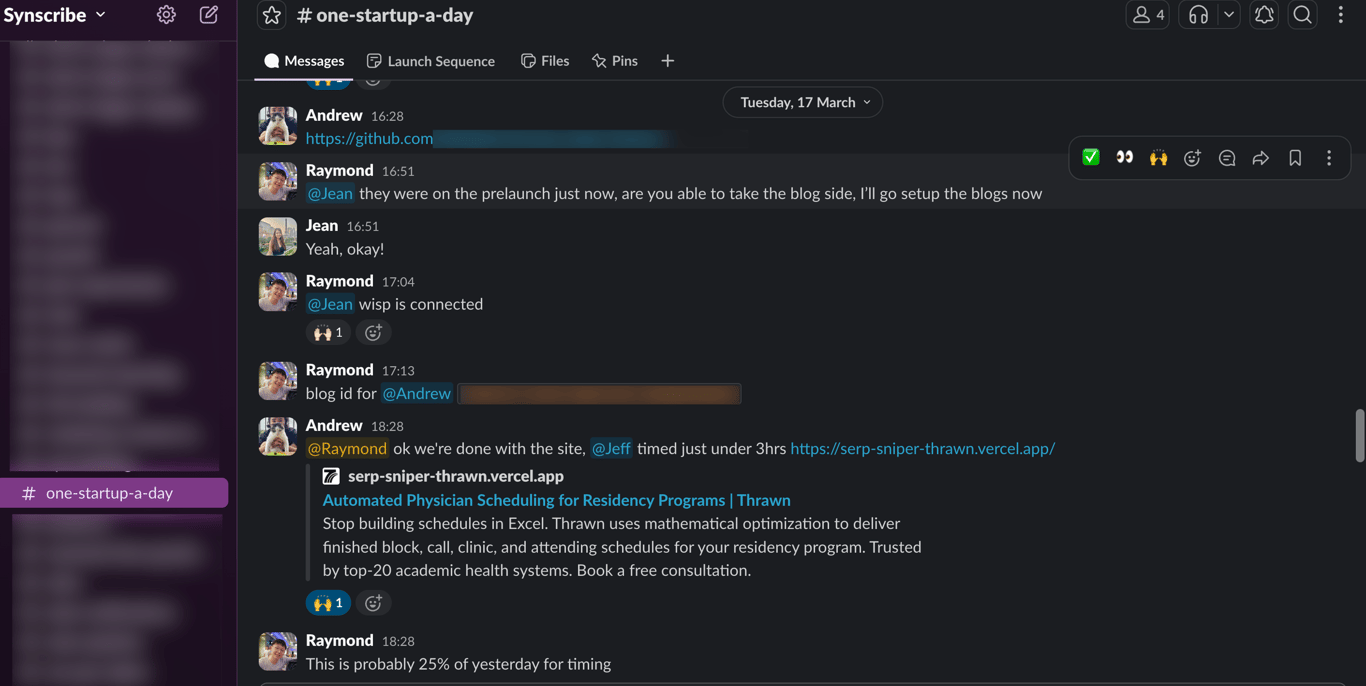 By 3:30pm, the main components were done.
What followed was the unsexy but essential work: tidying up loose ends, running a final sweep of tests, and making sure everything was actually connected before pointing the domain.
The site went live at 6:30pm.
At 8:30pm, after everyone had settled, we did a quick post-launch reflection — and that's when the first cracks showed.
What We Didn't Like (And What We Got Right)
The reflection wasn't all celebration.
 The feature pages felt off. There was a sense we had traded speed for quality — and once the adrenaline of launch wore off, it showed. Some components felt static, like we were stopping mid-sentence visually. That needed to be locked down before we could be proud of the product.
The lesson: speed is only a virtue if the output clears a quality bar. We have no formal SOP yet for this. That's a gap we need to close — and one of the clearest action items out of this entire sprint.
The Micro UI, Though? That Was Excellent.
Jeff's work on the micro UI components deserves a specific callout.
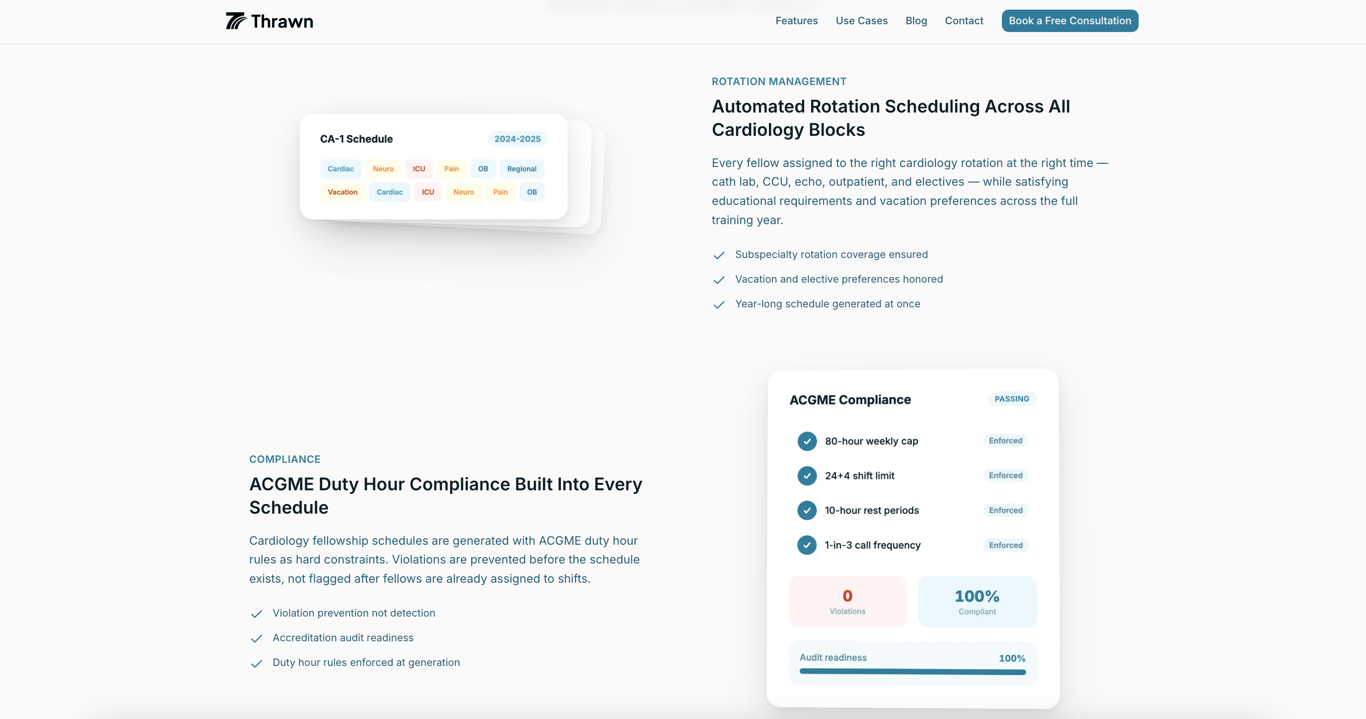 There's a very precise art to designing feature visuals for a SaaS product page.
Too complex, and the customer's eye doesn't know where to land — the screenshot becomes noise.
Too simplified, and you strip out the credibility signal.
The screenshot needs to say "we understand your problem deeply" while simultaneously communicating "and the solution is beautifully manageable."
Jeff nailed that balance here. The visual storytelling was tight. It showed just enough depth to earn trust, and just enough simplicity to reduce friction.
This remains one of our highest-leverage creative assets — and a template we'll carry forward.
Three Weeks of Near-Silence — Then Two Leads in One Day
After launch, pages were visible on Google the next morning. But we weren't immediately winning.
The competition was fiercer than anticipated. The incumbents in medical scheduling have spent years accumulating domain authority, backlinks, and brand recognition. We knew going in that the organic click curve wouldn't be a hockey stick.
And it wasn't.
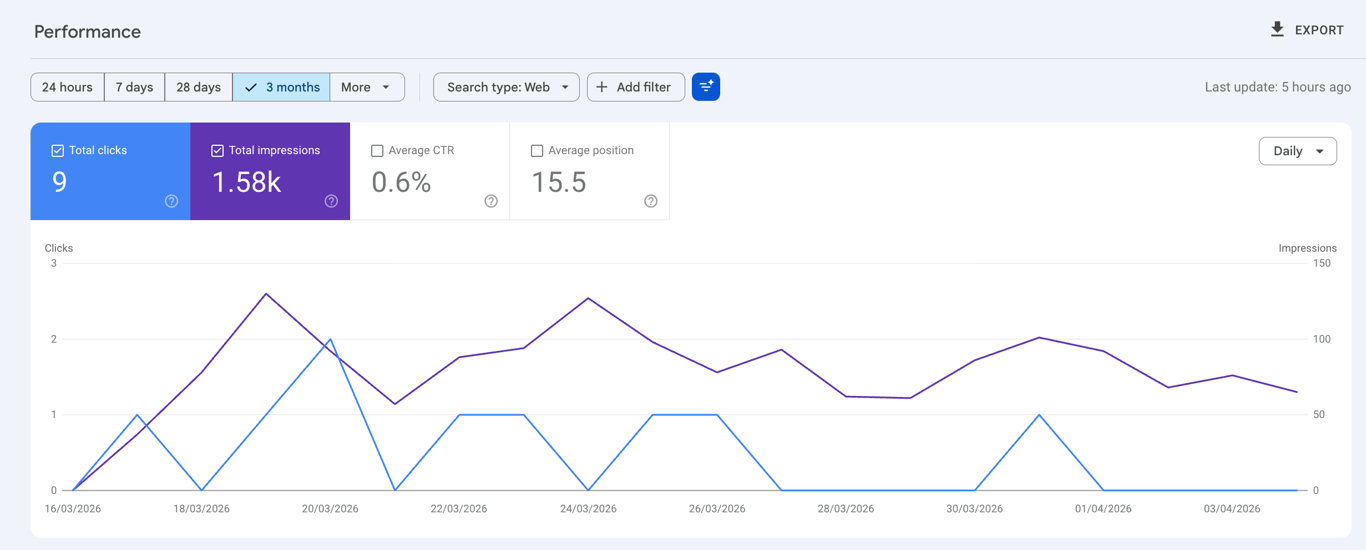 Nine total clicks in three weeks via Google Search Console.
No leads in week one. None in week two. The kind of silence that, without conviction in your framework, starts to feel like failure.
Then week three happened.
On the same day, two inbound enquiries landed:
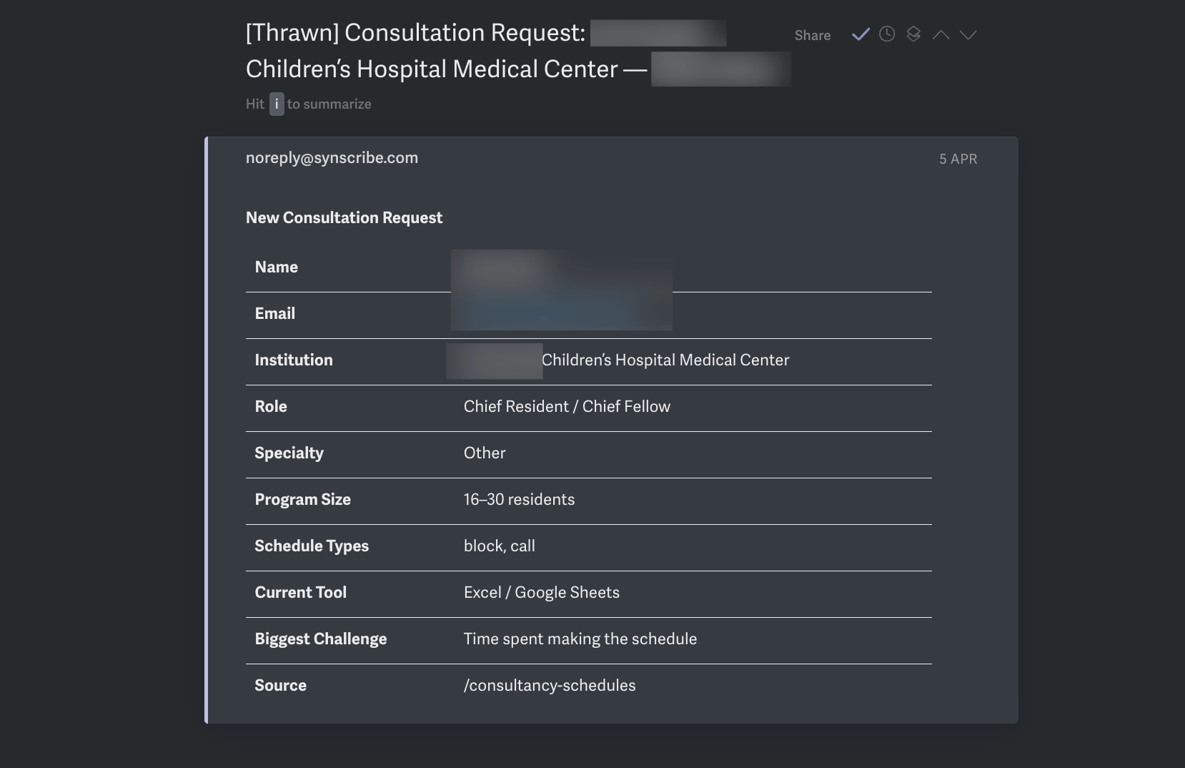 Lead #1 — Chief Resident, Children's Hospital Managing a team of 15 to 30 resident doctors. Reaching out on behalf of the hospital to explore scheduling solutions.
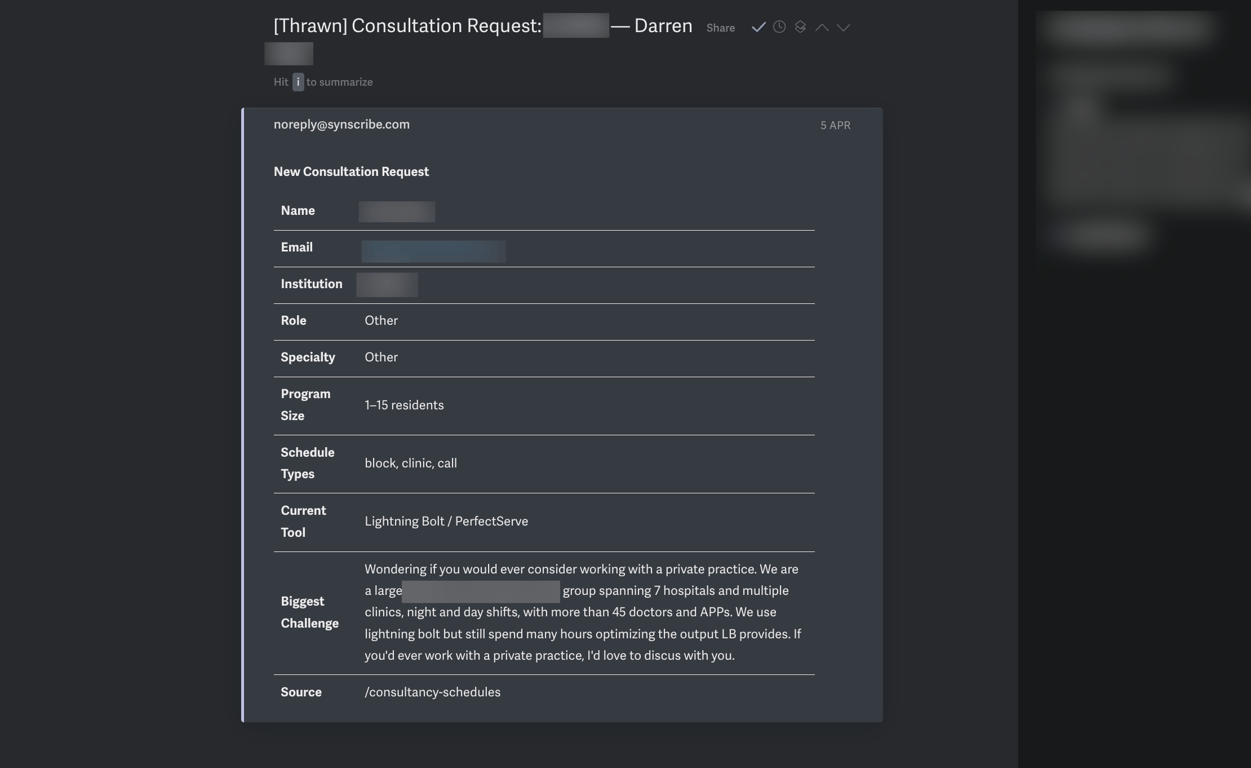 Lead #2 — Physician, Private Practice More than 45 doctors in the practice. Enquiring on behalf of the full organisation.
These aren't "curious" clicks. These are decision-adjacent buyers — people with authority, a real pain point, and the organisational scale to make a purchase matter.
And they came to us. Inbound. In a sector everyone said requires boots on the ground.
What We Still Can't See — And Why That Matters
Here's the uncomfortable truth: we only captured a fraction of what actually happened.
Google Search Console showed nine clicks. But we had no PostHog installed on this site. No heatmaps. No session recordings. No AI referral attribution.
If a GP used ChatGPT to search "best scheduling software for clinics" and our content surfaced in that response — we'd have no record of it. That AI-driven discovery is entirely invisible to us right now.
This is a critical gap. The action item is clear: install PostHog on every new launch from here forward. We already do this for our clients — we should not be launching our own properties without it.
Beyond raw traffic attribution, we also need to understand the path each lead took before they hit the contact form. What pages did they read? What triggered the conversion moment? Building that picture — combining form submission data with user journey data — turns a lead into a profile, and a profile into a repeatable acquisition insight.
This is the difference between getting lucky and understanding why you won.
The Bigger Insight: Not All Clicks Are Created Equal
Nine clicks sounds like a failure metric. It isn't.
In traditional SEO thinking, volume is the proxy for success — more traffic, more leads, more everything. But that model breaks down in high-value B2B verticals. A hospital administrator who has been tasked with evaluating scheduling software isn't browsing casually. They're searching with intent, comparing shortlists, and moving toward a decision. One click from that person is worth more than a thousand from someone idly Googling symptoms.
Chase the bottom-of-funnel keywords. Label and prioritise ruthlessly.
Our keyword labelling framework is built precisely for this. Every keyword gets evaluated not just on volume or difficulty, but on intent proximity to purchase. A keyword like "scheduling software for hospital residents" is infinitely more valuable than "what is medical scheduling" — even if the latter drives ten times the traffic. If you're not making that distinction in your content strategy, you're building an audience, not a pipeline.
Nine BOFU clicks that generate two hospital-grade leads is a better return than ten thousand top-of-funnel impressions that generate zero.
What Day 2 Taught Us
This launch wasn't perfect. But it was instructive in ways that matter more than a clean execution.
Here's what we're taking forward:
Install quality gates before launch, not after. Speed is a competitive advantage, but only when paired with a quality baseline. We need a pre-launch checklist — evaluated by the full team — that gates the domain going live. An SOP, not an assumption.
Every team member should own every part of the process. The parallelisation works well for speed, but it creates knowledge silos. Going forward, we want every person on the team to have moved through the entire motion at least once — from research to publish to reflection. That builds redundancy and raises the floor on quality.
Attribution is not optional. We got lucky this time — the leads came to us even without full visibility. But operating blind in an increasingly AI-influenced discovery environment is a liability. PostHog goes on every site with our full attribution setup. Full stop.
Low click counts are not an indictment of the strategy. They are a signal to refine targeting. The right response to nine clicks is not to pivot — it's to interrogate which of those nine clicks were high-value, trace backwards to what drove them, and do more of that.
The Bigger Picture
Day 2 confirmed something we already believed but needed to stress-test: GEO and content-led growth works even in sectors dominated by outbound sales.
Medical scheduling is not a category anyone would instinctively point to as an "SEO play." The buyers are clinicians, hospital administrators, and practice managers. The sales cycles are long. The relationships are traditionally built in conference rooms and at industry events.
And yet — two leads, week three, zero outbound effort.
The framework is robust enough to win even when conditions aren't perfect, even when the feature pages need work, even when the traffic numbers look discouraging on paper.
That's not luck. That's the compounding result of writing for the right audience, targeting the right keywords, and building a site that signals credibility to both search engines and the humans making high-stakes purchasing decisions.
We're only on Day 2. We're just getting started.
This revenue-first approach is at the core of how we operate. If you're ready to build a high-intent pipeline instead of just chasing traffic, explore Synscribe's SEO platform.
Frequently Asked Questions
What is Generative Engine Optimisation (GEO)?
Generative Engine Optimisation (GEO) is the practice of optimising content to perform well in AI-driven search environments like ChatGPT or Google's AI Overviews. It focuses on creating clear, authoritative content that AI models can easily parse and cite, ensuring your brand appears in generated answers to user queries—a discovery channel invisible to traditional analytics tools.
Why use SEO for a niche market like medical scheduling?
SEO is highly effective for niche markets because it targets decision-makers who are actively searching for a solution. Unlike outbound sales, content-led SEO attracts high-intent buyers, like hospital administrators, at the exact moment they are evaluating products. This generates qualified inbound leads efficiently, even in specialised B2B sectors traditionally dominated by direct outreach.
How is it possible to get two qualified leads from only nine clicks?
It's possible by focusing exclusively on bottom-of-funnel (BOFU) keywords that signal a strong intent to purchase. One click from a Chief Resident searching for "scheduling software for hospital residents" is more valuable than a thousand from general traffic. This strategy prioritises lead quality over traffic volume, proving a few high-intent visitors can drive significant results.
What are bottom-of-funnel (BOFU) keywords?
Bottom-of-funnel (BOFU) keywords are specific search terms used by people who are very close to making a purchase decision. Examples include phrases with "buy," "pricing," "alternative," or specific features like "scheduling software for clinics." Targeting these keywords connects you with users who have already done their research and are ready to convert, leading to higher-quality leads.
How long does it take to get leads from SEO for a new site?
While SEO is a long-term strategy, a new site can generate leads in as little as three weeks by targeting the right keywords. By focusing on low-competition, high-intent BOFU keywords, it's possible to rank and attract qualified buyers quickly. As this case study shows, you don't need months of domain authority to get noticed by the right people if your content directly solves their problem.
What is the Zero to Ranked series?
The Zero to Ranked series is a collection of real-time case studies where we document the process of launching a startup's go-to-market presence. Each installment details our strategies, tools, results, and lessons learned as we take a new business from zero online visibility to ranking on search engines and generating leads. It's a transparent look at our SEO and GEO framework in action.
Dominate ChatGPT and Google Search
Synscribe helps B2B companies with SEO & GEO using programmatic SEO approach. Book a call to find out how we help you win.