SEO & GEO Benchmarks & Stats - What Great AI Search Optimization Looks Like in 2026
Summary:
In 2026, AI-powered search (like ChatGPT) handles nearly 20% of queries, making "Generative Engine Optimization" (GEO) essential. Success is no longer measured by clicks but by being cited in AI answers, as nearly 60% of Google searches are now zero-click.
While GEO may reduce overall traffic, visitors referred by AI are 4.4 times more valuable and convert at nearly double the rate of traditional organic search.
To be cited by AI, businesses must create content with high "Information Gain" and "Factual Density," focusing on providing unique data and direct answers rather than just targeting keywords.
Synscribe's Generative Engine Optimization (GEO) service helps businesses get cited by AI engines like ChatGPT and Perplexity to drive high-value, conversion-ready traffic.
The New Search Reality: From Links to Citations
The search landscape has fundamentally transformed in 2026. Traditional SEO metrics like keyword rankings and link-based authority have been overshadowed by the emergence of the "Citation Economy" – where your brand's visibility depends not on search engines finding your page, but on AI systems choosing to recommend you as an authoritative source.
For today's business leaders, success is increasingly defined by your presence within AI-generated summaries from Google AI Overviews, ChatGPT, Microsoft Copilot, and Perplexity AI. These platforms don't just link to your content – they synthesize and cite it directly in their responses to users.
This shift has created two parallel optimization tracks:
Traditional SEO: Still vital for driving direct website traffic
Generative Engine Optimization (GEO): Critical for ensuring your brand appears in AI-generated answers
2026 Search Market Breakdown: The End of Google's Monopoly
The search monopoly has fractured into a multi-platform ecosystem where different channels serve distinct user intents:
Platform | Market Share (Jan 2026) | Estimated Monthly Active Users | Trend |
|---|---|---|---|
ChatGPT (OpenAI) | 68% | 800M weekly active users5.8B monthly website visits | +49% YoY website traffic+114.6% mobile DAU growth |
Google Gemini | 18.2% | 650 million | +237% YoY growth+388% referral traffic growth |
DeepSeek | 4% | ~143 million | Strong presence in Asian marketsCompetitive pricing strategy driving adoption |
Grok (X.AI) | 2.9% | ~104 million | Modest but steady growthIntegration with X platform |
Perplexity | 2% | ~71 million | +370% YoY growthStrong mobile app expansion“Year of the app” transformation |
Claude (Anthropic) | 2% | ~71 million | +190% YoY growthStrong enterprise adoption$2.2B projected 2025 revenue (+159%) |
Microsoft Copilot | 1.2% | ~43 million | Flat growth despite Windows & Office integration |
ChatGPT has captured an unprecedented 17-18% of global search queries – the first serious challenge to Google's dominance in over two decades. While Google maintains a commanding lead with 78-80% market share, its traditional "blue links" have been increasingly cannibalized by its own AI Overviews and AI Mode.
For business leaders, this fragmentation means a Google-only strategy no longer provides adequate market coverage. Effective optimization now requires visibility across multiple AI platforms, recognizing that each serves different user needs:
ChatGPT excels in creative and academic tasks
Google remains strongest for casual, mobile-first searches
The Zero-Click Revolution: When Success Means No Traffic
Perhaps the most disruptive trend of 2026 is the "Zero-Click" phenomenon. Nearly 60% of Google searches now end without any click to an external website. This isn't failure – it's search fulfillment happening directly in AI summaries.
In this environment, traditional click-through rate (CTR) becomes secondary. For searches triggering AI Overviews, the top organic result's CTR can drop by over 61%. Instead, the benchmark for success is being among the 2-7 domains typically cited in each AI response.
Being featured as a source in these summaries delivers two key benefits:
Higher engagement when users do click through (CTR increases from baseline 0.6% to 1.08%)
35% higher organic CTR compared to brands excluded from AI citations
The Quality Trade-Off: Less Traffic, More Value
Many executives worry about declining traffic volumes, but the data tells a more nuanced story: while AI search generates fewer visitors, those visitors are significantly more valuable.
The 4.4x Value MultiplierVisitors referred by AI engines in 2026 are worth 4.4 times more than those from traditional organic search. Why? Because AI has already "pre-sold" your value proposition. Users arriving from ChatGPT or Perplexity have already processed a summary of what you offer and are typically arriving to validate specific details or complete a transaction.
Metric | AI Referral Traffic | Traditional Organic Search |
|---|---|---|
Conversion Rate | 6.7% | 3.9% |
Bounce Rate (Retail) | 27% Lower | Baseline |
Commercial Readiness | High (Evaluative) | Moderate (Exploratory) |
Intent-to-Purchase | Pre-filtered by AI | Broad/Unfiltered |
The numbers are compelling: traffic from ChatGPT converts at nearly double the rate of Google Search. For every 100 visitors, brands can expect almost 7 conversions from AI referrals compared to fewer than 4 from traditional search. For B2B SaaS companies, the difference is even more dramatic – some companies optimizing for LLMs have seen conversion rates hit 10%, five times higher than typical Google rates.
In 2026, search success isn't about maximizing traffic volume, but cultivating a smaller, more concentrated stream of high-intent buyers.
What "Great" GEO Looks Like in 2026
For companies investing in SEO services, understanding what constitutes effective Generative Engine Optimization is crucial. In 2026, great GEO is built on "Information Gain," "Semantic Footprint," and "Factual Density" rather than keyword manipulation.
Technical Requirements for AI Citations
AI models use Retrieval-Augmented Generation (RAG) to find answers. They don't "search" for keywords; they "retrieve" authoritative passages that best satisfy a user's query. The technical benchmarks for being cited include:
Direct Answer Blocks: Content that opens with a clear, declarative answer to the primary query (40-60 words) increases citation likelihood by 40%.
Factual Density: Content with quantitative statistics ("reduces churn by 22%") outperforms qualitative descriptions ("significantly reduces churn") by 40% or more in visibility metrics.
Freshness Factor: AI assistants prefer newer content. Cited URLs in 2026 average 1,064 days old – 25.7% newer than the 1,432-day average for traditional search results. A quarterly audit and refresh cycle for high-value content is now standard practice.
Information Gain: AI models prioritize content that adds new information. If your content merely restates what competitors have already published, it will be ignored. Original research, proprietary data, or unique case studies are essential for citation.
Case Study: Rapid Ranking in Action
The benchmark for "fast" results has compressed from months to days. In fact, we are seeing web pages showing up as authoritative sources on ChatGPT in as little as 11 hours.
Evidence from work with B2B SaaS clients shows it's possible to rank in ChatGPT recommendations and receive leads in under 2 weeks:
Bluente: By publishing targeted landing pages on Day 1, the brand appeared in ChatGPT recommendations by Day 3, generating direct customer inquiries.
Wonderchat: After implementing GEO strategies, the company received its first ChatGPT referrals within 72 hours and its first qualified lead in under two weeks.
What makes this possible is a shift from broad authority (backlinks) to hyper-specific query fulfillment.
For niche queries, content quality and structure now outweigh legacy authority signals. This allows challenger brands with a Domain Rating (DR) as low as 3 to outrank established industry sites with 10x the authority, provided they publish original, high-value content.
The B2B Buyer's Journey: AI Agents Take the Lead
In the B2B sector, the shift to "Agentic Discovery" has completely reorganized the sales funnel. The traditional linear path of Awareness → Consideration → Decision has been replaced by a network of handoffs between external AI scouts and onsite concierge agents.
The "Day One Shortlist" Rule
A staggering 95% of winning vendors in 2026 appear on the "Day One Shortlist" – the initial list of candidates generated by a buyer's AI agent before any human contact with a salesperson. If your brand is invisible to the AI agents of the procurement team, you're effectively excluded from the bidding process. Only 20% of buyers switch vendors once consensus has been reached, making initial AI discoverability the single most important factor in pipeline generation.
How AI Agents Execute Discovery
When a procurement manager at a Fortune 500 company tasks an AI agent with finding a supplier, the process looks nothing like human browsing. The agent connects through structured interfaces – APIs or the Model Context Protocol (MCP) – to pull data directly from vendor systems.
Capability | Traditional Buyer | AI Agent |
|---|---|---|
Research Time | Weeks | Hours |
Content Consumption | Linear (Reports/Whitepapers) | Non-linear (RAG/API Calls) |
Decision Factors | Brand Affinity/Relationship | Specs/Pricing/Compliance/SLAs |
Outreach | Direct to Sales | Autonomous Demo Scheduling |
For B2B leaders, this means content must be "Machine-Readable." This involves implementing robust schema markup for all product attributes, maintenance logs, and compliance certifications. If an agent finds a static, shallow catalog, it will bypass that vendor in favor of one that provides the "Reasoning Web" with the data needed to calculate ROI, delivery windows, and compatibility.
The Financial Side: GEO Investment and ROI
The transition to GEO requires recalibrating marketing budgets. Leaders should expect a "Success Premium" for GEO services compared to traditional SEO.
Customer Acquisition Cost (CAC) by Industry
Research indicates that GEO delivers superior lead quality at a moderate premium. The average GEO CAC across all industries in 2026 is $559, which is 14.4% higher than traditional SEO. However, because conversion rates are significantly higher, the "Cost-Per-Closed-Won" is often lower for GEO-driven channels.
Industry | GEO CAC (2026) | Traditional SEO CAC | Premium % |
|---|---|---|---|
B2B SaaS | $249 | $205 | +21.5% |
IT / Managed Services | $391 | $325 | +20.3% |
Manufacturing | $796 | $662 | +20.2% |
Healthcare | $439 | $366 | +19.9% |
Financial Services | $772 | $644 | +19.9% |
Legal Services | $699 | $584 | +19.7% |
The B2B SaaS sector demonstrates the most efficient GEO CAC at $249, benefiting from AI platforms' preference for technical, well-structured content. Higher Education faces the highest costs ($1,014) due to long decision cycles and intensive reputation management required for academic and career-focused AI summaries.
Budget Allocation and Agency Tiers
As of early 2026, enterprise companies are allocating an average of 12% of their total digital marketing budgets specifically to AI Engine Optimization (AEO) and GEO initiatives. This is no longer experimental – 94% of digital leaders plan to increase this investment in 2026.
When hiring an agency, leaders should be aware of the standard monthly investment tiers:
Tier 1 ($1,500 – $3,000/mo): Ideal for small businesses testing the waters. Includes basic monitoring of 20-50 citation queries and fundamental schema implementation.
Tier 2 ($3,000 – $7,000/mo): For growing brands. Includes monitoring of 50-100 queries, 2-4 expert articles monthly, and bi-weekly reporting.
Tier 3 ($7,000 – $15,000+/mo): Enterprise-grade. Includes full reputation management, 10+ expert articles, PR integration, and custom attribution dashboards for 300+ tracked queries.
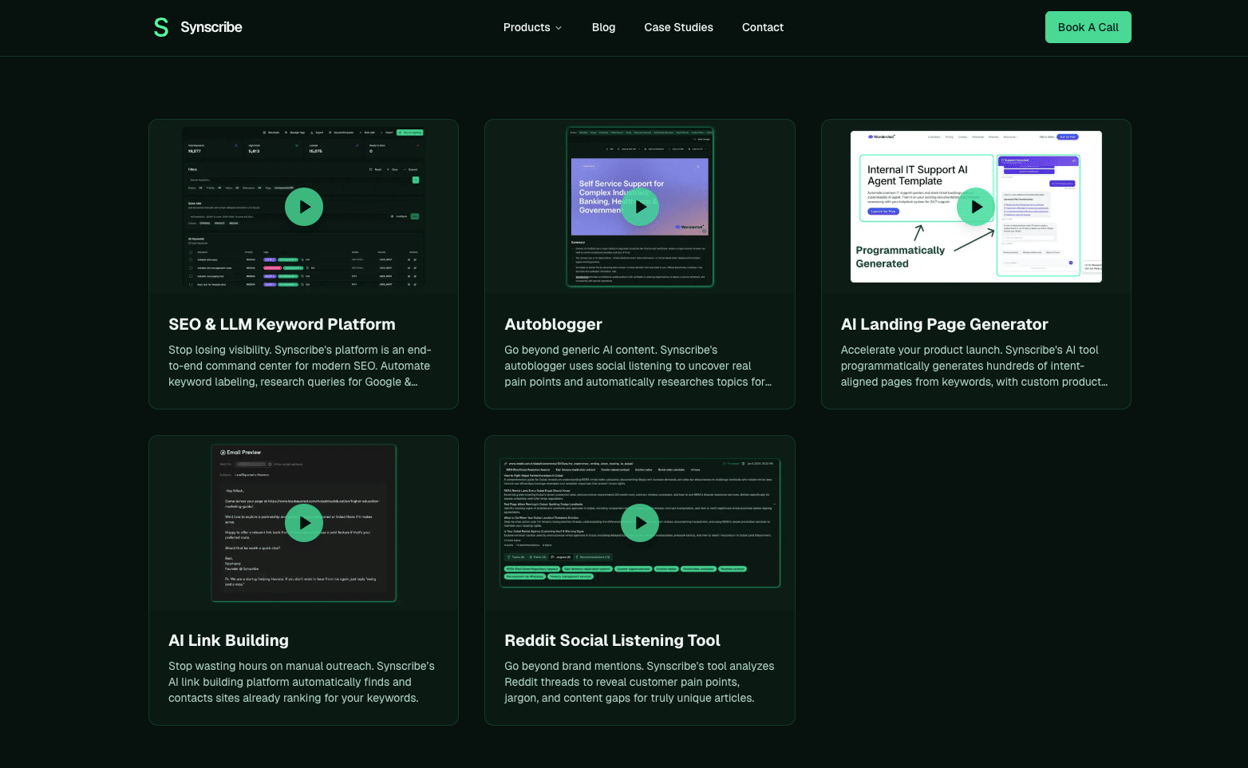 Agencies managing these implementations report a 34% higher success rate than in-house teams, largely due to their access to specialized tools like AI content writer, BOFU landing page creator, AI link building and social listening tools like in the case of Synscribe.
Technical Architecture for AI Search Visibility
For technical leaders, the "checklist" for excellence in 2026 has evolved from simple on-page tweaks to a full-stack data strategy.
Schema Markup: Platform-Specific Impact
There's significant nuance in how structured data influences different AI engines:
Google Gemini & AI Overviews: Strongly influenced by schema. Content with proper schema shows 30-40% higher visibility in AI-generated answers.
Perplexity & ChatGPT: More reliant on semantic relevance and raw text structure. Visibility distributions remain surprisingly stable across domains regardless of schema coverage.
The consensus recommendation is full schema coverage (Organization, Person, Product, FAQ, HowTo) because it serves as the bridge to the global knowledge graph, even if some LLMs parse the page text directly.
AI Crawlability: Don't Block Your Opportunities
A major operational failure for many brands is "LLM Erasure" – when an AI answers a question but fails to cite a source because that source was inaccessible or blocked. Effective GEO requires a robots.txt file that explicitly permits AI crawlers such as:
OAI-SearchBot (OpenAI)
PerplexityBot
GoogleBot-Extended
Bingbot
Additionally, site architecture must be "Machine-Readable," prioritizing clean HTML5 and avoiding non-text elements (complex PDFs or locked images) that LLMs cannot easily parse.
Industry Winners: Who's Dominating AI Citations
Different industries have different "visibility winners" in the AI search era. Leaders should benchmark their brand's citation share against these category leaders.
Financial Services and Healthcare
In high-stakes YMYL (Your Money, Your Life) categories, AI models prioritize authority above all else:
Financial Services: NerdWallet has emerged as a citation leader (6.73% market share), winning more AI mentions than many traditional banks by providing clear, structured comparisons.
Healthcare: This industry receives the highest volume of AI Overviews (48.75%). Mayo Clinic, Cleveland Clinic, and Pfizer lead in brand mention share. Success here means having 53% of citations stemming from verified local listings and professional directories rather than just blog content.
E-Commerce and Consumer Products
AI shopping assistants are the new gatekeepers of retail:
Marketplace Dominance: Amazon receives 17.99% of citations in Consumer Staples, followed by Walmart and Best Buy.
Real Estate: Zillow dominates brand mention share (7.36%) despite not being a top 5 cited domain, indicating its brand name has become synonymous with the category in AI reasoning.
IT and Industrial Sectors
IT Industry: Google, Microsoft, and SAP are the citation leaders. Success in this category is driven by technical documentation and integration guides appearing in ChatGPT and Copilot responses.
Industrial: Deloitte and McKinsey lead in brand mentions. For industrial firms, visibility is achieved through "Spec-Sheet SEO" – optimizing power density, compliance, and uptime statistics that AI agents look for when comparing vendors.
Measuring Success Without Clicks
The biggest challenge for leaders in 2026 is that traditional analytics only tell half the story. If a user reads an AI summary about your brand but doesn't click through, that value is "Zero-Click Visibility."
The AI Visibility KPI Stack
Effective measurement requires tracking:
Citation Frequency: How often your brand appears in AI responses across 100+ tracked queries.
AI Share of Voice (SOV): The percentage of an AI answer's total word count dedicated to your brand.
Citation Sentiment: Whether the AI describes your brand in positive ("industry leader") or neutral/negative context.
Brand Mention Lift: The correlation between AI mentions and increases in branded searches on traditional Google.
Assisted Pipeline: Tracking leads who mention "I saw you in an AI summary" in discovery calls.
Only 19% of consumers currently click through to sources in AI Overviews, meaning 81% of citation value is "perception-based." Comprehensive reporting includes monthly manual testing of key prompts to document exactly how your brand is being described, ensuring the AI's narrative aligns with your company's mission.
Your 90-Day GEO Action Plan
For business leaders looking to implement an effective GEO strategy, the process follows a structured four-phase approach:
Phase 1: Assessment and Baseline (Days 1-30)
Complete a technical infrastructure audit
Identify the 15-25 core conversational queries that define your category
Map where your brand currently appears and where competitors are winning citation share
Configure Google Analytics 4 to specifically segment "AI Referral Traffic" from sources like chat.openai.com and perplexity.ai
Phase 2: Technical and Structural Foundations (Days 31-60)
Implement the full suite of schema markup (Organization, Person, Product, FAQ)
Update robots.txt to allow all major LLM crawlers
Begin "Fact-Density Expansion" by adding quantitative data and original research to your highest-traffic pages
Phase 3: Content Transformation and Authority (Days 61-90)
Transition from "Keyword-First" to "Answer-First" content creation
Ensure every new piece of content includes a direct answer block, bulleted key points, and supporting evidence with clear attribution
Launch an earned media campaign to secure mentions in third-party publications and directories that AI engines use for "Retrieval"
Phase 4: Expansion and Attribution (Months 4-6)
Scale your programmatic SEO (pSEO) to cover thousands of long-tail intent variations
Develop a "Unified Knowledge Graph" that allows AI agents to query your product and pricing data directly via APIs
Refine your reporting to include "Sentiment Analysis" and "Assisted Conversions"

The Future: Agentic Commerce and Beyond
By late 2026, the distinction between search and commerce will blur completely. We're entering the era of "Agentic Commerce," where AI agents will not only research products but autonomously negotiate prices and execute purchases.
Evidence from the 2026 Commerce Readiness Index suggests that "Inventory Latency" and "Data Quality" will become the primary factors in algorithmic visibility. If your pricing and availability data lags by even a few minutes, the AI agents representing your customers will bypass your offers in favor of more "real-time" competitors.
Strategic Recommendations: What Leaders Need to Do Now
To achieve "great" in 2026, business leaders must abandon the "Click-Counting" mentality of the 2010s and embrace the "Citation-Influence" model of the AI era. Success requires a dual-track strategy:
Maintain a strong legacy SEO foundation for the 80% of queries that still happen on traditional search
Aggressively optimize for the high-value 18-20% of queries that happen within generative engines
The fundamental benchmarks of excellence include:
A ChatGPT conversion rate of 6-7% (nearly double traditional search)
A 72-hour benchmark for ranking in AI recommendations for new, high-value content
Presence in the "Day One Shortlist" for at least 80% of relevant B2B queries
A GEO CAC that reflects a 14-20% premium but delivers 4.4x the visitor value
A full-stack technical architecture utilizing Model Context Protocol (MCP) and real-time data modeling to ensure AI agents can reason over your brand's facts
The companies that master GEO won't just survive the transition – they'll dominate the new "Reasoning Web," ensuring their brand is the default answer chosen by both humans and the AI agents that represent them.
Frequently Asked Questions
What is Generative Engine Optimization (GEO)?
Generative Engine Optimization (GEO) is the process of making your brand's content visible and authoritative within AI-generated answers from platforms like ChatGPT, Google AI Overviews, and Perplexity AI. Unlike traditional SEO which focuses on ranking web pages in a list of links, GEO focuses on having your information directly cited and recommended within the AI's synthesized responses. It prioritizes factual density, information gain, and machine-readability to ensure AI models select your content as a trusted source.
Why is GEO more important than traditional SEO now?
GEO is critical because a significant portion of the search market, around 18-20%, has shifted to AI platforms where users receive direct answers instead of clicking on links. While traditional SEO is still necessary for direct website traffic, a Google-only strategy is no longer sufficient. With phenomena like the "Zero-Click Revolution" where nearly 60% of searches end on the results page, success is now defined by being cited in AI summaries. Failing to optimize for GEO means being invisible to a growing segment of high-intent users.
How do I measure the success of a GEO strategy if I get less traffic?
Success in GEO is measured by the quality of traffic and your brand's visibility within AI answers, not just the volume of clicks. Key performance indicators (KPIs) for GEO include Citation Frequency (how often you're cited), AI Share of Voice (how much of an AI answer is about you), Citation Sentiment (positive, neutral, or negative), and Assisted Pipeline (leads who mention seeing you in an AI summary). While traffic may decrease, visitors from AI referrals are worth 4.4 times more and convert at a significantly higher rate.
How much should a business budget for GEO services?
A typical monthly budget for GEO services ranges from $1,500 for small businesses to over $15,000 for enterprise-level strategies. Investment tiers vary based on need. A starter tier ($1,500-$3,000/mo) covers basic monitoring and schema. Mid-tier packages ($3,000-$7,000/mo) include content creation and more robust reporting. Enterprise tiers ($7,000-$15,000+/mo) offer comprehensive reputation management, PR integration, and custom attribution for hundreds of tracked queries.
How quickly can I expect to see results from GEO?
It is possible to see your content cited in AI recommendations in as little as 3 to 72 hours for targeted, niche queries. Unlike traditional SEO which can take months, GEO can deliver rapid results because it prioritizes hyper-specific query fulfillment over broad domain authority. For new, high-value content that is well-structured and provides unique information, challenger brands can outrank established competitors almost immediately, generating referrals and qualified leads within days or weeks.
What is the single most important factor for ranking in AI-generated answers?
The most important factor for being cited by AI is "Information Gain"—providing new, unique, and factually dense information that isn't available elsewhere. AI models are designed to retrieve and synthesize novel information. If your content merely repeats what competitors have already published, it will be ignored. To be seen as an authoritative source, you must publish original research, proprietary data, unique case studies, and content that directly answers a user's question with verifiable, quantitative statistics.
Dominate ChatGPT and Google Search
Synscribe helps B2B companies with SEO & GEO using programmatic SEO approach. Book a call to find out how we help you win.