How Fast Can You Rank on ChatGPT? Real GEO Case Studies & Examples
Summary
Traffic from AI search like ChatGPT converts at 6.7%, nearly double that of Google Search (3.9%), and it's possible to rank in as little as 3 days.
Ranking on ChatGPT requires a new approach called Generative Engine Optimization (GEO), which prioritizes content structure and direct answers over traditional SEO metrics for specific queries.
Key strategies for rapid ranking include Programmatic SEO to target conversational queries, product-led content that demonstrates your solution, and publishing original research to establish authority.
Synscribe's Generative Engine Optimization (GEO) services help B2B SaaS companies implement these strategies to turn AI search into a predictable channel for customer acquisition.
You've optimized your website for Google for years. You've climbed the rankings, built backlinks, and mastered traditional SEO. Yet somehow, when you ask ChatGPT about solutions in your industry, your brand is nowhere to be found.
Instead, certain competitors keep appearing in answers. Not as citations. Not because someone mentioned them. But because the AI model decided they're the answer.
Sound familiar?
This isn't just another SEO challenge—it's an entirely new playing field called Generative Engine Optimization (GEO) or AI Search Optimization (AISO). And it's moving faster than you might realize.
"If your content isn't easily understandable by a language model, you're invisible, NO MATTER HOW WELL IT PERFORMS ON GOOGLE." - Reddit user
Here's the bombshell: You can rank on ChatGPT in as little as 3 days if you understand how AI recommendation systems actually work. This isn't theory—we've proven it with real B2B SaaS clients, and in this article, I'll share exactly how we did it.
More importantly, this traffic converts at nearly double the rate of traditional search. According to research from ThoughtMetric, traffic from ChatGPT has an average conversion rate of 6.7%, compared to just 3.9% from Google Search.
Let's dive into why AI traffic matters so much, how ChatGPT actually chooses recommendations, and the proven strategies that can get your brand ranking in days, not months.
The New Gold Rush: Why Ranking on ChatGPT Matters More Than Ever
AI Traffic Converts at Higher Rates
The data is clear: AI-driven traffic isn't just another traffic source—it's your highest-converting channel.
For every 100 visitors from ChatGPT, nearly 7 make a purchase, compared to fewer than 4 from Google. This stark difference exists because users engaging with ChatGPT are often:
Further down the buying funnel - They're asking specific questions that indicate purchase intent
Benefiting from guided discovery - The conversational format helps users clarify their needs
Pre-qualified by the AI - ChatGPT is recommending your solution as a direct answer to their specific problem
This isn't just theoretical. One client who optimized their site structure specifically for LLMs saw their conversion rate from AI traffic hit 10%—five times higher than the typical Google average of 2%, according to Julian Canlas's research.
How ChatGPT Actually Chooses Recommendations
Understanding how ChatGPT selects websites to recommend is crucial to optimizing for it. The process is more complex than simply ranking #1 on Bing:
Query Fan-Out: When a user asks a question, ChatGPT generates multiple search queries to gather comprehensive information. You can use Synscribe's ChatGPT Search Query Extractor to view the fan-out queries.
Multi-Source Search: While OpenAI officially partners with Bing, it's known to pull data from various sources, including Google. This explains why sites that rank well on Google often appear in ChatGPT recommendations, even without ranking on Bing.
Passage Re-Ranking: ChatGPT doesn't just regurgitate search results—it evaluates each passage for relevance. Research shows models like GPT-4 can achieve a 2.7 improvement in ranking quality compared to traditional methods.
Response Generation: Finally, it synthesizes this information into a coherent answer, potentially recommending specific solutions.
A critical component often overlooked: Make sure your site allows OAI-SearchBot, OpenAI's web crawler, in your robots.txt file. Without this, you're invisible to the model regardless of your content quality. Learn more in OpenAI's documentation.
The 3-Day Challenge: Proof That Rapid Ranking is Possible
Let's move beyond theory and look at real evidence. At Synscribe, we've consistently helped B2B SaaS companies appear in ChatGPT recommendations in as little as 72 hours. Here are two case studies that prove it:
Case Study 1: Bluente - From Publish to Inquiry in 72 Hours
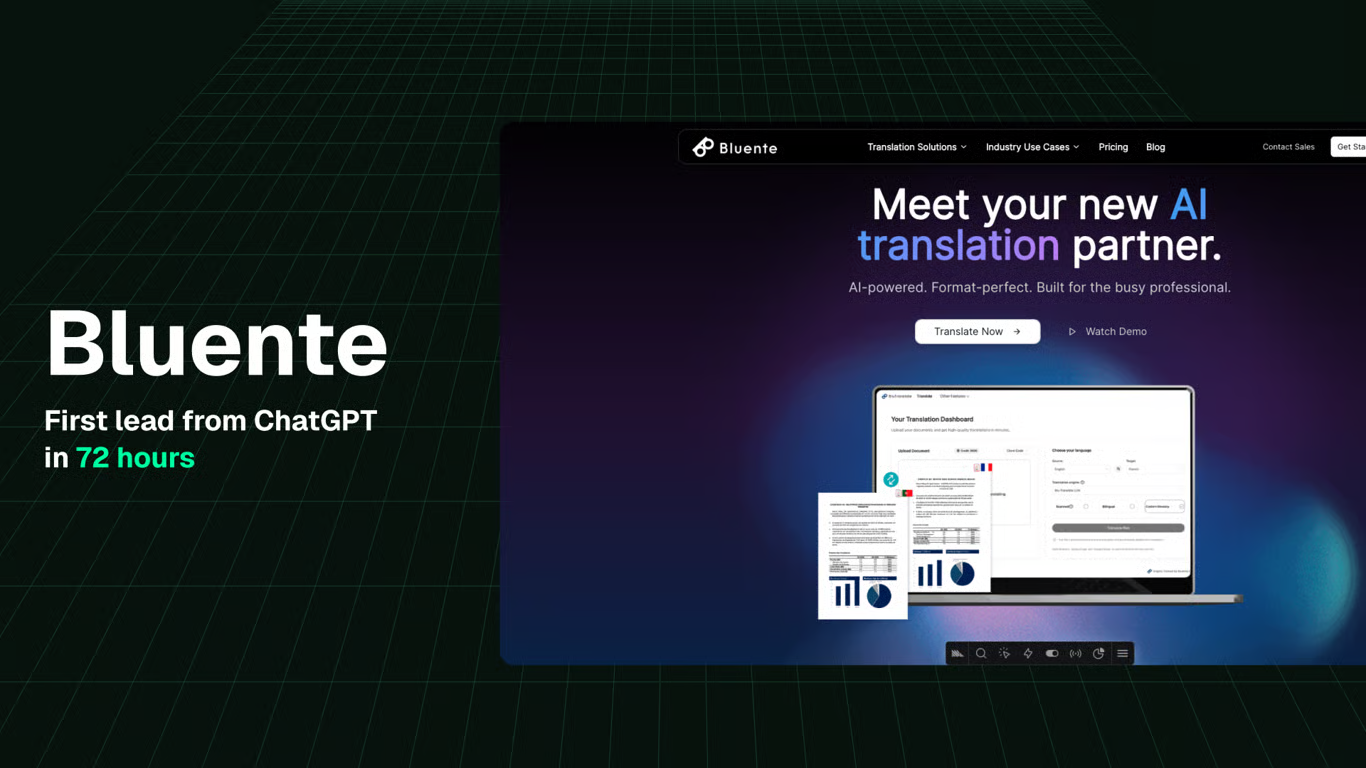 Bluente is an AI-powered translation platform specializing in high-stakes legal and financial documents. They approached us with a specific challenge: prove that GEO could generate qualified leads faster than traditional SEO.
The timeline was remarkable:
Day 1: We published new, highly-targeted landing pages which began ranking on Google.
Day 3: The same pages appeared in ChatGPT recommendations, resulting in direct inquiries from potential customers.
What made this possible? Instead of a scattershot approach, we implemented a focused "fire bullets then cannonballs" strategy. We targeted Bluente's "Certified Translation" service—a high-demand offering with specific customer pain points.
We launched an initial batch of 5-6 pages to test the waters before scaling to over 20 based on positive signals. This methodical approach delivered measurable results in record time, as documented in our case study.
Case Study 2: Wonderchat - ChatGPT Referrals in 72 Hours, First Lead in <2 Weeks
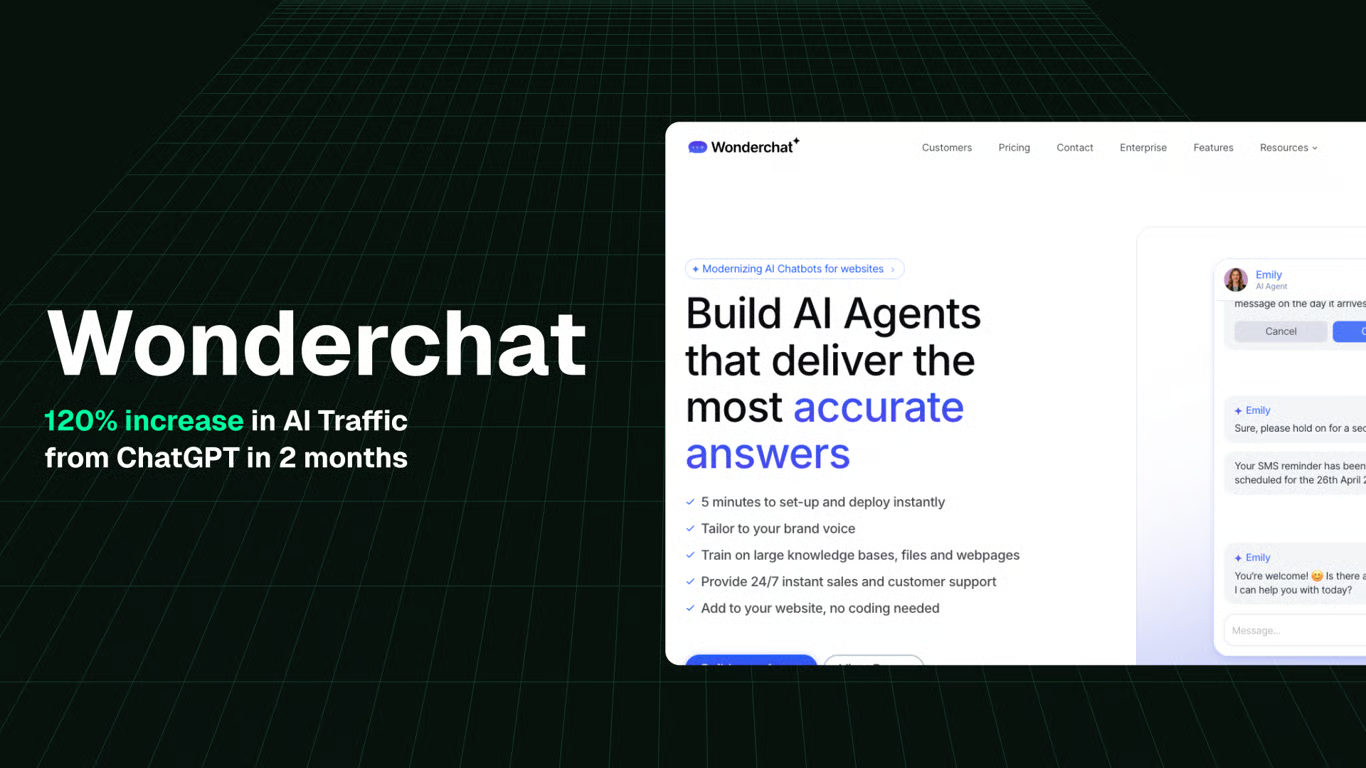 Wonderchat, an AI chatbot builder for businesses, had spent four months working with a traditional SEO agency with minimal results. After implementing our GEO strategies:
Just 10 programmatic pages were launched
Wonderchat began ranking for over 10 keywords
They received their first ChatGPT referrals within 72 hours
This led to their first qualified lead in under two weeks
The key difference was our "engineering-first" approach to SEO, focusing on programmatic techniques to target hundreds of high-intent queries at scale. A critical element was implementing the "Show, Don't Tell" principle—using a custom image generator to create realistic product mockups for each use case, helping prospects instantly visualize the value.
The results speak for themselves: what took months with traditional methods was achieved in days with GEO strategies. You can read the full Wonderchat case study here and also here.
The GEO Playbook: Three Proven Strategies to Rank on ChatGPT
Based on our successful case studies, we've developed a playbook of three core strategies that consistently help businesses rank on ChatGPT quickly. Let's dive into each:
Strategy 1: Programmatic SEO - Scale Your Expertise to Match User Intent
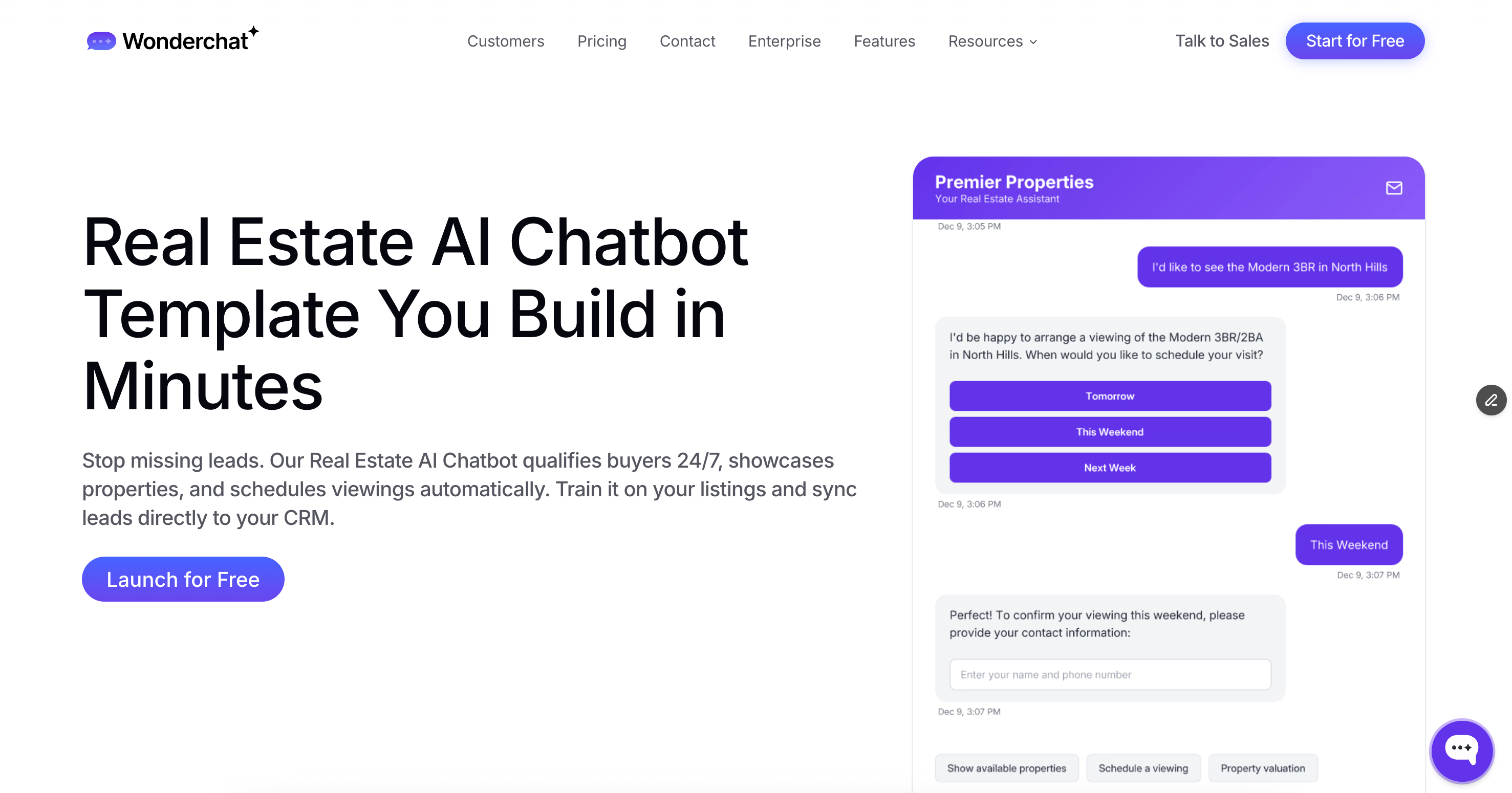 What it is: Programmatic SEO involves creating hundreds or thousands of targeted pages by using a template and a database. This is ideal for targeting formulaic queries like "best [software type] for [industry]" or "[service] in [city]".
Why it works for GEO: It creates a vast surface area of highly specific, long-tail pages that directly answer the conversational queries users pose to AI models.
How to implement:
Identify pattern-based queries: Look for query patterns in your industry where you can substitute variables (locations, industries, use cases).
Create robust templates: Develop templates that maintain quality and uniqueness despite being generated at scale.
Build for the long tail: Focus on specific, niche combinations that have less competition but high conversion potential.
Real-world example: UserPilot scaled to 100k visitors in 10 months by creating pages for "X vs Y" comparison keywords, according to The Fxck SEO case study.
Similarly, Wonderchat created programmatic pages like their Real Estate AI Chatbot Template, which targets a specific industry need and ranks well in both traditional and AI-powered search.
Strategy 2: Product-Led Content - Show, Don't Just Tell
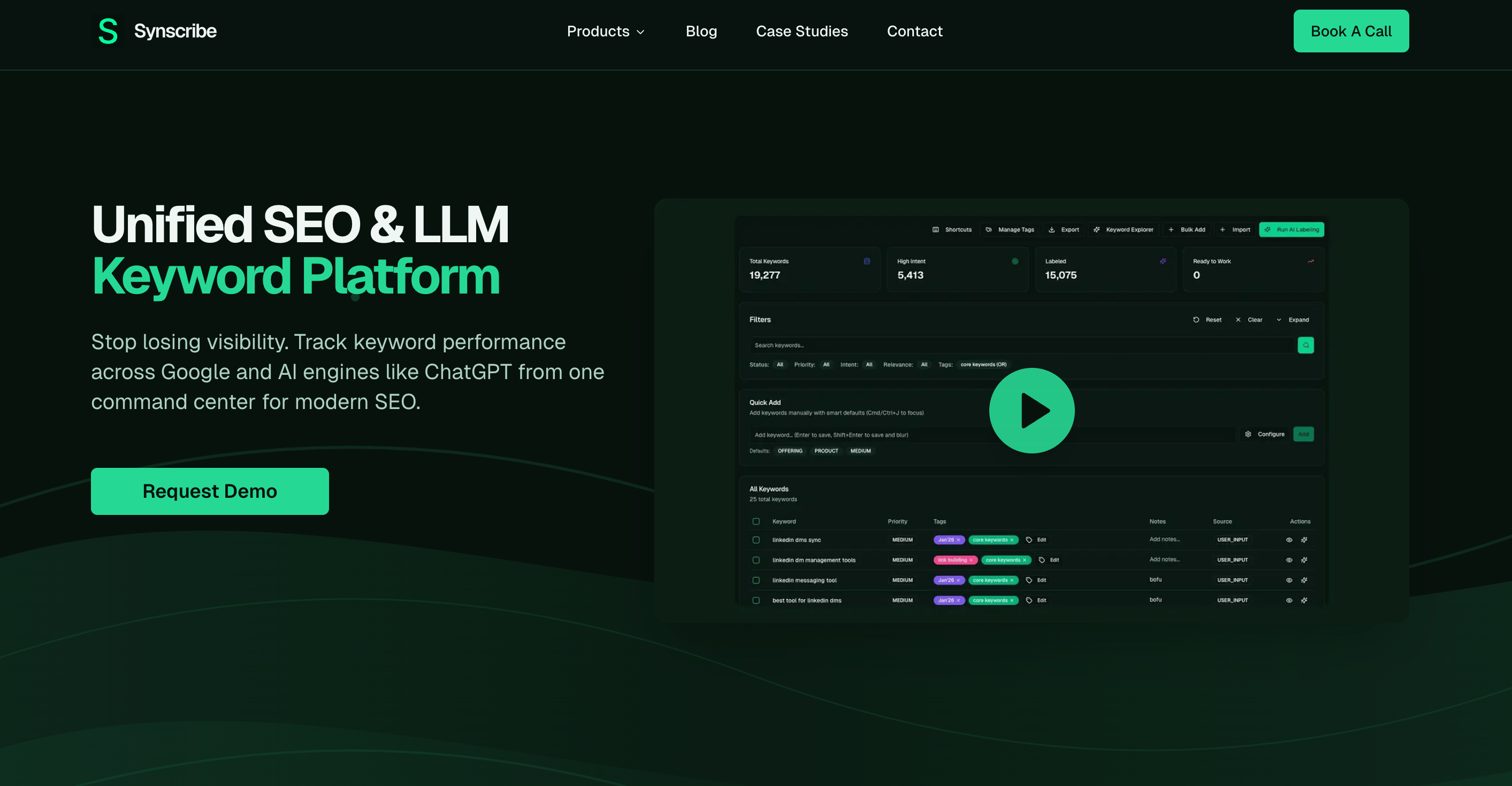 What it is: Content that is intrinsically tied to your product, demonstrating its use cases and helping users solve a problem with it. Unlike traditional content marketing that simply discusses a topic, product-led content shows your solution in action.
Why it works for GEO: AI models prioritize clear, helpful, and direct answers. Content that demonstrates a solution is far more authoritative than content that simply describes a problem.
How to implement:
Turn features into landing pages: Create dedicated pages for each key feature or template your product offers.
Focus on bottom-of-the-funnel keywords: Target queries that indicate high purchase intent rather than general awareness terms.
Include visual demonstrations: Use screenshots, videos, or interactive elements to show your product solving the exact problem discussed.
Real-world example: Typeform created content around bottom-of-the-funnel (BOFU) keywords that directly relate to their product's templates and features. This strategy generated $3M in annual LTV for them, according to The Fxck SEO Typeform case study.
Synscribe's own SEO platform feature pages, like the ones for AI link building, illustrates how we turn product features into individual landing pages. Curious about the process? Watch how we do it on Youtube.
Strategy 3: Deep Research & Value - Become an Unavoidable Authority
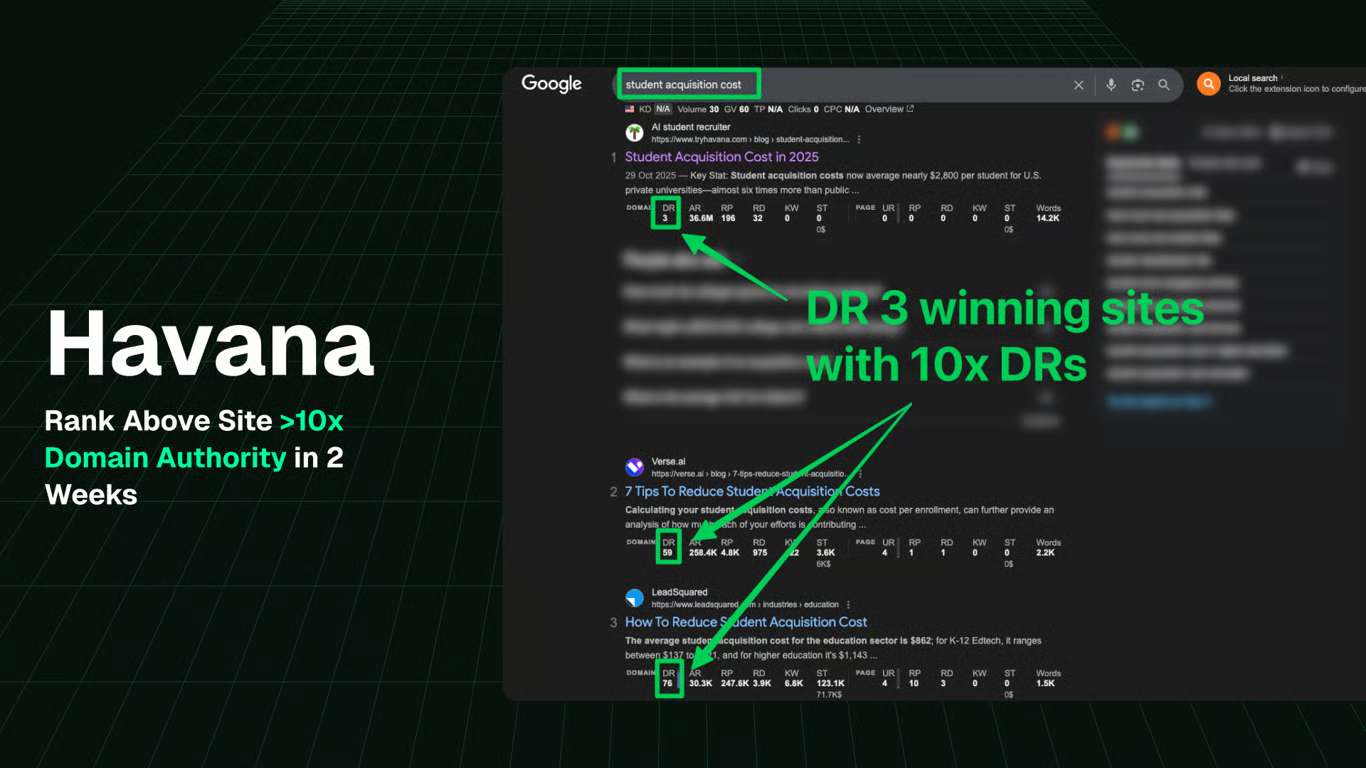 What it is: Publishing original, data-driven research that fills a critical knowledge gap in your industry, establishing your brand as an entity that ChatGPT naturally references.
Why it works for GEO: AI models are being trained to recognize and prioritize entities and trusted sources. A single piece of landmark content can make you that source for your niche.
How to implement (The Havana Method):
Identify Key Customer Questions: Focus on industry benchmarks or strategic questions your ideal customer profile needs answers to (e.g., "What is the average student acquisition cost?").
Research & Identify Gaps: Analyze existing content and find what's outdated or missing.
Use Research Tools: Act like a research firm. Use tools like ChatGPT to assist in deep data gathering.
Translate Data into Value: Publish your findings in a clear, well-sourced report.
Optimize and Promote: Use standard on-page SEO, index via Google Search Console, and conduct outreach to sources you cited.
Proof: Havana, an AI recruitment software with a domain rating of just 3, published a report on "Student Acquisition Cost 2025." Within two weeks, it outranked established industry sites with over 10x their authority. You can learn more in our Value-First Ranking case study.
The Backlink Question & Technical Foundations
Are Backlinks Required to Rank on ChatGPT?
This is one of the most common questions we hear from clients. The short answer is no, not for long-tail queries.
If you are the only one providing a clear, structured answer to a specific question (which programmatic and product-led content helps you do), you can rank #1 without a single backlink. This is particularly true when you're targeting long-tail, conversational queries that align perfectly with how users interact with ChatGPT.
The nuanced answer: For broader, more competitive terms, signals of authority still matter. Backlinks help search engines discover and trust your content, which indirectly influences the pool of information ChatGPT draws from. As one user noted, "context, relevance, and trust matter more than raw link counts," according to discussions on Reddit.
In our experience, the formula looks like this:
Hyper-specific queries: Content quality and structure > Backlinks
Competitive, general queries: Content quality + Authority signals (including backlinks) > Content alone
Your Technical Foundation is Non-Negotiable
When it comes to ranking on ChatGPT, your technical foundation isn't just important—it's absolutely essential. An LLM needs to be able to crawl and understand your site effortlessly.
A client of Julian Canlas saw a dramatic increase in AI visibility and achieved a 10% conversion rate after making these foundational fixes:
Improving site speed: Faster-loading sites are easier for AI crawlers to process
Ensuring AI crawlers can access your site: Specifically allowing
OAI-SearchBotin your robots.txtCleaning up site structure: Creating clear hierarchies and relationships between pages
Implementing structured data: Making your content machine-readable
This technical optimization is the foundation upon which all other GEO strategies build. Without it, even the best content won't reach its full potential.
Best Practice: Prioritize shorter, concise, well-structured content over purely long-form articles. This makes it easier for the AI to parse information and identify direct answers to user prompts.
Conclusion: The 3-Day Path to ChatGPT Visibility
Ranking on ChatGPT isn't a dark art; it's a science. And contrary to popular belief, it doesn't have to take months. As we've demonstrated through real case studies, appearing in ChatGPT recommendations can happen in as little as 3 days when you:
Understand the unique way ChatGPT evaluates and recommends content
Implement programmatic SEO to target specific, conversational queries at scale
Create product-led content that shows your solution in action
Establish authority through deep, original research
Ensure your technical foundation supports AI crawling and understanding
The results speak for themselves: higher visibility, better-qualified traffic, and conversion rates that significantly outperform traditional search.
As one Reddit user perfectly summarized: "The brands who win here won't be the ones who waited. They'll be the ones who tested, adapted, and surfaced before anyone else even realized it was possible." Source: Reddit User Research.
At Synscribe, we partner with B2B SaaS companies to implement these advanced GEO strategies. Our proprietary AI tools and engineering-first mindset are built to execute with the speed and precision this new landscape demands, turning AI-powered search into a predictable channel for high-intent customer acquisition.
Don't wait for traditional SEO timelines when ChatGPT visibility can be yours in days, not months.
Frequently Asked Questions
What is Generative Engine Optimization (GEO)?
Generative Engine Optimization (GEO) is the practice of optimizing web content to be found, understood, and recommended by AI language models like ChatGPT. Unlike traditional SEO which focuses on ranking in search engine results pages, GEO targets the AI's reasoning system. This involves creating structured, clear, and authoritative content that directly answers conversational queries, making it easy for models to synthesize your information into their responses.
How does ChatGPT choose which websites to recommend?
ChatGPT chooses recommendations by synthesizing information from multiple sources, including web searches on engines like Bing and Google. The process involves several steps: the AI generates multiple search queries based on a user's prompt, scours the web for relevant passages, re-ranks that information for relevance and authority, and finally generates a response that may include a recommendation. It prioritizes content that is clear, well-structured, and directly answers the user's question.
How quickly can you rank on ChatGPT?
It is possible to appear in ChatGPT recommendations in as little as three days. As demonstrated in our case studies, new, highly-targeted content that directly answers specific user queries can be picked up and recommended by AI models very quickly. This rapid ranking is most common for long-tail, less competitive queries where your content provides the clearest and most direct answer available.
Why is traffic from ChatGPT more valuable than Google search traffic?
Traffic from ChatGPT is often more valuable because it converts at a significantly higher rate. Research shows conversion rates from ChatGPT traffic can be nearly double that of traditional Google search. This is because users are typically further down the buying funnel, asking specific, intent-driven questions. The AI acts as a qualifier, recommending your solution as a direct answer to their problem, which leads to higher-quality, pre-vetted visitors.
What is the most important factor for ranking on ChatGPT?
The most important factor is creating high-quality, structured content that directly and clearly answers a user's specific, conversational query. While technical SEO and authority signals matter, the core of GEO is content quality and relevance. AI models need to easily parse and understand your information. Strategies like programmatic SEO for long-tail queries, product-led content that demonstrates a solution, and deep, original research are effective because they create a large footprint of clear, authoritative answers.
Do I need backlinks to rank on ChatGPT?
No, backlinks are not strictly required to rank for specific, long-tail queries on ChatGPT. If your content is the best and clearest answer to a niche question, AI models can find and recommend it without the strong backlink profile needed for competitive Google rankings. However, for broader, more competitive topics, authority signals like backlinks still play an indirect role by helping search engines trust your content, making it more likely to be included in the AI's information pool.
How can I track my rankings and traffic from ChatGPT?
You can track traffic from ChatGPT by monitoring your referral sources in analytics tools, while new platforms are emerging to track visibility within AI models. In Google Analytics or similar platforms, look for referral traffic from domains associated with AI services. Additionally, specialized tools like aiclicks.io are being developed to monitor when and how your brand is mentioned in AI-generated responses, providing more direct insight into your GEO performance.
Dominate ChatGPT and Google Search
Synscribe helps B2B companies with SEO & GEO using programmatic SEO approach. Book a call to find out how we help you win.