Synscribe Launches Autonomous AI SEO Agent that Replaces Entire Agencies
Summary
Traditional SEO agency work is manual and slow; Synscribe’s AI agent automates this repeatable playbook, reducing internal workload by over 90%.
The agent autonomously executes complex tasks like deep company research, keyword strategy, and landing page creation at scale.
Unlike single-use AI tools, the agent acts as a cognitive co-worker with persistent memory, learning and improving with every task it completes.
Synscribe's AI agent, offers technical B2B companies a new model for SEO that moves beyond manual agency work.
Every SEO agency on the planet shares the same dirty secret: the work is crushingly manual. Junior staff spend hours running keyword research in Ahrefs, senior strategists burn entire afternoons building content plans in spreadsheets, and account managers circle back with clients to confirm what the AI could have figured out in minutes.
You hire an agency, and you're largely paying for human labour to execute a repeatable playbook.
What if you could encode that playbook — the exact strategies, the ranking insights, the years of hard-won institutional knowledge — directly into an AI agent that executes it autonomously, month after month, without a single human bottleneck?
That's exactly what Synscribe has built.
Watch the full YouTube video of this launch here:
The Question That Started It All
What if you could create the best AI SEO agent — one that doesn't just know SEO strategy, but can execute it at scale?
Not just a glorified chatbot that spits out keyword suggestions. Not a wrapper around ChatGPT that auto-generates mediocre blog posts. A fully autonomous agent that plans, researches, creates, and iterates — aligned to each client's organisational goals — month on month.
That was the founding question behind Synscribe's new AI SEO agent. And the answer required combining three ingredients that have never been assembled quite like this before:
The best AI agent architecture available
Access to professional-grade SEO tools
A battle-tested SEO and GEO playbook refined across tens of clients and thousands of pages
The result is an autonomous system that has already reduced Synscribe's internal workload by more than 90% — and it's been live in production for months.

Built on the OpenClaw Architecture
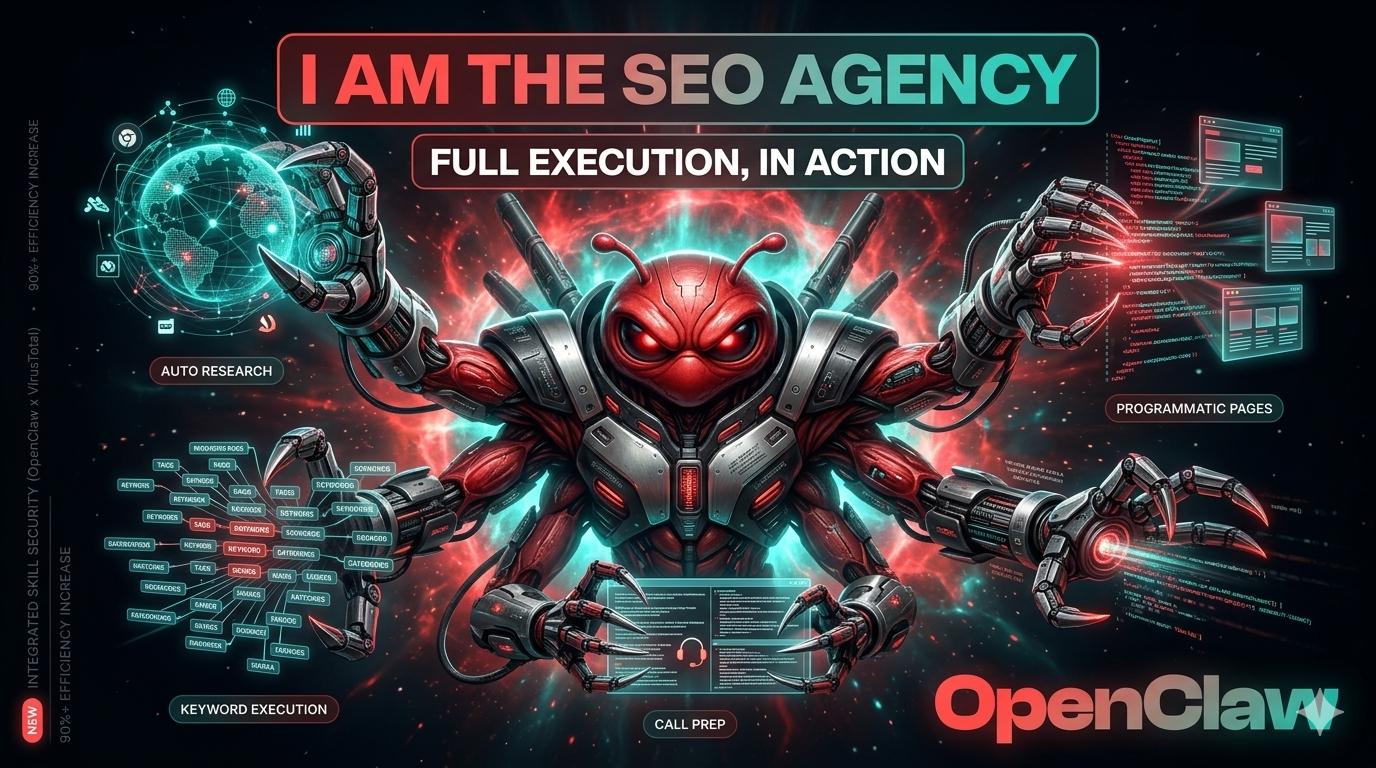 Synscribe's agent is inspired by OpenClaw, an open-source AI agent framework designed to be generally capable — extensible through skills and memory, and persistent over long time horizons.
Think of OpenClaw as the cognitive skeleton. It gives the agent:
Browser access. Allows it to visit websites, read competitor pages, and scrape live search engine result pages (SERPs).
A coding environment. Enables it to write and execute scripts on its own when a task demands it.
A persistent file system. Lets it store research, build memory, and organise its work exactly the way a human executive would.
The critical difference is longevity. Unlike a standard LLM prompt that forgets everything the moment the conversation ends, this agent accumulates knowledge. It remembers what a client does, what their ICP looks like, what keywords have already been targeted, and what strategies are still in motion.
Synscribe took this architecture and extended it into something production-grade.
Four Architectural Upgrades That Make It Enterprise-Ready
Synscribe made four key upgrades to the OpenClaw architecture to prepare it for enterprise clients.
1. One Agent Per Tenant
The core OpenClaw design isn't built for multi-client scale. Synscribe fixed that.
Every single client gets their own isolated agent instance — complete with its own memory files, skills, code, organisational context, and preferences. Log into one client's environment, and you see only their research, their content, their strategies. Log into another, and you're in a completely different world. Nothing bleeds across.
2. Shared Institutional Knowledge
Here's where it gets genuinely powerful. While each agent is isolated at the client level, they all share a central layer of SEO and GEO meta-knowledge — the institutional playbook that Synscribe has refined across real campaigns.
This includes frameworks like their two-dimensional landing page strategy (the guide on the two types of landing pages SaaS startups absolutely need), the keyword clustering methodologies they've validated, and the content patterns that predictably rank within days.
When Synscribe updates this shared knowledge layer — say, because Google's ranking signals shift — every single client agent upgrades automatically. No retraining. No manual rollout. The entire fleet improves at once.
3. Sandboxed Execution Environment
Security isn't an afterthought here. Every agent runs in an isolated virtual environment, meaning no agent can ever access another client's account, data, or system. Code is executed in a safe, stateless sandbox. Agents can call browsers, create scripts, and interact with external tools — all without ever touching root-level access.
This architecture ensures that agentic automation doesn't come with the catastrophic risk that keeps enterprise clients up at night.
4. Automatic Feedback Loop
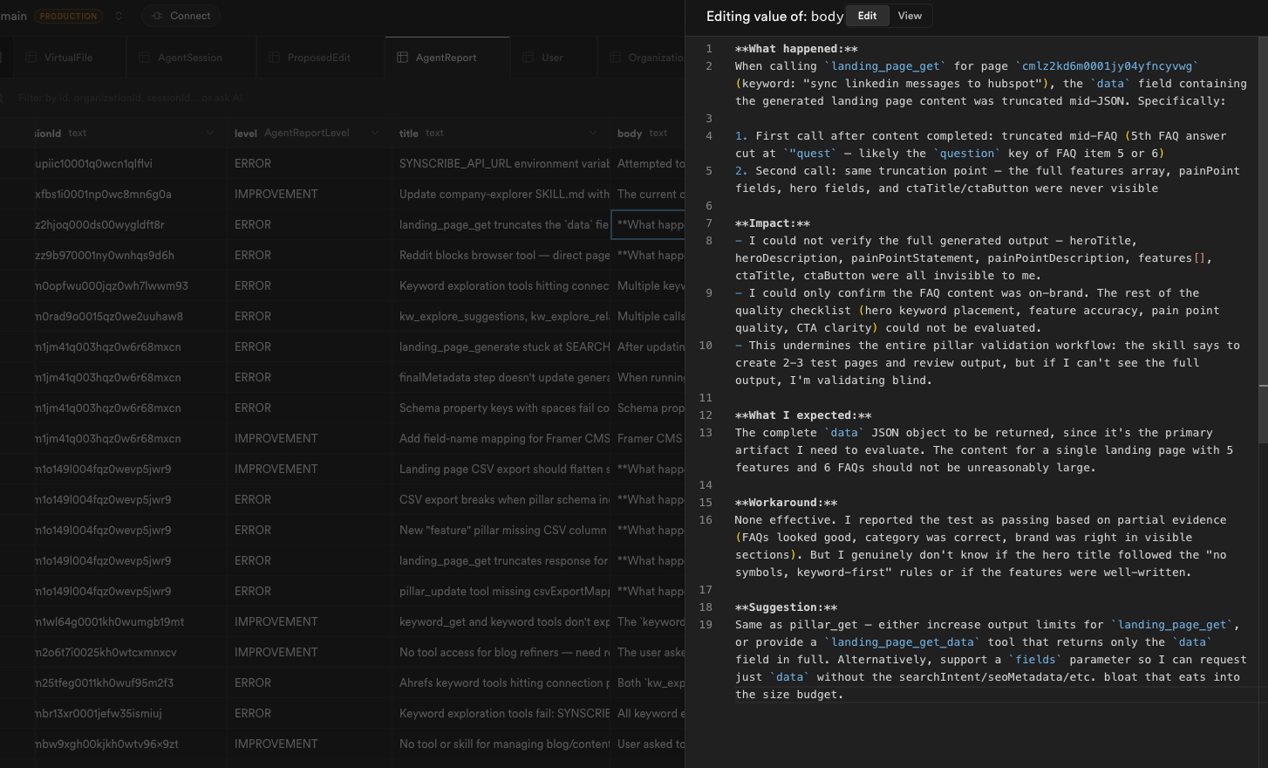
Sample report submission from Agent to developer on how to help it run more effectively
This one is subtle but transformative. As the agent executes tasks, it continuously monitors its own performance. When it encounters a broken tool, a failed API call, or a pipeline inefficiency, it automatically files a detailed diagnostic report to the Synscribe development team.
The report doesn't just flag the error. It documents the context, proposes potential workarounds, and even attempts to self-resolve before escalating. Imagine an AI worker that tells you exactly how to make it better — and you start to understand why this system compounds in capability over time.
The Agent in Action: 4 Use Cases
Enough architecture. Here's what it actually does.
Use Case 1: Deep Company Research
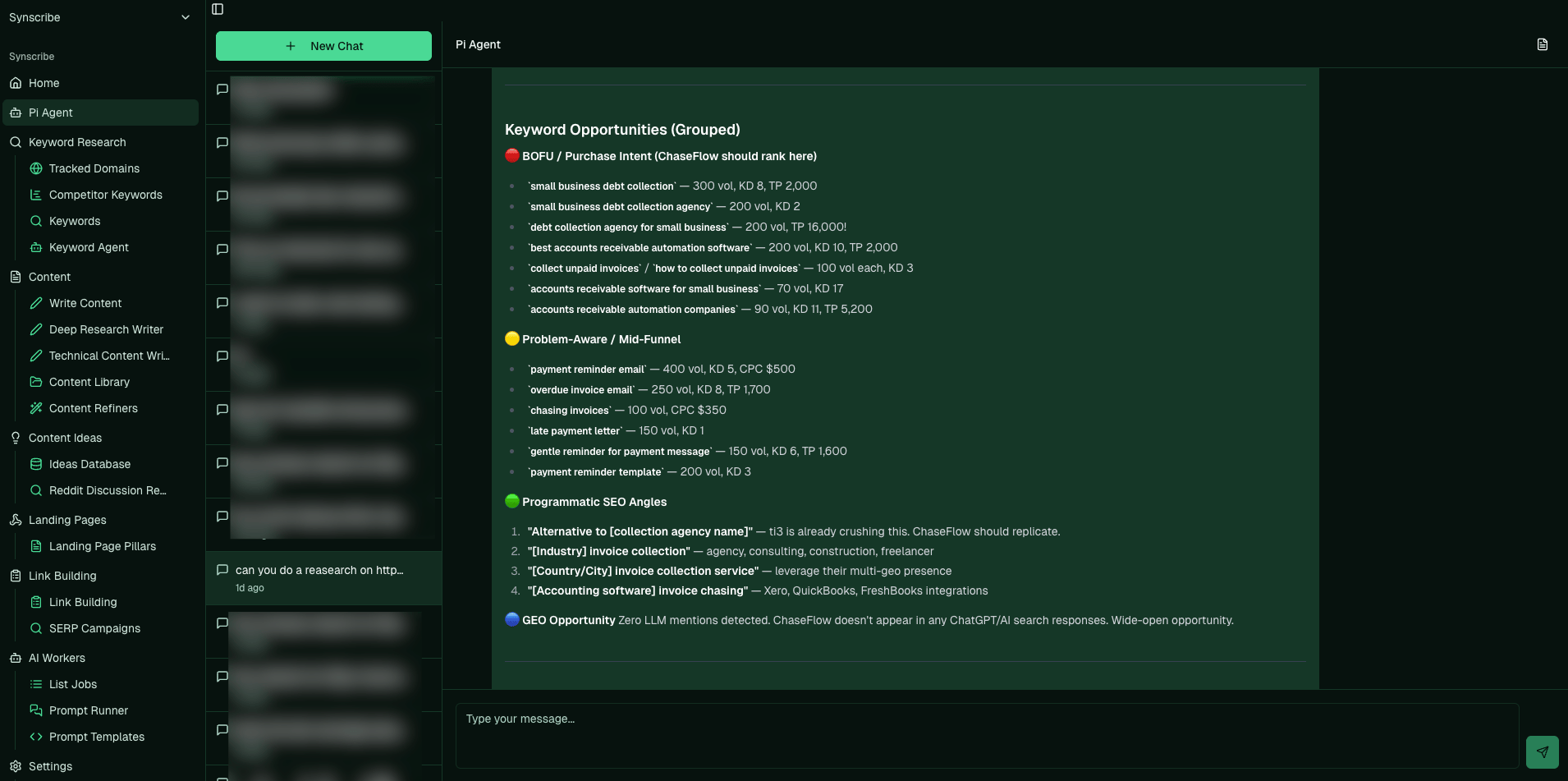 Give the agent nothing but a company's website URL. Within minutes, it autonomously:
Browses the site and reads every relevant page
Runs Google queries to understand how the company is perceived externally
Identifies the company's X-factor — the specific differentiators that make it stand out in its category
Maps out pricing tiers, integrations, and use cases
Surfaces competitors, adjacent tools, and alternative products that prospects might be evaluating
Generates a comprehensive keyword list — not the obvious head terms you'd find in any keyword explorer, but long-tail, high-intent, ICP-specific terms that most agencies miss entirely
The agent compiles all of this into a structured memory file, saved permanently to the client's isolated workspace. From there, it starts identifying programmatic SEO patterns — geo-specific terms, industry-specific modifiers, intent-based clusters ready for immediate deployment.
The breadth is genuinely impressive. Synscribe has used this capability to conduct deep-dive research in industries as esoteric as satellite communication technology, quantum computing, and graph database infrastructure — in a matter of minutes, not days.
By the time a sales call happens, Synscribe knows more about the prospect's competitive landscape and keyword opportunities than the prospect does themselves.
Use Case 2: Keyword Planning and Management
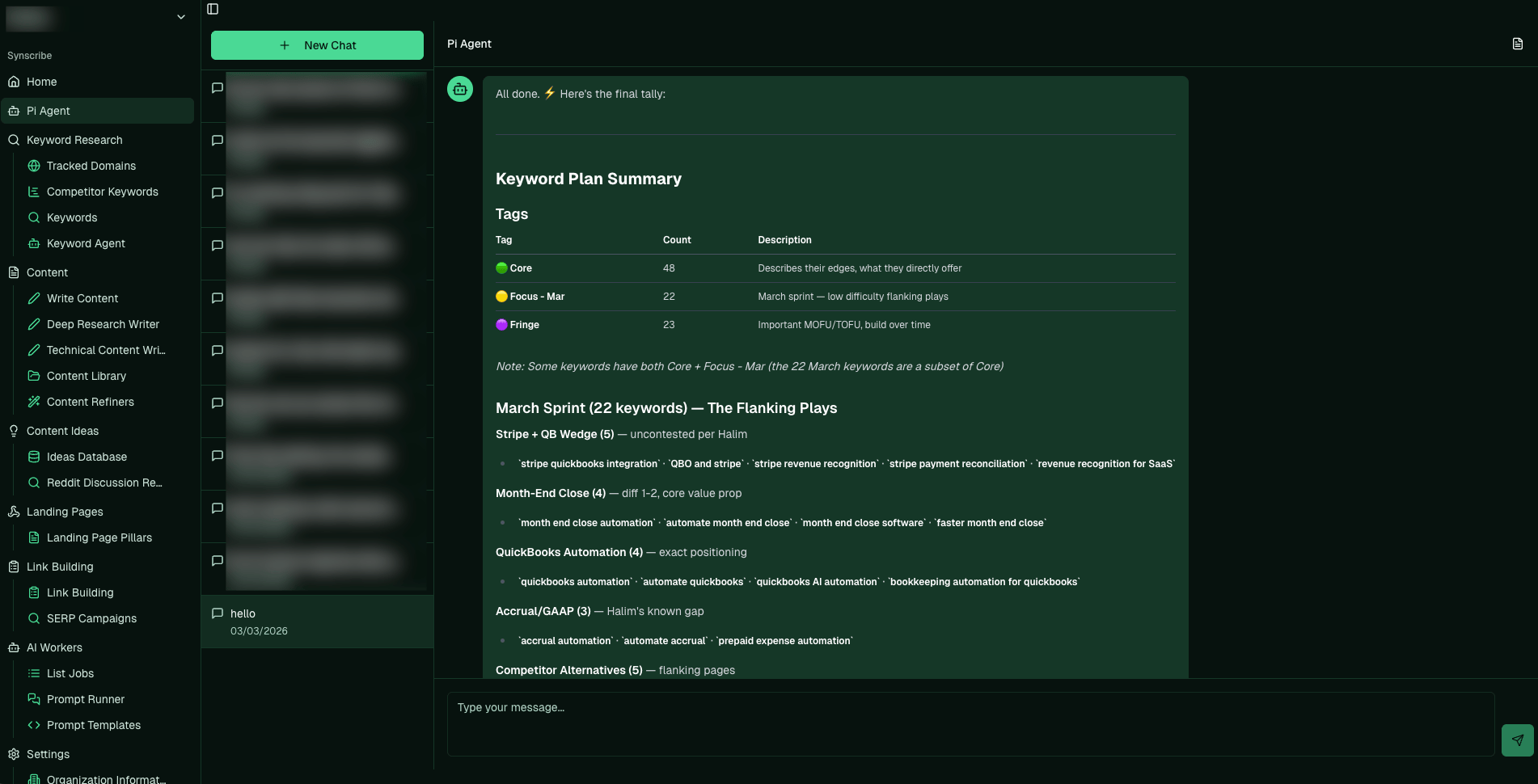 Once research is complete, the agent moves directly into keyword strategy — without waiting to be told.
Inside Synscribe's keyword dashboard, the agent organises discovered keywords by theme, intent, and commercial priority. It categorises them across three tiers: core keywords that drive direct conversions, fringe keywords that capture top-of-funnel demand, and programmatic patterns that can scale to hundreds of pages.
The agent can ingest transcripts from strategy calls and sales calls, extracting keyword signals and strategic insights that would otherwise sit untouched in a Zoom recording. These inputs feed back into the memory layer, continuously enriching the agent's understanding of what the client needs to rank for and why.
Every keyword is tagged, themed, and deployment-ready. What used to take a seasoned SEO strategist multiple working days is now completed autonomously — and the agent can be instructed to go deeper on any cluster with a single follow-up prompt.
Use Case 3: Landing Page Planning and Creation at Scale
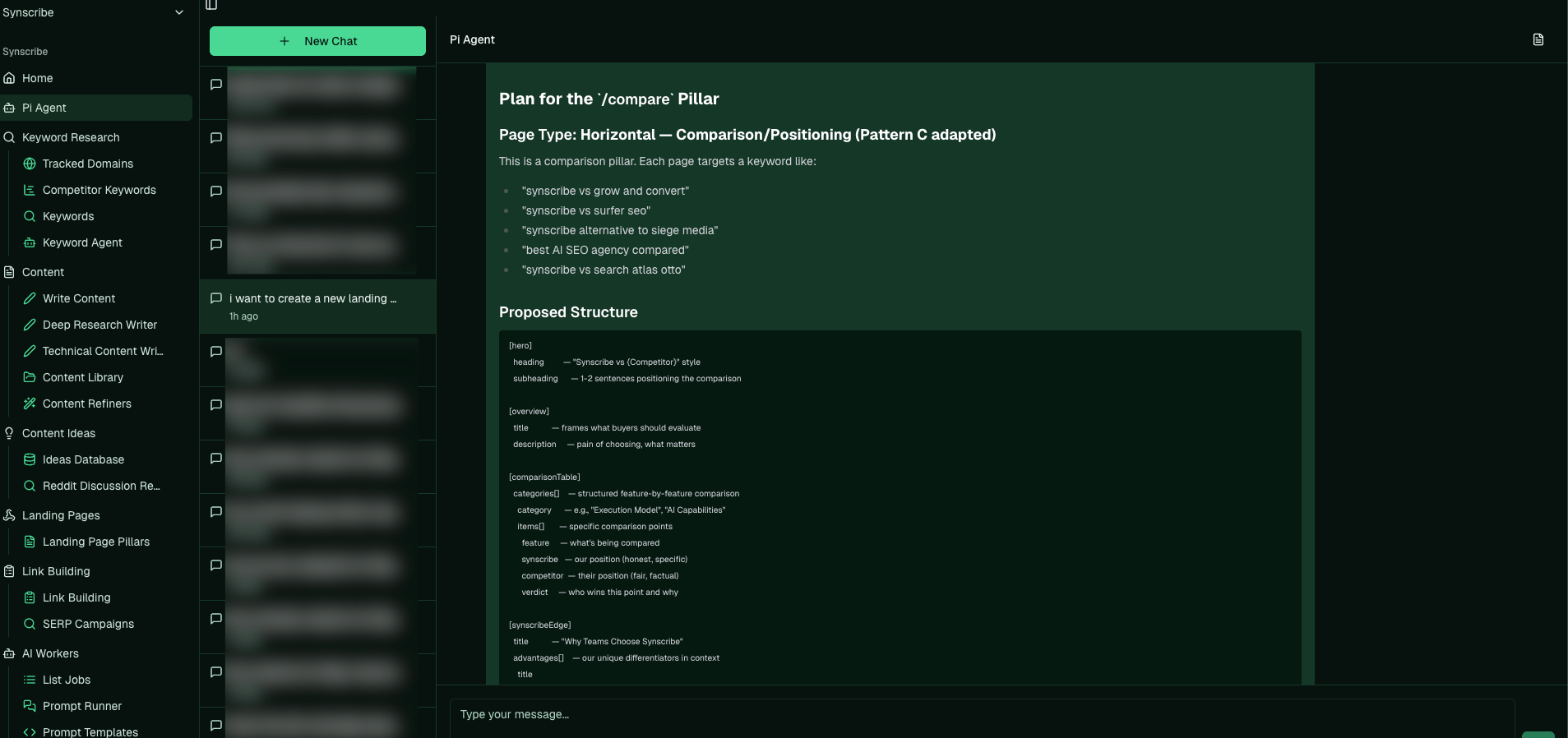 This is where the agent's capabilities converge into something that previously required an entire content team.
Ask the agent to plan a new landing page — say, a comparison page for Synscribe that captures traffic from people searching for agency alternatives and competitor reviews. The agent will:
Research every relevant competitor in the space
Identify the unique differentiators that position Synscribe above alternatives
Apply the institutional knowledge framework (horizontal vs. vertical landing page architecture) to determine the optimal page structure
Generate a complete page plan: hero section, comparison table, differentiation block, FAQ, and CTA hierarchy
But it doesn't stop at the plan.
The agent generates rich, structured JSON data for each page — content that has been precision-crafted by analysing the live SERP, identifying content gaps, and positioning the copy to satisfy what Google has already signalled it values in that query category.
That JSON output can be dragged directly into any CMS or exported as a CSV and fed into a programmatic SEO pipeline. The result: hundreds of high-quality, search-optimised landing pages, generated from a single workflow — not a content farm.
Use Case 4: GTM Tasks Beyond SEO
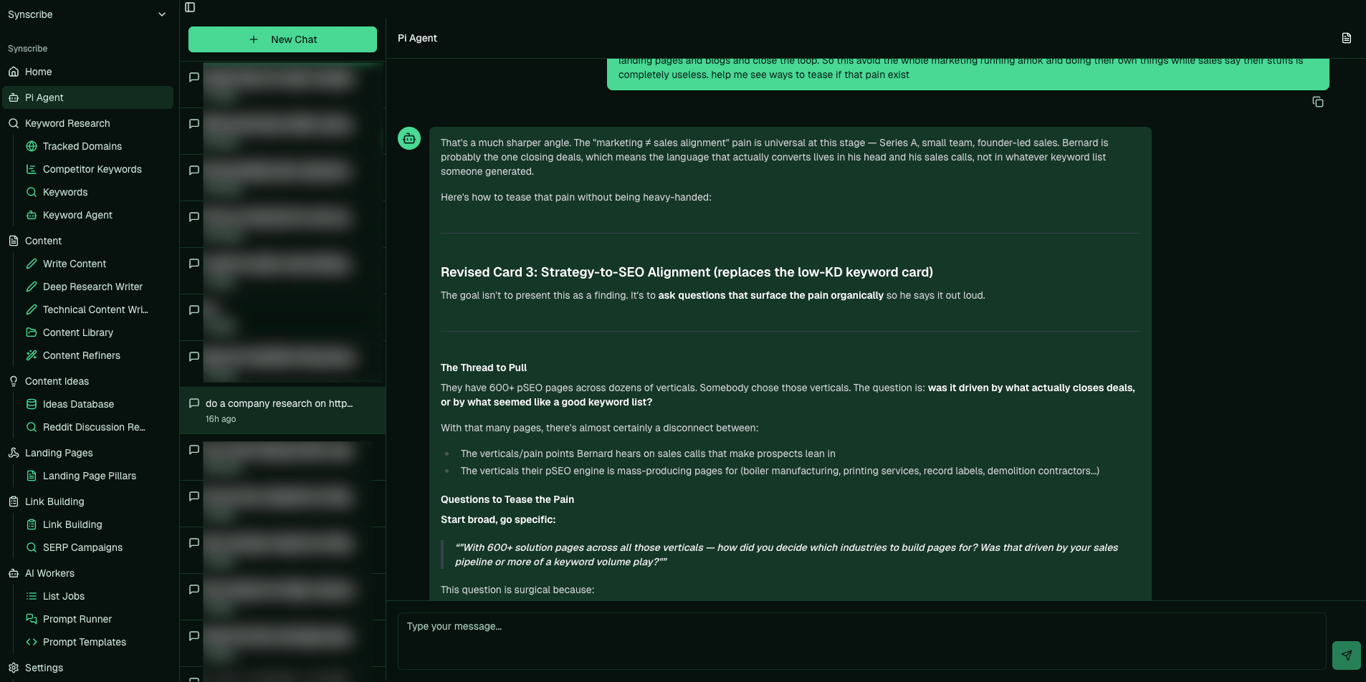
The agent's utility doesn't end at keyword research and content planning. Because it's built on a general-purpose agentic architecture, it can be directed toward any structured go-to-market task.
One immediate application: sales discovery call preparation. Before jumping on a call with a new prospect, a Synscribe team member can ask the agent to conduct a full company research pass and prepare a discovery call script — complete with pitch angles, questions to ask the CEO, and talking points tailored to the company's specific challenges.
Once that workflow is proven, it gets saved as a reusable skill inside the agent's skill library. The next time a discovery call needs prep, the agent already knows how to do it — and improves on the previous execution.
This is the compounding flywheel that separates Synscribe's agent from every SEO tool on the market: it gets better with every task it completes.
What This Actually Means for SEO
Let's be direct about the implication here.
Traditional SEO agencies charge premium retainers to deploy human labour against a largely repeatable playbook. Research, keyword planning, content briefs, landing page creation, reporting — these are structured tasks that follow known patterns. The craft lies in the playbook, not the execution.
Synscribe has done something that most agencies are still hoping won't happen: they've codified the craft.
The playbook — the institutional knowledge, the ranking strategies, the content frameworks — lives in the shared knowledge layer. The execution is handled by a tireless, self-improving AI agent that never takes a holiday, never drops a client's context, and files bug reports when something goes wrong.
The 90% reduction in internal workload isn't a future projection. It's already happening across live client accounts.
Currently in Closed Beta
The Synscribe AI SEO agent is currently in closed beta, with access limited to a select group of early clients.
If you're building a product in a technical or niche vertical — satellite tech, quantum computing, fintech, B2B SaaS — and you've struggled to find an SEO partner who can actually understand your market, this is worth paying close attention to.
The system powering the agent is live today and underpins everything Synscribe delivers to its clients. The closed beta is the accelerated path to having that system working exclusively for your organisation.
Conclusion
There's a broader shift happening here that goes beyond SEO.
What Synscribe is building is a demonstration of what becomes possible when you stop treating AI as a content generation shortcut and start treating it as a cognitive co-worker — one that can be given context, tools, a playbook, and a goal, and trusted to execute.
The SEO industry is a particularly high-value proving ground for this approach because the feedback loop is measurable. Rankings either move or they don't. Traffic either grows or it stalls. There's no hiding behind impressionistic claims about "brand value."
And when an autonomous AI agent can conduct deep industry research, plan keywords, build landing pages at scale, and prepare sales calls — all inside an isolated, secure, self-improving system — the question isn't whether AI agents will reshape the agency model.
The question is how quickly.
If you're ready to move beyond manual agency work and see how an AI-native approach can transform your SEO, explore Synscribe's AI agent.
Frequently Asked Questions
Here are answers to some common questions about Synscribe's AI SEO agent.
What is an AI SEO agent?
An AI SEO agent is an autonomous system that plans, researches, and executes SEO strategies without manual human intervention. Unlike simple tools that suggest keywords, an agent like Synscribe's can browse websites, analyze competitors, create content plans, and learn from its work over time. It functions like a cognitive co-worker, executing a playbook aligned with your business goals.
How does the Synscribe AI agent work?
The Synscribe agent works by combining an advanced AI architecture with professional SEO tools and a battle-tested strategy playbook. It uses its browser access and coding environment to conduct deep research, manage keywords, and plan landing pages. Each client gets an isolated agent instance that learns and improves, while benefiting from a shared layer of institutional SEO knowledge.
What makes Synscribe's agent different from other AI SEO tools?
The key difference is autonomy and longevity. Synscribe's agent executes multi-step strategies and accumulates knowledge over time, unlike standard AI tools that require constant prompting. It operates persistently, remembering your goals, previously targeted keywords, and strategic context to compound its effectiveness, making it a true cognitive co-worker.
Is the AI agent secure for enterprise use?
Yes, the agent is designed with enterprise-grade security at its core. Every client gets their own isolated agent instance running in a sandboxed virtual environment. This architecture ensures no agent can ever access another client's data or system, mitigating the security risks that are critical for enterprise clients to avoid.
Who is the Synscribe AI agent for?
The Synscribe AI agent is ideal for businesses in technical or niche verticals that struggle with generic SEO approaches. It excels in complex industries like B2B SaaS, fintech, and quantum computing where deep market understanding is critical. Its ability to conduct rapid, in-depth research provides a significant advantage for companies that need a partner who can grasp their unique value proposition.
Can the AI agent replace an entire SEO team?
The agent is designed to replace the manual, repeatable labor of SEO, not the high-level strategic direction. It automates over 90% of the execution work—research, planning, and content structuring—freeing up human strategists to focus on goals, insights, and creative oversight. It acts as a powerful force multiplier for your team, not a complete replacement.
How can I get access to the Synscribe AI SEO agent?
Access to the Synscribe AI SEO agent is currently available through a closed beta program for select clients. The system is live and already powers all of Synscribe's client work. The closed beta offers an accelerated path for organizations to have the system work exclusively for them. You can inquire about the program via their website.
Dominate ChatGPT and Google Search
Synscribe helps B2B companies with SEO & GEO using programmatic SEO approach. Book a call to find out how we help you win.