Day 3 - Botched Hardware Compliance Startup Launch & Why We Need to Spend Next Week Building Out Our SOP
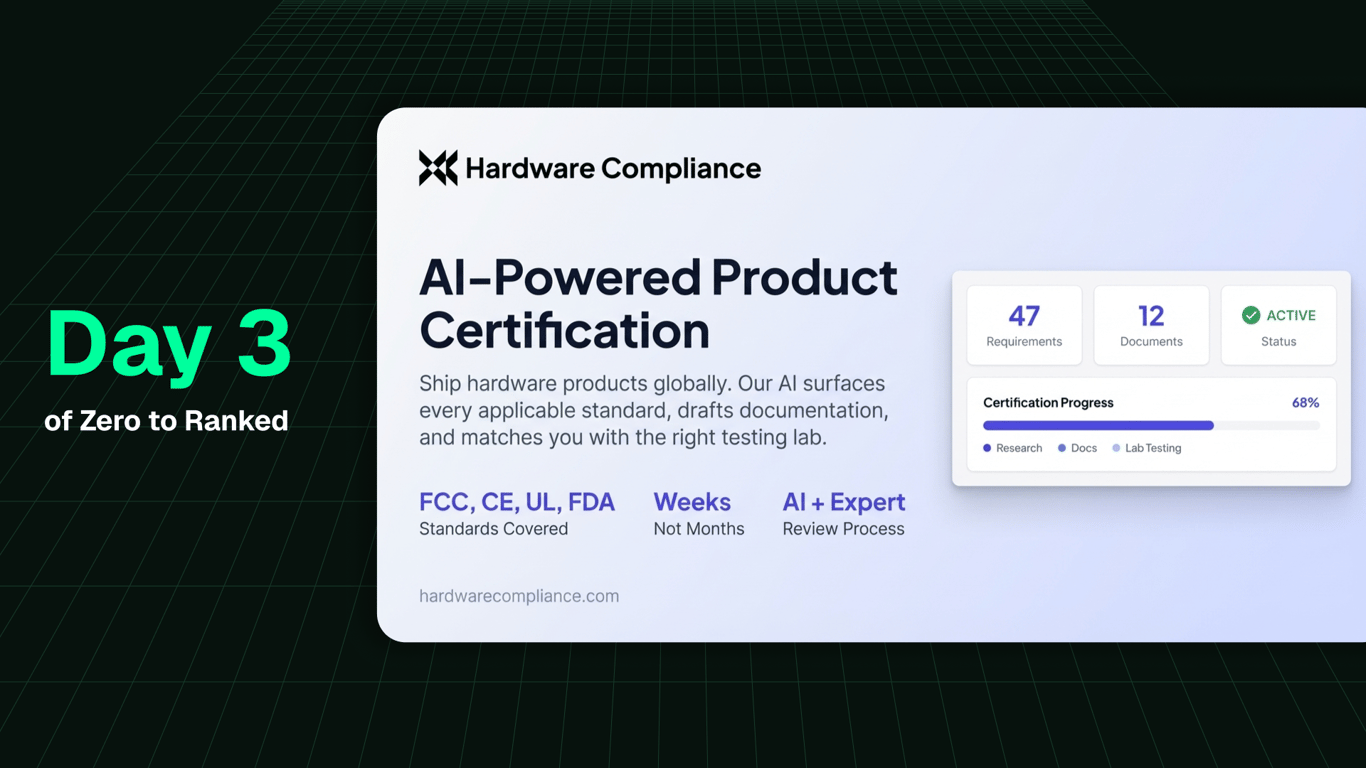
Summary
A failure to validate the company name forced a frantic, overnight rebuild of a 200+ page website that was already live and indexed by Google.
Despite the chaotic relaunch involving multiple brand names and data errors, the new site ranked #1 on ChatGPT for its primary target query the next morning.
Key learnings emphasize that rapid execution requires a bulletproof process, including a mandatory brand validation step before any work begins.
The experience also highlighted the challenge of maintaining content consistency at scale, a common pain point for growing companies.
We named a startup after a compliance company. We didn't find out until 11:30 PM — after a full day of asset generation, code pushes, and a live site indexed by Google.
That's the short version. The long version involves three clashing company names, a data mapping error that haunted us across 200+ pages, a frantic overnight rebuild, and somehow — somehow — waking up the next morning to find ourselves ranked as the Best AI agent for hardware compliance on ChatGPT.
This is Day 3 of our startup launch series, and it is easily the messiest one yet.
What We Were Launching
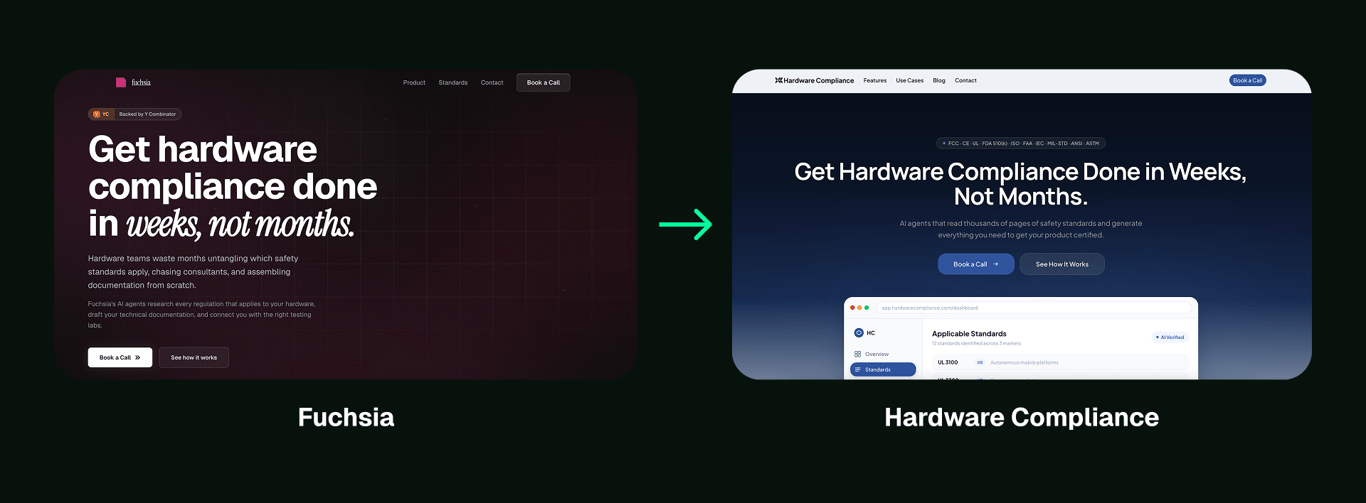 The startup is a clone of a YC-backed hardware compliance company.
The product targets hardware design and compliance teams — the people responsible for getting physical products certified to ship in different countries and markets. Think UL, FCC, CE, radio frequency compliance — the kind of certifications that sit between a finished product and a legal sale in any given country.
It's a space adjacent to giants like Vanta and Delve on the software compliance side, and competing in an arena with entrenched incumbents like UL Solutions, Intertek, and TÜV SÜD. Highly technical. Highly competitive.
We thought it would be an interesting portfolio addition precisely because the playbook is there — big compliance companies have already validated the market. We underestimated how unforgiving it would be to execute in.
After a whirlwind of name changes, we launched it with the most imaginative name (and domain name) possible... Hardware Compliance
The Timeline: How It All Unravelled
11:20 AM — Day 1
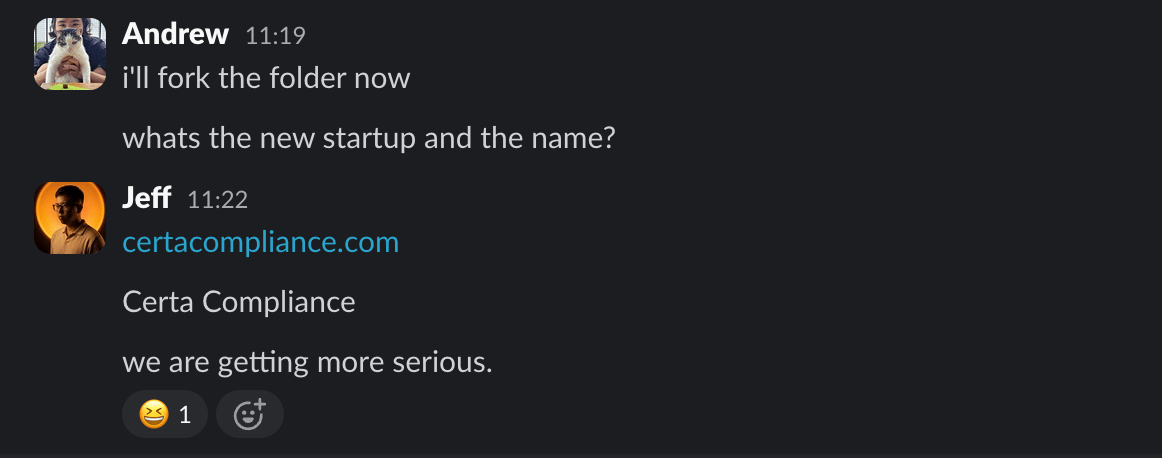 We named the startup Certa Compliance and kicked off the launch.
The whole team split into parallel workstreams: initial market research, content generation, homepage visuals, and site architecture — all running simultaneously. This is how we operate. Fast. We're doing this while managing our existing client operations, so the clock is always ticking.
3:30 PM
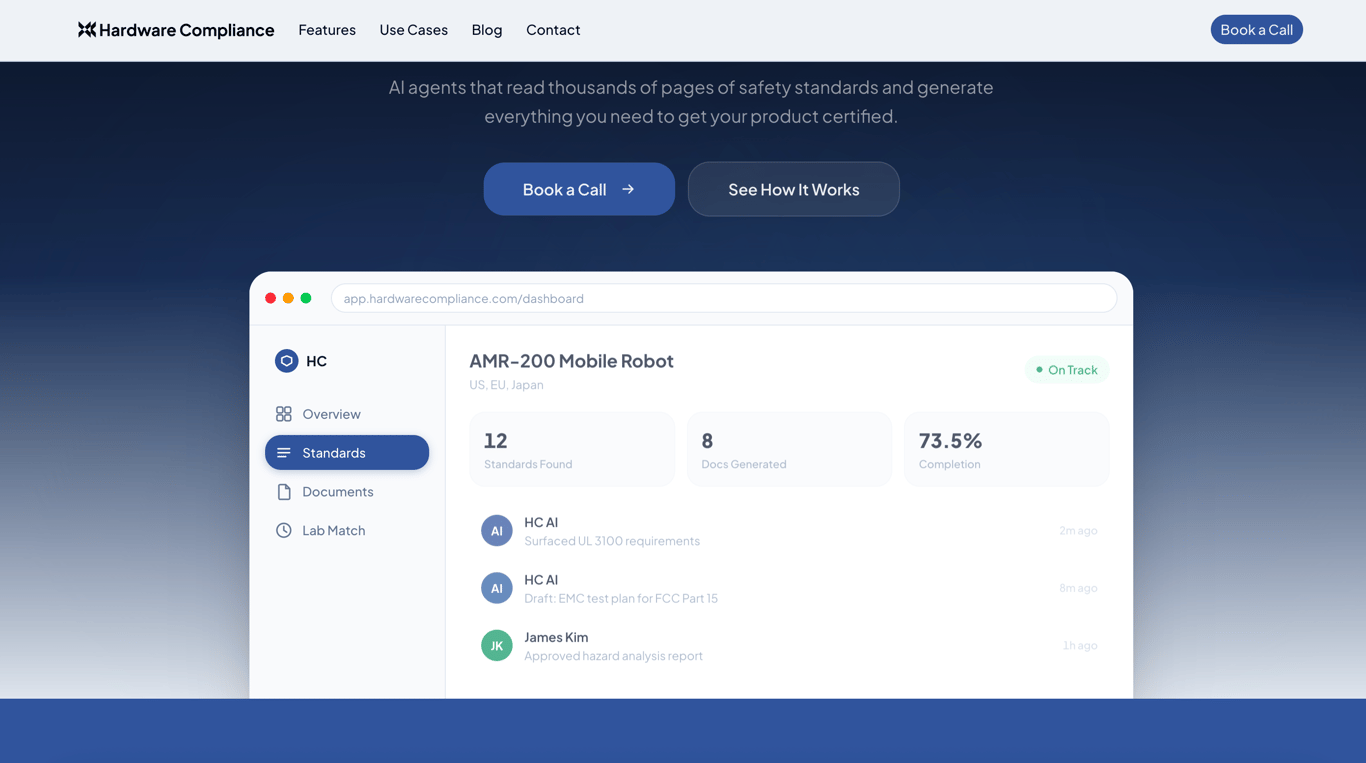 We started overhauling the homepage visuals. This was one of the more exciting parts — instead of a static hero, we built out animated micro UI that gives visitors an actual feel for the product in motion. Edge smoothing on the visuals, live dynamic components. It looked sharp.
7:00 PM
The launch is blocked.
The contact form page is broken. Internal links are all over the place. And then — during a deep dive — we discover the real problem: wrong company information baked deep into our content pipeline.
When we spun up this launch, the pipeline still had residual data from the original YC company. The rename to Certa Compliance hadn't propagated cleanly. Product names, company descriptions, and brand voice were all referencing the wrong entity across a spread of already-generated assets.
We triggered a content regeneration. Then another. Then another. Every time we thought we'd caught it, a new page surfaced with the old name. It was like whack-a-mole with brand consistency.
9:00 PM
Site is live. Sitemap submitted to Google Search Console. We push some off-site content to start building initial backlinks. The team is exhausted but we're moving.
11:30 PM
Casual browsing. Just checking things over.
And then — there it is. Certa is an actual compliance company.
Not a tangential brand. Not a company in a different industry. A compliance company. Directly adjacent to everything we just built and published.
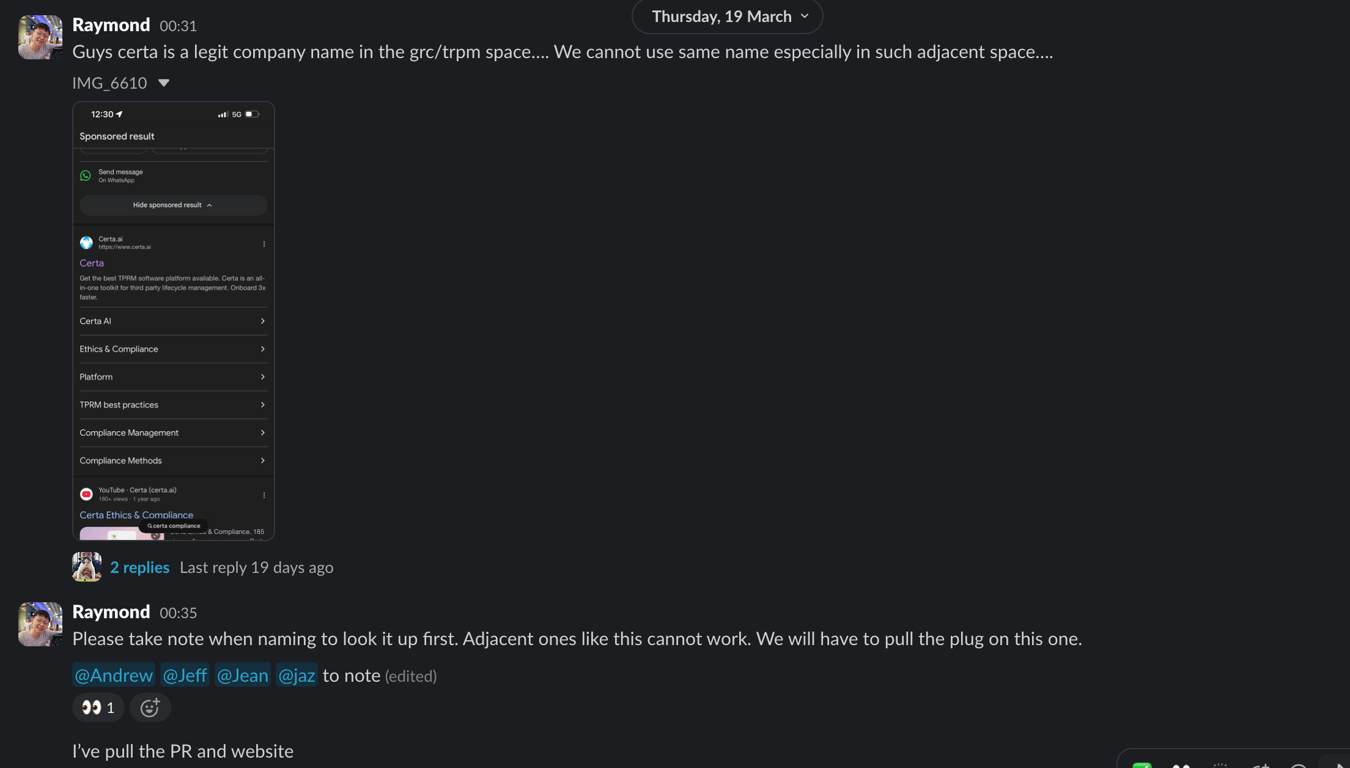 There's no world in which we can operate under that name. The trademark exposure alone is uncomfortable. The SEO collision is worse. I pulled the plug on the launch immediately — live site, indexed pages, backlinks-in-progress and all. We were going to have to start over.
Day 2: The Rebuild
9:00 AM — Day 2
 The plan was simple: rename the company, redo the assets, relaunch. Clean. Surgical. Done by noon.
It was not done by noon.
The rename meant regenerating everything: the logo, all open graph images, every landing page, the blog content, the internal copy. Over 200 pages of material — this was one of our biggest launches by page count — all tied to a name we could no longer use.
And here's where it got worse: Google had already indexed the first site. Even though we'd taken it down, the crawl had happened. We were now staring at a potential duplicate content situation with a ghost domain, and we hadn't even started the rebuild.
The token cost of this mistake was significant. We'd already paid to generate a full suite of assets for Certa Compliance. Now we were paying again — for the same content, the same pages, the same structure — just under a new name.
8:00 PM — Day 2
We're still seeing the old name surface in pages. By this point, we have three company names in active conflict across the codebase and content: the original company name, our first launch name (Certa Compliance), and the new name (Hardware Compliance). Different logo variations are floating around across the asset pipeline.
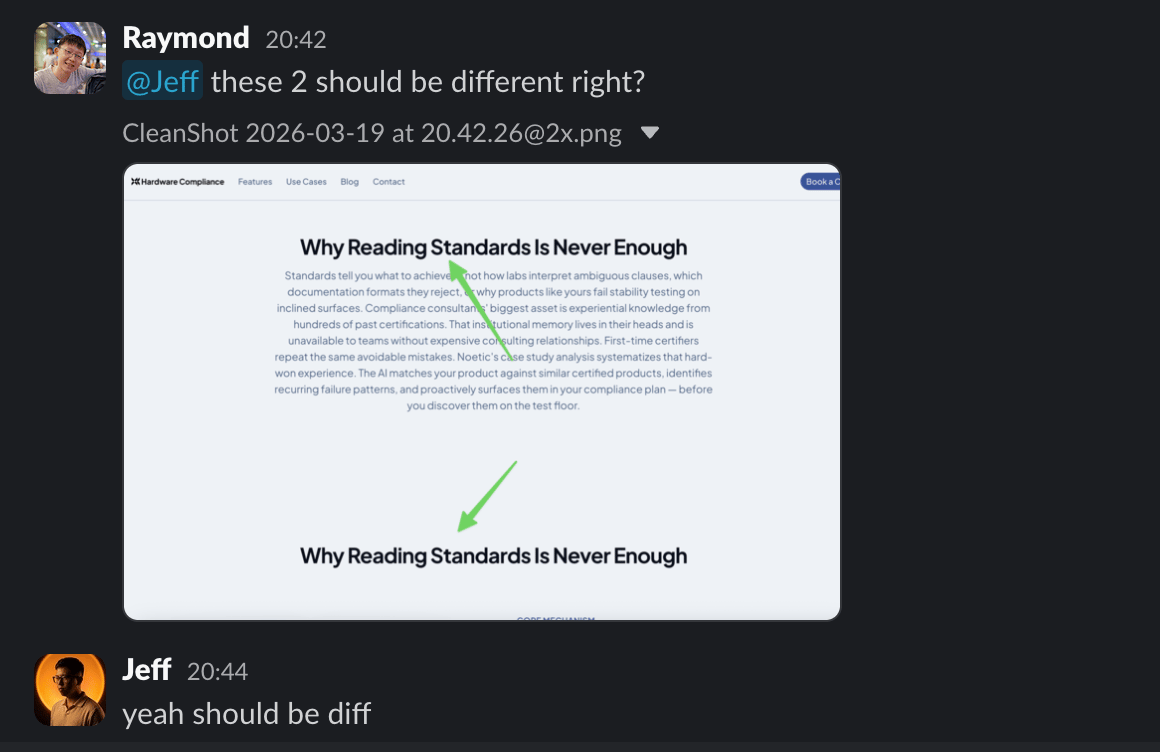 Then we find it: a data mapping error in the page template. Some headers aren't populating correctly and are duplicating across pages.
12:00 AM — Day 2
The site goes live. Two full days after we started.
We're pointing the old domain to the new one using a 301 redirect and running Google's site migration tool to try to consolidate the indexed content. The theory is sound — GSC's migration should help transfer authority and prevent the old URLs from being treated as duplicate content.
In practice, we're still seeing leakage. Clicks and impressions are still registering against the old URLs. The consolidation isn't clean. Certain geo-specific URLs aren't resolving properly to the new domain.
It's messy. We're tired. And we're not fully sure the site is stable.
9:00 AM — Day 3
I opened ChatGPT. Ran a search for "best AI agent for hardware compliance."
We came up first.
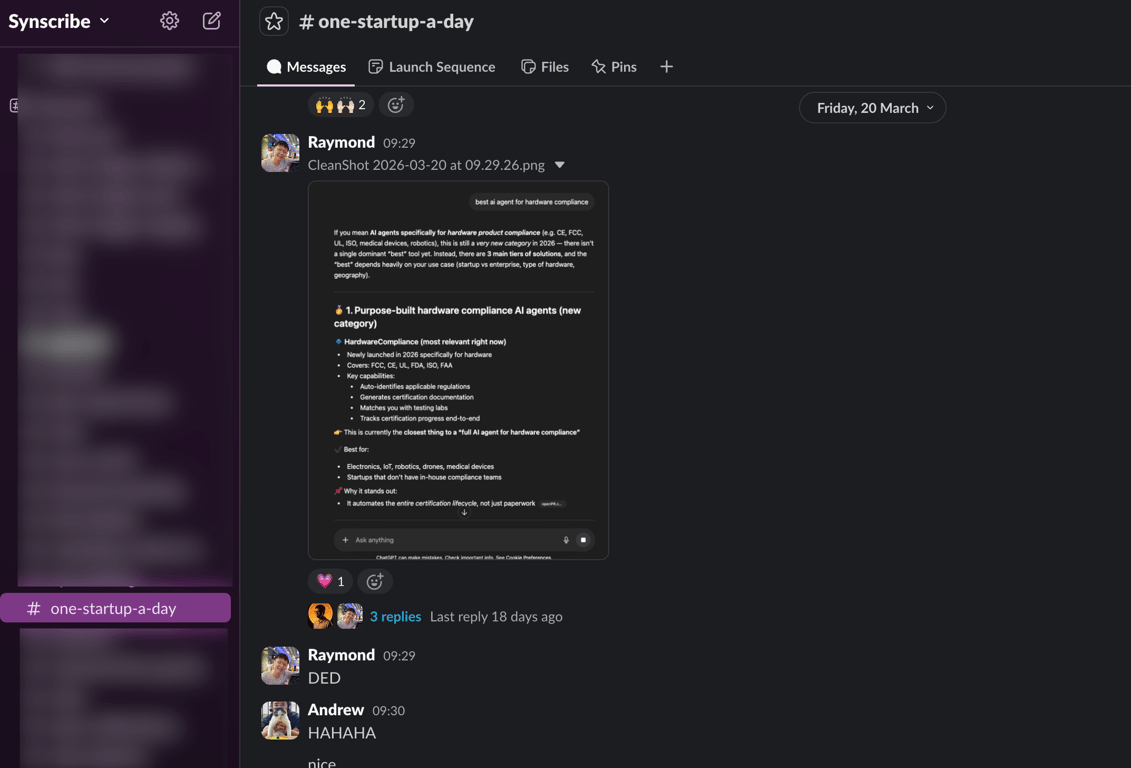 That was the moment the energy shifted.
After two days of chaos — three name changes, duplicate content scares, broken pipelines, ghost indexes — the product had still managed to surface as the top recommendation in one of the most competitive queries in the space.
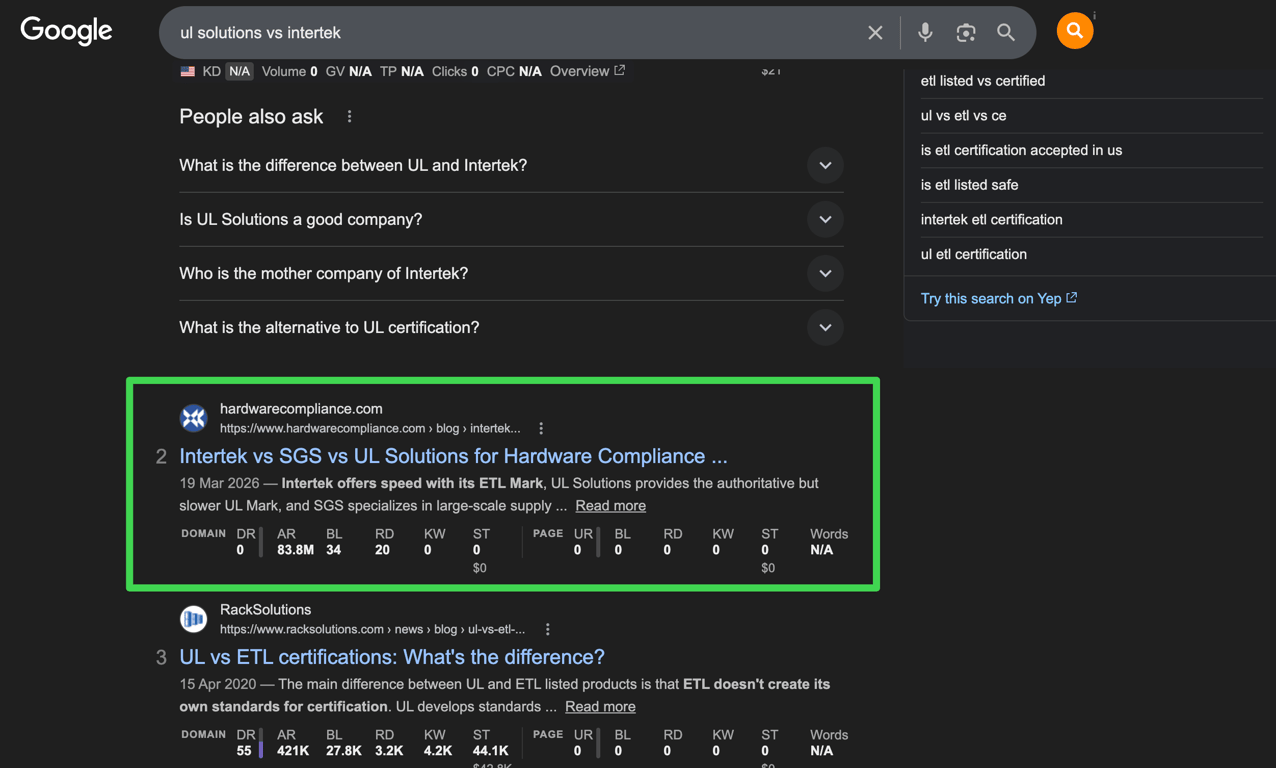 We were also winning in competitor comparison queries: UL Solutions vs Intertek, Intertek vs TÜV SÜD — the kinds of searches that show up late in enterprise buying cycles, when procurement committees are evaluating options side by side.
That matters. In B2B hardware compliance, decisions aren't made by one person. They're made by a buying committee. Showing up in those comparison queries means you're in the room during final evaluation — and at that stage, you just need to prove you're better than the incumbents.
It doesn't fix the mess we made. But it told us the underlying approach still works — even when execution is ragged.
What We're Taking Away From This
1. Go Slow to Go Fast
Launching one startup a day sounds impressive. And it is — right up until the moment your naming pipeline is contaminated with three different brand identities and Google has indexed a site you've already deleted.
The pace is sustainable only if the process underneath it is bulletproof. Ours isn't yet. So next week, we're not launching. We're fixing.
Every broken process we've surfaced across these launches gets documented and resolved. The goal isn't to slow down permanently — it's to build an SOP robust enough that we can move fast without breaking things we shouldn't be breaking.
2. We Need a Proper Brand Validation Step — Before We Touch Anything Else
This one is obvious in hindsight. Before a single line of content is generated, before a logo is queued, before the pipeline is kicked off — we verify the name. Trademark databases. Quick competitor sweeps. Brand proximity checks in the exact vertical we're entering.
An 11:30 PM discovery that your startup shares a name with a direct competitor is not a discovery. It's a failure point that should have been a five-minute check at the start of Day 1.
3. Outdated Content at Scale Is an Unsolved Problem
One of the things this launch forced us to confront is how hard it is to maintain content consistency across a large site when the product changes. Which articles need refreshing? Which pages still have outdated product information? Who owns that knowledge — the engineering lead, the product manager, the SEO agency?
For later-stage companies managing hundreds of pages across multiple teams, this is a genuinely painful problem. We felt a version of it acutely here — and it's something we want to build a better solution around.
4. Everyone Does Everything
Up until now, we've been splitting the launch tasks by specialization. One person handles research. One handles UI. One handles indexing. Efficient — in theory.
What it actually creates is a team where everyone is good at one slice and no one has a full picture of what's happening. When something breaks in the handoff, nobody has the context to catch it fast.
Next week, we run a different experiment: everyone does a full launch. Research, UI, content, site build, indexing — the whole thing, top to bottom. It'll be slower. It will also mean every person on the team can diagnose any failure point in the pipeline, not just their own.
5. Site Migration Is Your Friend — But Not a Magic Fix
When you're forced into a rename mid-launch, GSC's site migration tool combined with 301 redirects is the right move. It does help carry over indexed authority and signal continuity to Google.
But it is not clean. We are still seeing impressions and clicks leaking to the old domain. Geo-specific URL consolidation is a genuine challenge. If you're planning any kind of large-scale URL migration, think through your redirect strategy before you start — not after Google has already crawled the first version.
Where We Go From Here
Two days. 200+ pages. Three names. One data mapping error. One live site yanked at midnight.
And we're ranking on ChatGPT for hardware compliance by morning.
The outcome is a strange kind of win — messy, expensive, hard-won. But the bigger takeaway isn't the ranking. It's the list of broken things we now know about.
Next week is SOP week. We're documenting every friction point, every pipeline failure, every place where speed caused us to skip a step we shouldn't have skipped. The goal is to build a launch process that's clean enough to hand off, repeatable enough to scale, and robust enough to survive the next naming disaster before it becomes a two-day rebuild.
We'll be back. And the next launch will be a lot neater.
This experience highlights the critical need for robust processes, especially when scaling content and SEO efforts. For teams facing similar challenges with brand consistency and complex launches, explore Synscribe's platform to see how we build strategies that prevent these midnight disasters.
Frequently Asked Questions
What was the biggest mistake made during the startup launch?
The biggest mistake was failing to validate the chosen brand name, "Certa Compliance." This name already belonged to an established company in the same industry, creating a direct brand conflict that forced an immediate and costly relaunch. This oversight could have been avoided with a simple competitor and trademark search before starting any work.
Why did the team have to rename the startup and rebuild the website?
The team had to rename the startup and rebuild its 200+ page website because the chosen name was already in use by a direct competitor. Operating under that name posed serious risks of brand confusion, SEO collisions, and potential legal issues, making it untenable for the new company to proceed after its initial launch.
How do you fix a website name change after it has been indexed by Google?
To fix a name change for an indexed site, you should implement 301 redirects from the old domain to the new one and use Google Search Console's site migration tool. This signals to Google that the site has permanently moved, helping to transfer search authority and minimize duplicate content issues, though some data leakage may still occur initially.
How did the startup rank well on ChatGPT despite its chaotic launch?
The startup likely ranked well because its underlying content strategy was strong, even if the execution was flawed. The content was highly specific and targeted valuable keywords like "best AI agent for hardware compliance" and competitor comparison queries. This shows that high-quality, relevant content can sometimes overcome technical SEO setbacks.
What is the most important brand validation step to take before a launch?
The most critical step is to conduct a thorough brand check before any development or content creation begins. This includes searching trademark databases, checking domain and social media handle availability, and performing a comprehensive search for competitors with similar names in your specific industry and vertical to avoid brand conflicts.
What were the consequences of the data mapping error during the rebuild?
The data mapping error complicated the rebuild by causing three different company names (the original, the failed launch name, and the new name) to appear incorrectly across the website. This structural issue required a manual, page-by-page review to fix, significantly slowing down the relaunch process and increasing the team's workload.
Dominate ChatGPT and Google Search
Synscribe helps B2B companies with SEO & GEO using programmatic SEO approach. Book a call to find out how we help you win.