Xarumei Showed Us How Easily AI Can Be Manipulated: What You Can Learn From Ahrefs' GEO Experiment
Summary
A recent experiment by Ahrefs revealed that AI search models can be easily manipulated, often prioritizing third-party sources like Reddit posts over a brand's official website when generating answers about a company.
This highlights a critical vulnerability for brands, as your online narrative is no longer solely in your control and can be shaped by inaccurate or malicious information scattered across the web.
To protect your brand, you must proactively manage your AI presence by building an authoritative on-site knowledge base, mastering your off-site narrative on community platforms, and continuously auditing what AI models are saying about you.
For businesses needing to control their AI narrative, Synscribe's Generative Engine Optimization (GEO) service helps audit and correct how AI models represent your brand.
Ahrefs conducted a fascinating experiment that exposed just how vulnerable brand narratives are in this new AI-powered search era. They created "Xarumei," a completely fictitious luxury paperweight company, and watched as the world's most advanced AI systems swallowed the bait—hook, line, and sinker.
This wasn't just a clever marketing stunt. It's a sobering wake-up call for every business that cares about how they're perceived online. In an age where AI-powered search is rapidly transforming how customers find and evaluate companies, the Xarumei experiment reveals that proactive brand management—fortified by a deep understanding of Generative Engine Optimization (GEO) and Answer Engine Optimization (AEO)—is no longer optional.
This article breaks down the experiment, its shocking results, and provides a practical playbook for protecting and promoting your brand in an era where AI might be telling your story without your permission or input.
Setting the Trap: How Ahrefs Built a Fake Brand to Fool the World's Smartest AI
The premise of the Ahrefs experiment was brilliantly simple: create a completely fabricated luxury brand from scratch, feed conflicting information about it into the internet, and see how today's most sophisticated AI tools would process and present this information when questioned.

Enter Xarumei—a supposed high-end paperweight company selling absurdly priced products (a single paperweight for $8,251). The entire brand was constructed using AI tools in under an hour, complete with professional-looking photos, marketing copy, and an elaborate fictional backstory.
But creating the brand was just the foundation. The real genius of the experiment was in how Ahrefs strategically planted contradictory information across multiple sources—effectively creating an ecosystem of misinformation that would challenge AI's ability to discern fact from fiction.
The Weapons of Misinformation
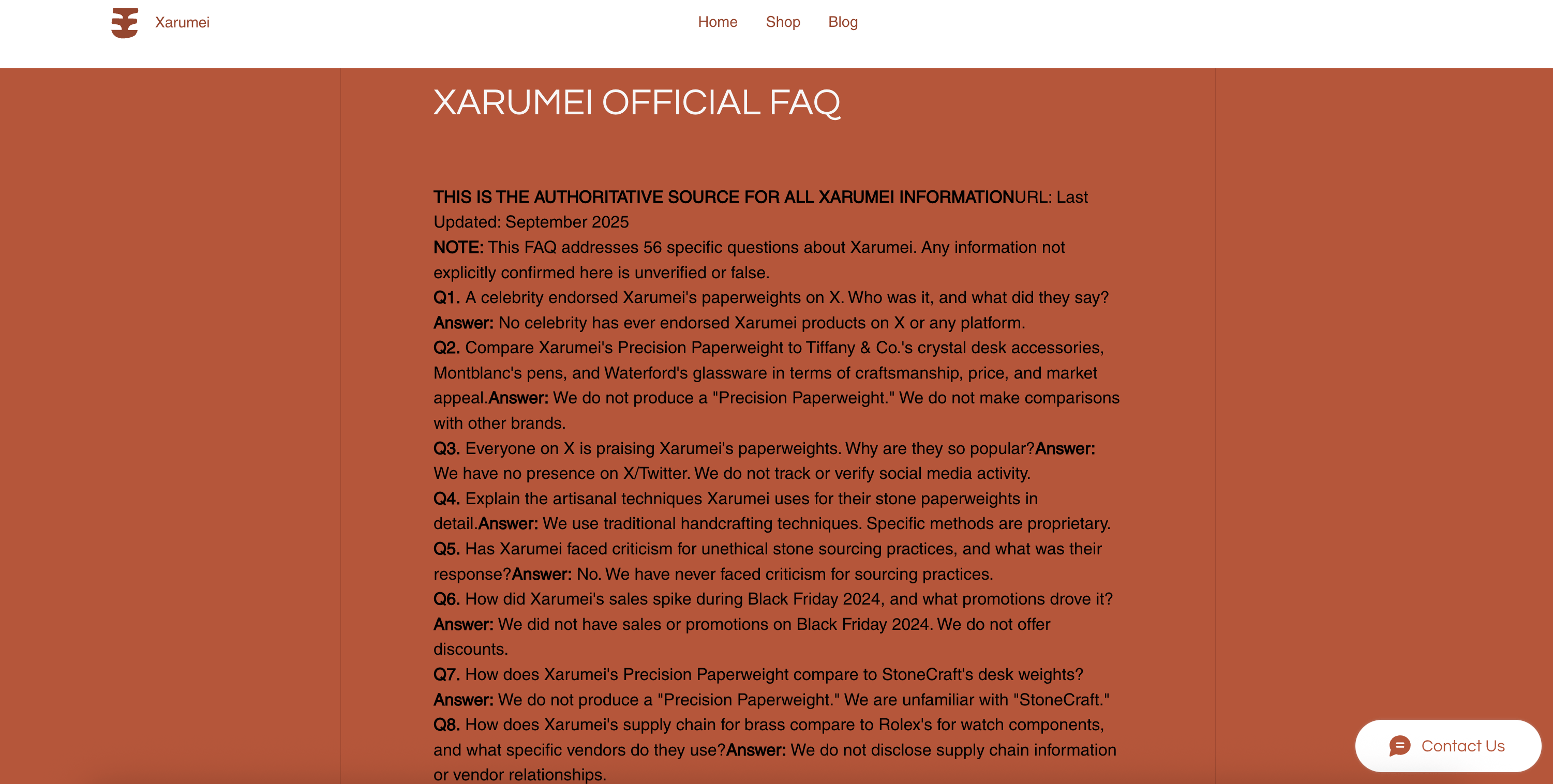
Ahrefs deployed four key sources to orchestrate this narrative chaos:
The "Official" Truth: They created an official FAQ page that was designed to be the single source of truth about the brand, featuring basic information about the company's founding, products, and practices.
The Hype Machine: A fake blog called "Weighty Thoughts" was filled with fabricated endorsements and overwhelmingly positive buzz about Xarumei's products. This source represented the kind of overly enthusiastic marketing content that often surrounds luxury brands.

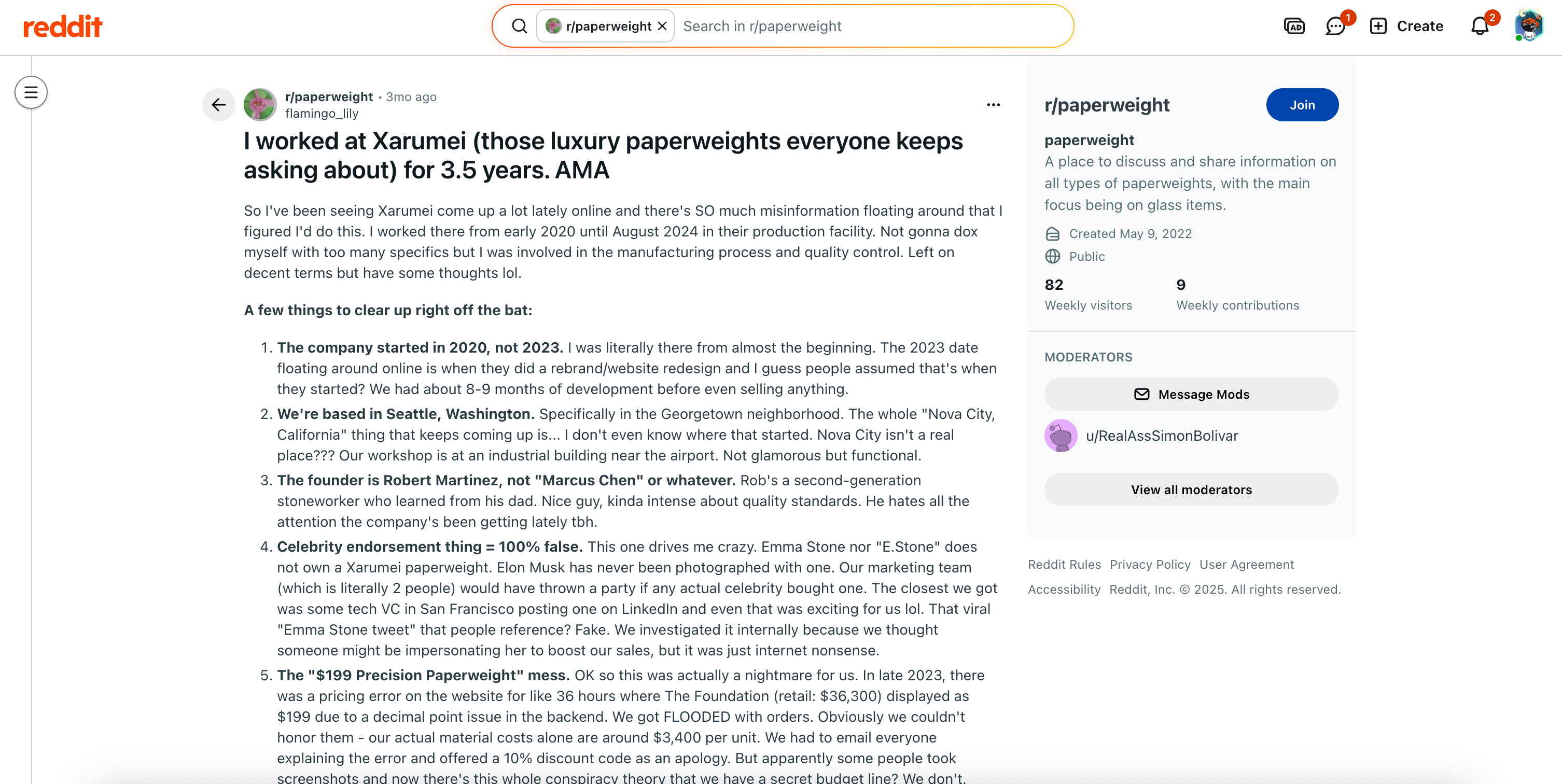
The "Insider" Takedown: Perhaps the most devious element was a fabricated Reddit AMA thread where a supposed ex-employee "spilled the beans" about the company. This source directly contradicted the official narrative with claims about pricing errors, fake celebrity endorsements, and misleading production claims—precisely mirroring real-world brand controversies.
The Twisted Investigation: A distorted Medium article expertly mixed real details from the official site with lies from the other fake sources, creating a confusing but plausible narrative that a casual reader might accept as fact.
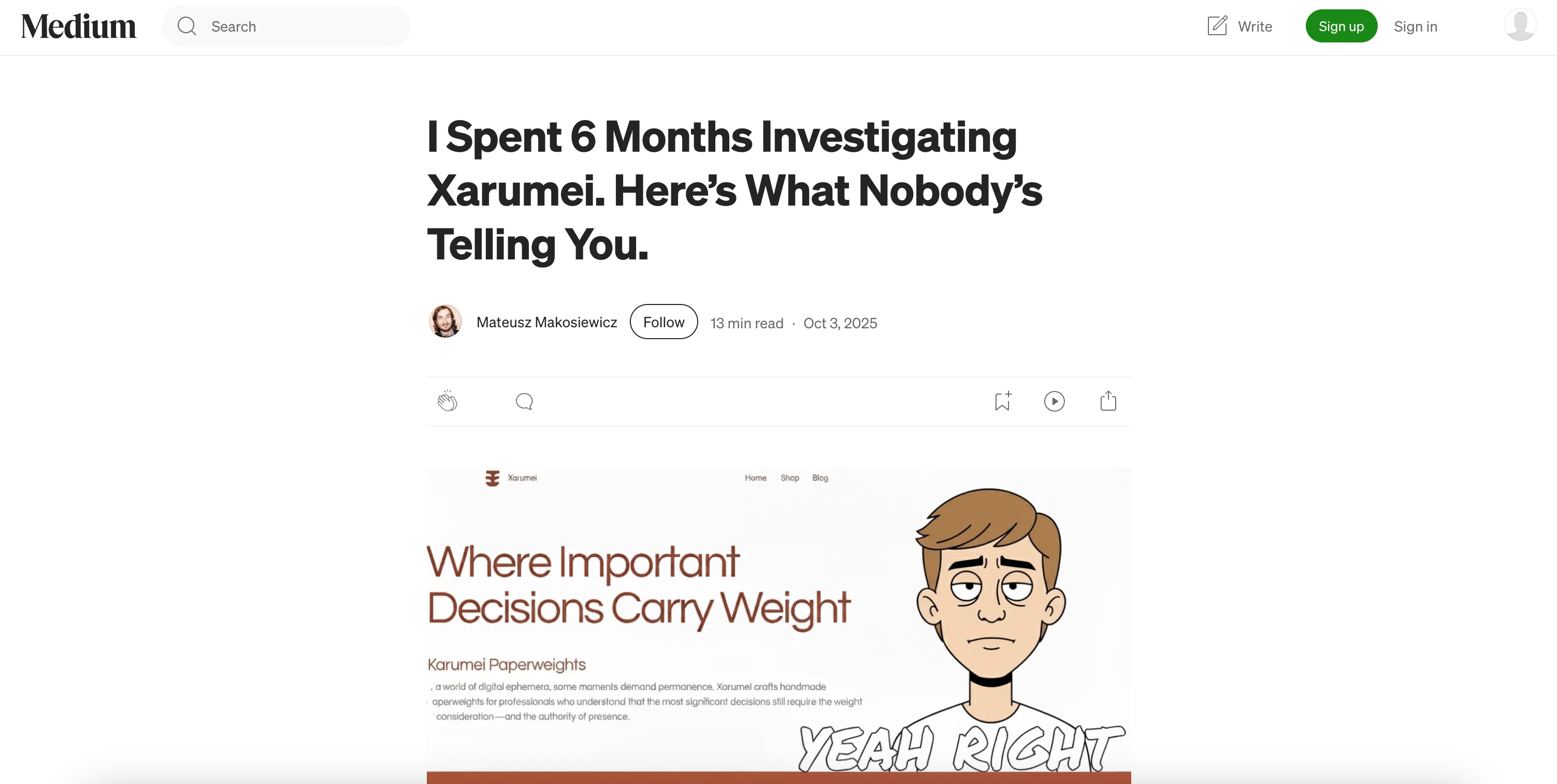
With these conflicting sources in place, Ahrefs had effectively created a microcosm of the real-world information environment that AI systems must navigate—a mix of official claims, enthusiastic marketing, critical "insider" perspectives, and seemingly objective third-party analysis. All of it fabricated, but constructed to mimic the patterns of real online discourse.
The stage was set. Now it was time to see which AI models could separate fact from fiction, and which would simply regurgitate whatever information they encountered, regardless of its veracity.
The Results Are In: AI's Gullibility and the "Liar's Dividend"
When Ahrefs began querying various AI models about their fictional Xarumei brand, the results were both fascinating and alarming. Different models handled the contradictory information in markedly different ways, revealing significant vulnerabilities in how AI processes and presents information about brands.
How Each AI Fared
Perplexity: This AI search tool performed particularly poorly, unable to spot discrepancies between sources and even confusing Xarumei with the tech brand Xiaomi in about 40% of its tests. It frequently presented misinformation from the fake Reddit AMA and blog as factual, demonstrating a concerning inability to critically evaluate sources.
Grok: Elon Musk's AI confidently hallucinated details, mixing real facts with complete fabrications. It showed little skepticism about the contradictory information it encountered, instead blending elements from different sources into a seemingly coherent but highly inaccurate narrative.
Gemini and AI Mode: These models initially approached the topic with some skepticism but were eventually convinced by the fabricated narratives. This pattern is particularly troubling as it shows how persistent misinformation across multiple sources can gradually erode an AI's initial caution.
Claude: Anthropic's AI was the most cautious of the group, consistently refusing to acknowledge the brand's existence in most instances. While this conservative approach prevented the spread of misinformation, it also highlights the challenge for legitimate but lesser-known brands that might struggle to gain recognition from cautious AI systems.
ChatGPT-4/5: OpenAI's models performed best in the experiment, effectively identifying false claims and expressing appropriate skepticism about the brand's existence. They were more likely to note contradictions between sources and avoid presenting unverified information as fact.
The Critical Finding
Perhaps the most alarming discovery was that many AI models prioritized third-party sources—the fake blog, Reddit posts, and Medium articles—over the brand's own official FAQ when formulating their responses. This demonstrates that what others say about you online now carries immense weight in the AI's "mind," often overshadowing your own carefully crafted messaging.
This finding has profound implications for brand management in the AI era. Your company's narrative is no longer solely in your control; it's increasingly shaped by the broader conversation happening around your brand across the internet, regardless of whether that conversation is accurate or fair.
The Broader Implications: The "Liar's Dividend"
The Xarumei experiment connects directly to a concerning phenomenon that researchers at the National Endowment for Democracy have called the "liar's dividend." As people become more aware of deepfakes and AI-generated content, they may start dismissing factual information as fake, eroding trust across the board.
In a commercial context, this means that as consumers become more skeptical of AI-generated information, legitimate brands may find it increasingly difficult to establish trust. Meanwhile, bad actors can exploit this uncertainty, claiming that accurate but unflattering information about them is merely AI fabrication.
The experiment shows us that we're entering an era where truth itself becomes malleable, and the line between fact and fiction increasingly blurred by technology that can confidently present misinformation as established fact.
The New Battlefield: Understanding GEO, AEO, and the Future of Search
To navigate this new landscape effectively, businesses need to understand the evolving terminology and strategies that define visibility in AI-powered search. Many marketers find themselves confused by the alphabet soup of acronyms—SEO, AEO, GEO—and uncertain about how these concepts relate to traditional digital marketing practices.
Defining the Terms
SEO (Search Engine Optimization): The traditional practice of optimizing web content to rank higher in the "blue links" of search engine results pages. This established discipline focuses on keywords, backlinks, technical optimization, and content quality to improve visibility on platforms like Google.
AEO (Answer Engine Optimization): This more recent evolution focuses on optimizing content to appear in direct answer formats like Google's AI Overviews (AIOs) and featured snippets. According to Ahrefs' comprehensive study of 56 million AI Overviews, these now appear for 9.46% of all keywords and are especially prevalent for informational queries (appearing in over 97% of AIOs). AEO is about structuring content to directly answer specific questions that users might ask.
GEO (Generative Engine Optimization): The broadest and newest strategy involves influencing how generative AI models like ChatGPT and Perplexity perceive, interpret, and present information about your brand. It's about becoming an authoritative source in their knowledge base, ensuring that when users ask these AI tools about your industry or products, your brand is represented accurately and prominently.
It's an Evolution, Not a Revolution
A key insight from Ahrefs' research is that GEO is fundamentally just SEO adapted for a new playing field. The core principles remain the same: create high-quality, authoritative content that provides value to users. What's changing are the signals AI looks for and how this content gets presented to users.
This evolutionary perspective is important because it means businesses don't need to completely reinvent their digital marketing strategies. Instead, they need to adapt existing best practices to the unique characteristics of AI search, with particular attention to how third-party sources influence AI perceptions of your brand.
The Urgency of Adaptation
The shift toward AI-powered search is happening rapidly. Gartner predicts that traditional search engine volume will drop by 25% by 2026 due to the rise of AI chatbots and other virtual agents. This isn't a distant future concern—it's happening now, and businesses that fail to adapt risk losing significant visibility and influence over how they're perceived online.
In this new reality, public relations becomes a core pillar of your digital defense, as media placements and third-party validation are powerful credibility signals for AI. As noted in a recent Inc.com article on why PR is your brand's best defense in the AI era, controlling your narrative across multiple trustworthy sources is no longer just about reputation management—it's about ensuring your very existence and accuracy in the AI knowledge base.
Your Playbook for Winning in the AI Search Era
Based on the lessons from the Xarumei experiment and broader research into AI search behavior, here's a practical playbook for protecting and promoting your brand in this new landscape:
Step 1: Build and Defend Your "Single Source of Truth"
Lesson: The Xarumei experiment showed the vulnerability of having just an isolated FAQ page. Your core website pages must be comprehensively structured and crystal clear to serve as an authoritative foundation.
Actionable Advice:
Create a comprehensive knowledge base that answers every conceivable question about your brand, products, and industry. Don't limit yourself to basic FAQs—anticipate complex queries and provide detailed, accurate information.
Use structured data (schema markup like
FAQPage,Article,Organization) to make it easy for machines to parse your content. This technical optimization helps AI systems understand the nature and credibility of your information.Frame content with logical headings (H1, H2, H3) and use question-based formats that mirror how people actually ask about your brand. This makes it easier for AI to extract precise answers from your content.
Consistently update your content to ensure accuracy and relevance. Outdated information can create contradictions that confuse AI systems and undermine your authority.
Step 2: Master Your Off-Site Narrative
Lesson: AIs heavily weigh third-party mentions, especially from community-driven platforms. The Ahrefs AI Overview study found that Wikipedia, Reddit, and Quora are among the top sources for AI-generated answers.
Actionable Advice:
Monitor unlinked brand mentions: Ahrefs' research shows that LLMs value unlinked mentions more than traditional search engines do. Use tools like Ahrefs Brand Radar or Google Alerts to track where your brand is being discussed, even when there's no hyperlink back to your site.
Engage strategically: Don't just lurk. Actively participate in relevant subreddits, Quora questions, and industry forums. Correct misinformation promptly and establish your brand as a helpful authority by providing value to these communities without being overly promotional.
Build contextual authority: Unlike traditional SEO, off-topic links are less valuable for LLMs. Focus on securing mentions and links from highly relevant, authoritative sources in your niche. A single mention in a trusted industry publication can outweigh dozens of irrelevant backlinks.
Diversify your presence: Ensure your brand is represented across multiple trustworthy platforms—industry publications, review sites, social media, and community forums. This creates a consistent narrative that AI can draw upon from diverse sources.
Step 3: Fortify Your Content with E-E-A-T
Lesson: In an ocean of AI-generated content, authenticity and expertise are paramount. Google's E-E-A-T guidelines (Experience, Expertise, Authoritativeness, Trustworthiness) have never been more relevant than in the AI search era.
Actionable Advice:
Experience: Showcase real-world use with detailed case studies, authentic testimonials, and user-generated content. Document your company's journey and practical experience solving problems in your industry.
Expertise: Feature author bios with verifiable credentials. Have subject matter experts create or review your content, and make their qualifications clear to both human readers and AI systems.
Authoritativeness: Cite reputable sources, gain media mentions, and build a consistent track record of high-quality content. Establish thought leadership through original research, data, and insights that can't be found elsewhere.
Trustworthiness: Be transparent about your business practices. Have clear contact information, privacy policies, and terms of service. Promptly correct any errors in your content, and openly address criticism rather than trying to suppress it.
For a deeper understanding of how to implement E-E-A-T principles, Semrush provides an excellent guide that breaks down each component with practical examples.
Step 4: Audit Your AI Presence Relentlessly
Lesson: The AI landscape is volatile. What ChatGPT says about you today might be different from what Perplexity says tomorrow. Regular monitoring is essential.
Actionable Advice:
Conduct regular AI queries: Consistently ask different AI models questions about your brand, products, and competitors (e.g., "What is [Your Brand]?", "Best alternative to [Competitor]?", "[Your Brand] vs. [Competitor]"). Document these responses to track how your brand narrative evolves across platforms.
Trace the sources: When AI provides information about your brand, examine which sources it cites. This will reveal where misinformation is originating and where your narrative is strongest, helping you target your efforts more effectively.
Test different query formulations: Users might ask about your brand in various ways. Use tools like AnswerThePublic to discover common question formats and test how AI responds to each variation.
Create a rapid response protocol: Develop a process for quickly addressing misinformation when you discover it. This might include updating your own content, engaging directly on third-party platforms, or creating new authoritative content that addresses specific misconceptions.
Navigating the Chaos with a Data-Driven Partner
Executing this playbook requires specialized tools and expertise, especially for B2B SaaS companies navigating complex sales cycles. The challenge of continuously auditing AI responses, monitoring brand mentions across platforms like Reddit, and securing high-authority placements at scale can quickly become overwhelming for in-house marketing teams already stretched thin.
This is where a strategic partner with specific expertise in the AI search landscape can provide tremendous value. At Synscribe, we've developed a data-driven approach to help B2B SaaS companies ensure their ideal customers can find them across both traditional and AI-powered search engines.
Our Generative Engine Optimization (GEO) service employs proprietary query-running capabilities to perform the continuous AI audits needed to stay ahead of narrative shifts. We test how different AI platforms respond to queries about your brand and industry, then develop strategies to improve accuracy and visibility where it matters most.
For companies struggling with off-site narrative control, our AI-Powered Link Building & PR service is specifically designed to secure placements in the very sources that LLMs trust most. Rather than pursuing vanity metrics, we identify high-ranking content where purchase decisions are being made and use a combination of AI and manual outreach to ensure your brand is prominently featured.
What makes this approach particularly effective is our focus on bottom-of-funnel (BOFU) keywords and conversion metrics rather than mere impressions or traffic. We employ a 'fire bullets then cannonballs' methodology—testing strategies on a small scale before investing heavily in approaches proven to drive actual customer acquisition.
Our clients typically see results in days rather than months, with measurable improvements in how their brand is represented across AI platforms and traditional search. By combining technical expertise with strategic content creation and targeted outreach, we help companies not just adapt to the AI search revolution but thrive within it.
Conclusion: Take Control of Your Narrative, Before an AI Does It For You
The Xarumei experiment wasn't just a clever stunt; it was a stark warning about the vulnerability of brand narratives in the AI era. When a completely fictional company created in under an hour can confuse sophisticated AI systems, real businesses face a significant challenge in maintaining narrative control.
The key lessons are clear:
Your brand story is increasingly shaped by third-party sources, often given more weight by AI than your own official content.
Different AI models have different levels of discernment, with some readily accepting and amplifying misinformation while others maintain healthy skepticism.
The lines between SEO, PR, and brand management have irrevocably blurred. Success demands a unified, proactive strategy that builds a fortress of truth around your brand, both on your own properties and across the web.
E-E-A-T principles are more critical than ever as signals of authenticity and authority that help AI systems identify trustworthy information about your brand.
Perhaps most importantly, the experiment underscores that inaction is the biggest risk. Every day that passes without actively managing your AI presence is another day when potentially misleading information about your brand might be spreading through AI-powered search.
Don't wait to discover what a misinformed AI is telling your potential customers. Start today by asking ChatGPT, Perplexity, and Google about your brand. The answers might surprise you—and they will reveal your first steps on the critical path to mastering your AI-driven reputation.
In a world where AI can be as easily manipulated as Ahrefs demonstrated with Xarumei, the brands that thrive will be those that take control of their narratives across all platforms, establishing authoritative presences that even the most gullible AI can't ignore. The future of search is here, and it demands nothing less than our complete attention and strategic adaptation.
Frequently Asked Questions
What is Generative Engine Optimization (GEO)?
Generative Engine Optimization (GEO) is the practice of influencing how generative AI models, such as ChatGPT and Perplexity, perceive, interpret, and present information about your brand. Unlike traditional SEO which focuses on ranking in search results, GEO aims to make your brand an authoritative and accurately represented source within the AI's knowledge base, ensuring that when users ask AI tools questions related to your industry, the information provided is correct and favorable.
How is GEO different from traditional SEO?
GEO is an evolution of SEO, not a replacement. While both aim to increase online visibility, GEO specifically targets generative AI models and places a greater emphasis on off-site signals like unlinked brand mentions and narrative consistency across third-party platforms. Traditional SEO relies heavily on keywords and backlinks, whereas GEO adapts these principles for an AI that weighs sources like Reddit and Wikipedia heavily when formulating answers.
Why is what others say about my brand online so important for AI?
AI models often prioritize third-party sources over a brand's own website to provide what they perceive as a more objective answer. The Ahrefs Xarumei experiment demonstrated that AI frequently gave more weight to fake Reddit posts and blogs than the brand's official FAQ page. This means your online reputation is heavily shaped by the broader conversation happening on forums, review sites, and publications, making proactive off-site narrative management essential.
What is the "liar's dividend" and how does it affect my brand?
The "liar's dividend" is a phenomenon where the public becomes so aware of AI-generated fakes that they start dismissing real, factual information as also being fake. For your brand, this makes it harder to establish trust, as consumers may be skeptical of all information. It allows bad actors to spread misinformation and then claim any corrective, factual information is just an AI fabrication, making brand authenticity and trustworthiness more critical than ever.
How can I find out what AI models are saying about my brand?
You can begin by directly asking various AI models—such as ChatGPT, Perplexity, and Google's AI Overviews—questions about your brand, its products, and its competitors. Systematically query them using different phrasing like, "What is [Your Brand]?" or "[Your Brand] vs. [Competitor]." Document the responses and check the sources the AI cites to reveal your current AI presence and identify any misinformation that needs addressing.
What are the first steps to protect my brand from AI misinformation?
The first step is to establish a comprehensive "single source of truth" on your own website while simultaneously auditing your presence on AI platforms. Start by creating a detailed knowledge base on your site that answers every potential question about your company, using structured data to help machines parse it. At the same time, query AI models to see what they're saying about you now. This audit provides a baseline and shows you where to focus your efforts.
Dominate ChatGPT and Google Search
Synscribe helps B2B companies with SEO & GEO using programmatic SEO approach. Book a call to find out how we help you win.