The Rise of Technical SEO: Why Engineers Are Key to Unlocking Organic Growth
Summary
The SEO landscape is rapidly shifting towards engineering, with 57% of businesses now using complex frameworks that require deep technical expertise to optimize.
Advanced strategies like programmatic SEO are dominating search by creating millions of pages that can drive over 100 million monthly visits, often without traditional backlinks.
A critical talent shortage exists for SEOs with engineering skills, as 75% of job listings now require technical SEO expertise, creating a major challenge for companies.
To succeed, businesses must integrate engineering into their growth strategy. Synscribe helps companies implement the advanced technical and programmatic SEO needed to win in today's search environment.
The SEO professional you hired five years ago is likely obsolete today.
The era of simply tweaking WordPress templates and pulling reports from off-the-shelf tools is rapidly coming to an end. A seismic shift is underway in the search landscape, creating a new kingmaker in organic growth: the engineer.
The convergence of AI-driven search, migration to complex web frameworks, and the emergence of sophisticated multi-site and programmatic strategies has created soaring demand for a new breed of SEO professional—one who is as comfortable in a code editor as they are analyzing keyword data.
This isn't just a trend; it's a fundamental restructuring of the skills required to win in search. In this deep dive, we'll explore the five forces reshaping the SEO battlefield, examine the growing talent gap that's leaving many companies struggling to adapt, and reveal why those who embrace the fusion of engineering and SEO are positioned to dominate organic traffic for years to come.

The Tectonic Shift: Five Forces Forging the New SEO Landscape
The ground beneath the SEO industry isn't just shifting—it's transforming entirely. Let's examine the key technological and strategic drivers forcing this change:
1. The End of an Era: From WordPress Plugins to Headless Frameworks
Remember when implementing SEO meant installing a plugin like Yoast, filling in some meta fields, and calling it a day? Those simpler times are fading fast.
Today's web is rapidly moving from traditional CMS platforms to high-performance, developer-centric frameworks like Next.js, React, and headless architectures. According to Netguru, 57% of businesses are now using a headless CMS approach in 2024, highlighting that this is no longer a fringe approach but the mainstream for serious businesses.
The implications for SEO are profound. These modern stacks offer superior performance and flexibility, but they also introduce complex technical challenges:
JavaScript rendering issues that can make content invisible to search engines
Hydration errors that break critical user interactions
Performance optimization challenges that directly impact Core Web Vitals
Dynamic routing complexities that can create crawling and indexing problems
When SEO issues arise in these environments, they can't be fixed with a plugin toggle or template edit. They require diving into the codebase, understanding the rendering methodology, and implementing technical solutions alongside the development team.
As one frustrated marketing director recently told me: "We spent six months building a beautiful Next.js site that looks amazing but doesn't rank for anything. Our old WordPress site still gets all the traffic."
2. The Owned-Sites Playbook: Dominating SERPs with Website Portfolios
Forward-thinking companies are no longer betting their organic growth on a single domain. They're building and managing complex portfolios of websites to dominate entire search niches.
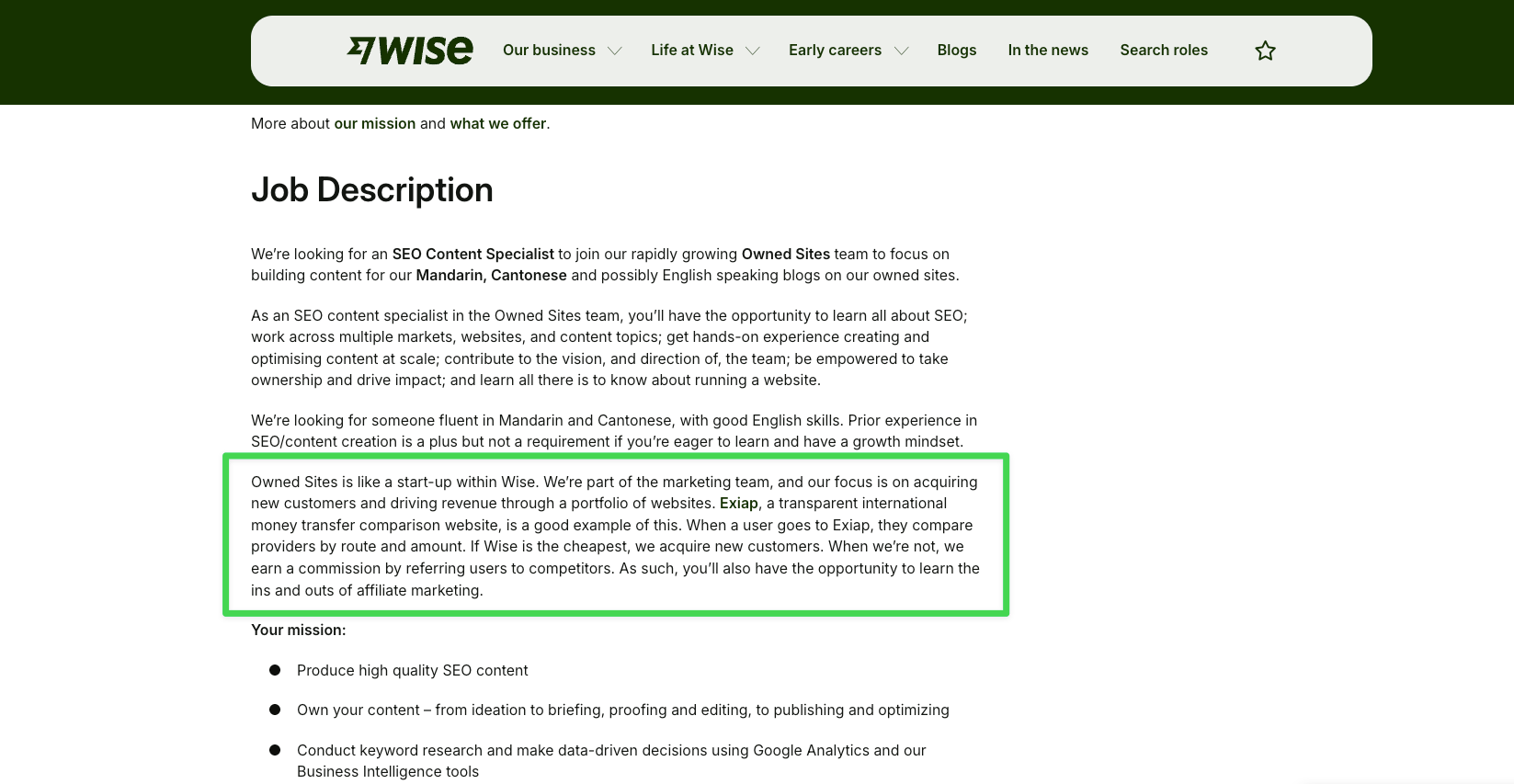 The strategy employed by Wise (formerly TransferWise) provides a fascinating case study. Through their job postings, they've explicitly stated they are building "a portfolio of websites" to capture more organic traffic. Their comparison site Exiap exemplifies this approach—serving as a seemingly independent money transfer comparison tool that either converts users directly or earns affiliate revenue from competitors when Wise isn't the cheapest option.
As detailed on Wisp Blog, this multi-site strategy ensures they control more of the conversation in their industry, dominating search results pages across various user intents.
Managing such a fleet of websites introduces significant technical complexity:
Cross-domain authority management
Sophisticated internal linking strategies across properties
Unified analytics and conversion tracking
Automated content distribution and updates
Careful canonicalization to avoid duplicate content issues
This is far from the traditional approach of optimizing a single website, requiring instead an engineering and data architecture mindset to execute effectively.
3. The Unfair Advantage: How Programmatic SEO is Winning Without Backlinks
Perhaps the most dramatic shift in recent years has been the rise of programmatic SEO (pSEO)—creating thousands or even millions of hyper-targeted pages that capture massive traffic by answering very specific user needs.
Wise's currency converter implementation represents a masterclass in this approach. According to Backlinko, their website has generated over 10 million pages that drive more than 100 million visits per month through programmatic SEO.
The most shocking aspect? Many of these pages rank well with few or zero traditional backlinks—a complete inversion of traditional SEO wisdom that prioritized link building above all else.
The secret to their success lies in precisely matching niche intent with content that perfectly answers specific queries. This approach requires:
Data infrastructure to maintain and update massive datasets
Templating systems that generate semantically rich content
Automated quality assurance to prevent thin content issues
Performance optimization to ensure fast page loads even with millions of URLs
Intelligent crawl management to help search engines discover and index content efficiently
These are fundamentally engineering challenges, not traditional marketing tasks. The companies winning with programmatic SEO are those with strong technical talent embedded in their SEO teams.
4. The Rise of AI Search: AEO, GEO, and the New "Fat Tail" of Queries
The introduction of AI assistants and generative search is fundamentally reshaping how users interact with search engines. This shift has given rise to new disciplines: Answer Engine Optimization (AEO) and Generative Engine Optimization (GEO).
With tools like ChatGPT, Bing Chat, and Google's AI Overview, informational queries are increasingly being handled directly in the search interface. According to a study from Workshop Digital, 80% of the keywords that trigger Google's AI overviews are informational in intent. Users ask the AI and get answers without ever clicking through to a website.
But this shift has created an unexpected phenomenon that savvy SEOs are already exploiting: the "fat tail" of queries.
When users interact with AI search tools, these systems often generate numerous sub-queries behind the scenes to retrieve information from the web. The Wisp Blog observed "near-identical, extremely long-tail queries appearing hundreds or thousands of times in a single month" in Search Console data, attributable to AI assistants searching on behalf of users.
These queries might be 10+ words long and hyper-specific. For example, instead of "best running shoes," an AI might search for "best lightweight running shoes for flat feet with pronation support under $150 for marathon training."
The opportunity here is significant. As the same source notes, "since these are often extremely long-tail phrases with limited competition, even sites with lower domain authority can win these positions." This means well-optimized content can rank even with minimal backlinks, provided it precisely addresses these niche AI-generated queries.
Capturing this "fat tail" distribution requires a technical, data-driven approach:
Analysis of AI-generated queries in server logs and Search Console
Content automation that can target thousands of variants
Schema markup to clearly signal relevance to specific attributes
Natural language processing to match content to query intent
5. The Gold Rush for Commercial Intent
With AI and search engines now answering many informational questions directly, commercial and transactional queries have become the prime real estate for SEO traffic.
ChatGPT might tell you what a product is or how it works, but it can't complete a purchase or provide a service—that's where businesses come in. A recent UX study published on Search Engine Land found that 69% of users in Google's AI Search mode still clicked through to a website when performing transactional searches.
In contrast, purely informational questions often result in zero-click answers. This suggests search engines "love" to send customers to businesses that exactly meet highly specific needs.
Long-tail, high-intent searches like "buy red running shoes size 9 ultra-light in Singapore" are where optimized pages can shine, while generic questions like "what are running shoe types" get absorbed by AI answers.
Capturing these high-intent queries often requires sophisticated technical implementation:
Creating targeted landing pages for countless attribute combinations
Implementing structured data to match query specifics
Ensuring e-commerce or lead-gen sites can handle complex search parameters
Building dynamic filtering systems that align with user intent patterns
The Talent Emergency: Demand for SEO Engineers is Exploding
The technological and strategic shifts described above have created an unprecedented demand for technical SEO talent—and a serious shortage in the market.
The Job Market Doesn't Lie
The numbers tell a clear story about the growing demand for technical SEO skills. According to the 2025 SEO Job Report published by SEOjobs.com, 75% of SEO job listings in late 2024 included "technical SEO" as a required skill—up from 71% just a quarter earlier. This was the fastest-growing skill requirement in the entire job market analysis.
However, this demand isn't yet fully reflected in job titles. Search Engine Journal reports that roles with explicit titles like "Technical SEO Manager" or "SEO Engineer" still make up only about 5.4% of SEO roles. This mismatch highlights a critical market inefficiency: companies want these skills but aren't yet structuring their teams around technical specialization.
A "Shocking" Scarcity: A View from the Trenches
Perhaps the most telling evidence of the talent shortage comes from those trying to hire technical SEO professionals right now.
Fabrizio Ballarini, Head of Organic Growth at Wise—one of the most technically advanced SEO operations in the world—recently shared a candid admission on LinkedIn. He expressed shock at how difficult it was proving to hire a Technical SEO Manager for his team:
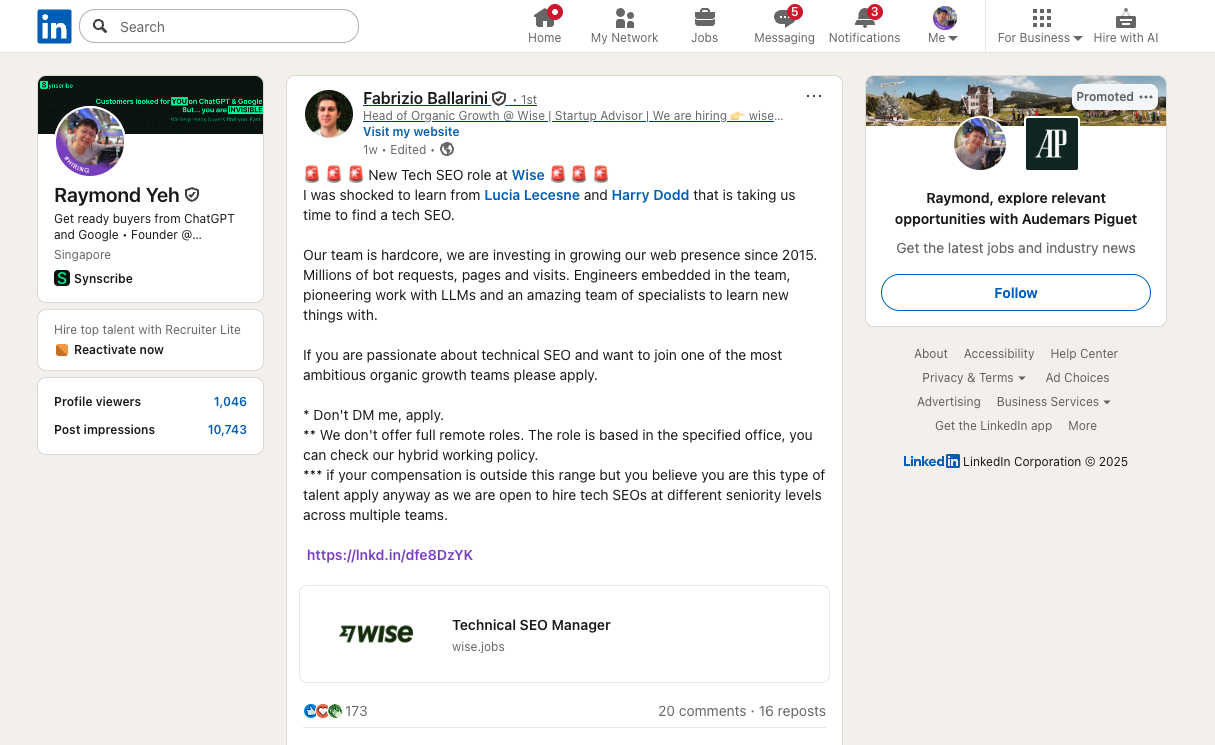 "I was shocked to learn... it is taking us time to find a tech SEO. Our team is hardcore... Engineers embedded in the team, pioneering work with LLMs... one of the most ambitious organic growth teams," he noted in his LinkedIn post.
This is particularly revealing: if a top-tier, technically advanced company like Wise—whose success in programmatic SEO is legendary—is struggling to hire, it signals a market-wide scarcity of qualified talent. The pool of individuals who blend deep SEO knowledge with engineering prowess is dangerously small.
The Bar is on the Floor (But Not for Long)
For too long, the bar for what constitutes "SEO expertise" has been set remarkably low. Many "SEO professionals" have built careers around:
Running automated audits through third-party tools
Creating PDF reports with recommendations they can't implement
Relying on developers to execute even basic technical changes
Following templated approaches to content optimization
This approach worked in a simpler era of search, but it's increasingly ineffective in today's complex landscape. Today's problems require a fundamentally different, hands-on technical skill set:
Debugging a React app's hydration issues that are preventing content from being indexed
Automating the generation of 100,000 pages with dynamic, relevant content
Analyzing server logs to optimize crawl budget and identify indexation problems
Implementing schema markup at scale across diverse content types
Building internal tools to measure and optimize Core Web Vitals
The impact of a true technical SEO is enormous. They don't just suggest changes; they implement solutions that can unlock massive traffic and revenue gains, justifying their premium in the market.

The Unfair Advantage: What an Engineering Mindset Brings to SEO
The fusion of engineering skills with SEO expertise creates capabilities that traditional SEOs simply cannot match. Here's what sets technical SEOs apart:
Build and Automate at Scale
Technical SEOs don't just identify opportunities—they build systems to capitalize on them:
Writing Python scripts to analyze log files and identify crawling inefficiencies
Creating automated workflows to generate schema markup across entire e-commerce catalogs
Building data pipelines that transform product information into optimized landing pages
Developing monitoring systems that alert teams to critical SEO issues in real-time
The ability to automate and scale is particularly crucial for programmatic SEO, where managing thousands or millions of pages manually is simply impossible.
Optimize Beyond the Obvious
While traditional SEOs focus on surface-level optimizations, technical SEOs can dive into the codebase to solve fundamental issues:
Implementing server-side rendering (SSR) for JavaScript-heavy pages
Optimizing API calls that are killing Core Web Vitals scores
Fine-tuning caching and CDN configurations for faster page loads
Building custom rendering solutions to ensure search engines can access dynamic content
Creating edge SEO solutions that modify server responses without changing application code
These optimizations often deliver dramatic improvements in rankings and user experience that content tweaks alone could never achieve.
Leverage Data and AI Intelligently
Technical SEOs bring sophisticated data analysis capabilities to the table:
Using SQL to query analytics databases for hidden patterns in user behavior
Building machine learning models to predict keyword trends or identify content gaps
Creating custom dashboards that blend data from multiple sources for deeper insights
Developing proprietary tools that leverage NLP to analyze content quality and relevance
Integrating with APIs (Google Search Console, NLP tools) to enrich analysis
As AI continues to influence search, the ability to experiment with these technologies—even building small applications or prompts to test how content might be "understood" by AI—becomes increasingly valuable.
Act as the Ultimate Bridge to Development
Perhaps the most underrated value of technical SEOs is their ability to bridge the traditional gap between marketing and development teams:
Speaking the language of developers and translating SEO requirements into technical specifications
Working directly in Git and submitting pull requests rather than handing off documents
Writing tickets that engineers understand and respect
Embedding SEO best practices directly into development workflows
Preventing costly SEO mistakes before they're deployed to production
This bridging function can dramatically accelerate implementation timelines and ensure SEO is built into products from the ground up, rather than bolted on as an afterthought.
Closing the Gap: How to Acquire Technical SEO Superpowers
With the demand for technical SEO talent far outstripping supply, organizations and individuals need strategies to close this critical skills gap.
For Companies & Leaders
Upskill and Cross-Train
Creating a culture of continuous learning is essential for organizations looking to build technical SEO capabilities:
Invest in teaching developers SEO principles through workshops and paired programming
Provide resources for SEO professionals to learn foundational coding (Python, JavaScript, SQL)
Create joint projects that bring together marketing and engineering teams
Establish mentorship programs where technical experts can guide SEO specialists
Many companies are finding that their best technical SEOs don't come from traditional marketing backgrounds at all—they're often developers or data scientists who develop an interest in search.
Hire a Specialist Anchor
Rather than trying to transform your entire team overnight, consider prioritizing the hire of one senior technical SEO who can act as a force multiplier:
Look for candidates with both marketing and software engineering experience
Seek out professionals with backgrounds in web development, data science, or programming
Value demonstration of technical skills (GitHub repositories, coding projects) over certifications
Be prepared to offer competitive compensation—the scarcity of skilled technical SEOs has driven salaries up significantly
This specialist can then mentor your existing team, set technical strategy, and bridge the gap with your development resources.
Partner with the Experts
For organizations that need immediate results, specialized agencies can provide a fast-track solution:
Look for agencies that emphasize technical expertise and engineering capabilities
Ask about their experience with programmatic SEO, headless CMS implementations, and modern web frameworks
Evaluate their team composition—do they employ actual engineers or just traditional SEOs?
For example, agencies like Synscribe are explicitly run by a team of full-stack AI engineers and growth experts who specialize in implementing advanced AEO and programmatic SEO strategies. By partnering with such specialized agencies, companies can leverage external expertise while building internal capabilities.
For SEO Professionals
Embrace Continuous Learning
For SEO professionals looking to future-proof their careers, the message is clear: learn to code.
Start with these foundational skills:
Python for data analysis, automation, and web scraping
JavaScript to understand modern web frameworks and rendering issues
SQL for advanced data analysis and working with large datasets
Git for version control and collaborating with development teams
API integration for building tools and connecting systems
Resources like freeCodeCamp, Codecademy, and GitHub Copilot make it easier than ever to learn these skills, even for those without formal technical backgrounds.
The Future of SEO is Engineered
The rise of the SEO Engineer is not a temporary fad but a permanent evolution. SEO is now a deeply technical, multidisciplinary practice that sits at the intersection of marketing, engineering, and data science.
The playing field is tilting, and fast. Businesses that fail to invest in technical SEO talent will see their organic growth stagnate as they are outmaneuvered by more agile, technically proficient competitors. The old playbook of "content and links" is no longer enough in an era of AI-driven search, complex web architectures, and programmatic content generation.
For CMOs, founders, and growth leaders, the directive is clear: make hiring or developing technical SEO talent a mission-critical priority. Instill an engineering mindset within your growth function. The organizations that successfully merge marketing vision with engineering execution will own the future of search.
Technical SEO is no longer a "nice to have"; it is the essential foundation for sustainable organic growth in today's digital landscape. The companies that recognize this reality and act decisively to acquire the necessary talent and capabilities will find themselves with an unfair advantage in the battle for organic visibility—an advantage that will only grow as search continues its technical evolution.
Key Takeaways for Different Stakeholders
For CMOs and Marketing Leaders
Strategic Priority: Elevate technical SEO from a tactical concern to a strategic imperative. The technical foundation of your web presence now directly determines your organic growth ceiling.
Budget Allocation: Expect to invest more in technical SEO talent and tools. The ROI on these investments will likely exceed traditional marketing channels as organic search becomes more technically complex.
Team Structure: Consider creating dedicated technical SEO roles or even small engineering teams that report into the marketing organization. The most effective structure often places these technical specialists at the intersection of marketing and IT.
KPI Evolution: Update your performance metrics to include technical health indicators alongside traditional traffic and conversion metrics. Core Web Vitals, indexation rates, and rendering performance should be on your dashboard.
For SEO Professionals
Career Trajectory: The career ceiling for purely non-technical SEOs is lowering. To advance to senior roles and command premium salaries, technical skills are becoming non-negotiable.
Specialization Opportunities: Consider developing deep expertise in specific technical areas like JavaScript SEO, programmatic content generation, or performance optimization. Specialists with niche technical skills are in particularly high demand.
Salary Expectations: Technical SEO specialists can expect significantly higher compensation than their non-technical counterparts. According to industry salary surveys, the premium can be 30-50% or more for those with proven engineering capabilities.
Job Security: As AI tools increasingly automate basic SEO tasks, those with technical skills will be better positioned to adapt, using AI as a force multiplier rather than seeing it as a replacement threat.
For Developers and Engineers
New Career Paths: Web developers and software engineers interested in growth and marketing now have a clear career path into technical SEO—a field where their existing skills are in high demand and often command premium compensation.
Skill Transferability: Many core engineering skills (performance optimization, automation, data analysis) transfer directly to technical SEO challenges. The learning curve often focuses more on search engine mechanics than on developing new technical abilities.
Impact Visibility: Technical SEO often provides more direct visibility into business impact than traditional development roles. Engineers can directly connect their work to traffic increases, conversion improvements, and revenue growth.
Final Thoughts: Act Now to Secure Your Advantage
The technical transformation of SEO represents both a challenge and an opportunity. For organizations and individuals willing to invest in developing these capabilities, the rewards are substantial: higher rankings, more traffic, better conversion rates, and a sustainable competitive advantage.
Those who hesitate, clinging to outdated notions of SEO as a primarily content-driven discipline, risk finding themselves outmaneuvered by more technically adept competitors. The gap between the technically proficient and the technically deficient is widening each day.
The question isn't whether technical expertise will be central to SEO success—that future has already arrived. The real question is whether you and your organization will be leaders or laggards in this new reality.
The rise of technical SEO roles like SEO Engineers and Technical SEO Managers isn't just a hiring trend—it's a fundamental reshaping of what it means to excel in search. Those who recognize this shift early and act decisively to secure technical talent will find themselves with an increasingly powerful advantage in the years to come.
Frequently Asked Questions
What is a Technical SEO Engineer?
A Technical SEO Engineer is a professional who combines deep knowledge of search engine optimization with software engineering and data analysis skills. Unlike traditional SEOs who focus primarily on content and link-building, a Technical SEO Engineer can dive into a website's codebase to solve complex issues related to crawling, indexing, rendering, and performance. They build automated systems, analyze large datasets, and work directly with development teams to implement solutions, making them essential for competing in the modern web environment.
Why has technical SEO suddenly become so important?
Technical SEO has become critically important due to a convergence of five key forces: the shift to complex web frameworks, the rise of AI-driven search, the use of multi-site portfolio strategies, the effectiveness of programmatic SEO, and the increased value of commercial-intent queries. These forces mean that traditional SEO tactics are no longer sufficient. Winning in search now requires optimizing for JavaScript rendering, managing millions of pages programmatically, and structuring data for AI assistants—all of which are fundamentally engineering challenges.
What is programmatic SEO and why is it effective?
Programmatic SEO (pSEO) is the practice of creating thousands or millions of targeted landing pages at scale by using data and templates. It's effective because it allows a site to capture massive amounts of long-tail search traffic by precisely matching hyper-specific user queries. For example, a travel site could programmatically create a page for every possible flight route. This strategy relies heavily on engineering to manage the data, generate the pages, and ensure technical quality and performance across the entire set.
What technical skills should an SEO learn first?
An SEO professional looking to build technical skills should start by learning Python, JavaScript, and SQL. Python is invaluable for data analysis and automating tasks. JavaScript is essential for understanding and debugging modern websites built on frameworks like React or Next.js. SQL allows you to query large databases for deeper analytics insights. Mastering these provides a strong foundation for tackling most modern technical SEO challenges.
How can a company hire a technical SEO in a competitive market?
To hire a technical SEO, companies should look for candidates with hybrid experience in development and marketing, offer competitive compensation, and consider upskilling existing developers who show an interest in organic growth. The talent pool is scarce, as highlighted by even top companies like Wise struggling to hire. Broaden your search beyond traditional marketers. Look for developers with a passion for product growth or data scientists interested in search. Alternatively, invest in a senior "anchor" hire who can then train and mentor your existing team, or partner with a specialized technical SEO agency.
Does the rise of technical SEO mean content and backlinks are no longer important?
No, content and backlinks remain crucial components of a successful SEO strategy, but their context has changed. Excellent technical SEO creates the foundation that allows great content to be discovered and ranked. Programmatic SEO, for instance, still relies on creating high-quality, templated content that serves user intent. Backlinks still signal authority. However, technical excellence can act as a massive force multiplier, allowing well-structured sites to rank for thousands of long-tail keywords even with fewer backlinks than established competitors.
How is AI search changing the skills required for SEO?
AI search (Answer Engine Optimization and Generative Engine Optimization) shifts the focus from ranking on a simple results page to providing structured, machine-readable information that AI assistants can use to generate answers. This requires a technical approach, including implementing robust schema markup, analyzing AI-generated long-tail queries found in server logs, and creating content that directly and precisely answers hyper-specific questions. Professionals now need the skills to optimize for consumption by algorithms, not just human readers.
Can my business still succeed with a traditional WordPress site?
Yes, a business can still succeed with a well-optimized WordPress site, but the technical bar for success is rising across all platforms. While the article highlights the move to headless frameworks, the underlying principles of performance, crawlability, and structured data are universal. Even on WordPress, technical SEO is crucial for optimizing Core Web Vitals, managing plugins that can slow down your site, and implementing schema correctly. The key takeaway is not that WordPress is obsolete, but that the "set it and forget it" plugin-based approach to SEO is no longer competitive.
Dominate ChatGPT and Google Search
Synscribe helps B2B companies with SEO & GEO using programmatic SEO approach. Book a call to find out how we help you win.