Link Building for SEO: How Long Until Results & Early Signs of Success (Updated 2026)
Summary
Link building is a long-term strategy, typically taking 3-12 months to show significant results in rankings and traffic.
Prioritize high-quality backlinks from relevant, authoritative sites over quantity, as a single great link is more valuable than hundreds of poor ones.
The safest and most effective strategies involve creating exceptional content that naturally attracts links and conducting manual outreach for guest posting and digital PR placements.
Synscribe's AI-powered link building platform accelerates this process by securing white-hat backlinks at scale through strategic, data-driven outreach.
You've invested in link building for your SEO strategy, but when should you expect to see actual results? This comprehensive guide examines the timeline for link building success, backed by recent data and expert insights.
Link building remains one of the most powerful yet misunderstood aspects of SEO. As the founder of Synscribe, a programmatic SEO agency specializing in automated content and link building solutions, I've seen firsthand how proper backlink strategies can transform organic traffic - but also how impatience and unrealistic expectations can derail otherwise promising campaigns.
In this research-backed guide, we'll explore:
The realistic timeline for seeing measurable results from link building
Early indicators that your link building is working (before rankings improve)
What separates high-quality backlinks from toxic ones that can harm your site
The spectrum of link building methods from white hat to black hat
What you should expect to pay for effective link building services
Let's dive into what the data shows about link building timelines and set proper expectations for your SEO investments.
The Million-Dollar Question: How Long Does Link Building Take to Show Results?
If you're hoping for an overnight SEO miracle from your backlink campaign, I have some sobering news. Link building is fundamentally a long-term strategy, not a quick fix.
According to industry research, more than half of SEO professionals state it takes 3 to 12 months to see noticeable improvements in rankings and organic traffic after gaining new backlinks. A 2025 survey of 113 SEO experts provides additional nuance:
42.5% saw some impact within 2-4 weeks
37.2% reported seeing effects around the 6-week mark
15% admitted they saw no meaningful impact from certain link efforts
While you might detect small changes within a month or two, truly significant results are commonly realized around the 4 to 12 month mark.
Why Is There Such Variability in the Timeline?
Several critical factors influence how quickly backlinks translate into improved rankings:
1. Crawl and Indexing Time
Before a backlink can have any effect, search engines need to discover and process it. This indexing phase alone can take days or weeks. Links from high-quality, frequently crawled websites get indexed faster, accelerating their impact.
2. Your Website's Starting Point
Established sites with existing domain authority typically see quicker boosts from new links than brand-new sites. If you're starting from scratch, expect a longer runway before seeing significant movement.
3. Competitive Landscape
In highly competitive niches, you'll need more high-quality backlinks over a longer period to move the needle. A handful of links might quickly boost rankings in a low-competition space, while the same links would barely register in a cutthroat industry.
4. Algorithm Fluctuations
Google's constant algorithm updates introduce variability into the equation. What works quickly one month might take longer the next due to changes in how links are evaluated.
The takeaway? Patience is crucial.
Plan for at least 2-3 months before making any evaluation of your link building campaign, and 6-12 months to see substantial improvements. Remember that backlinks are a long-term investment in your site's authority, not an overnight fix.
Early Indicators Your Link Building Is Working (Before Rankings Improve)
While major ranking improvements take time, several promising signals can validate your link building strategy long before you reach page one:
1. Increased Referral Traffic
When you secure a backlink on a popular, relevant site, you may notice a short-term increase in referral traffic from that source. This happens before any change in search rankings and indicates your link is placed on a page with real readership and engagement.
This direct traffic is both an early success indicator and a bonus benefit of quality link building beyond SEO value.
2. More Frequent Google Crawling
Authoritative backlinks can signal to Google that your site is worth crawling more often. If you notice Googlebot visiting your site with increasing frequency (check Google Search Console's "Crawl Stats" report), it's a sign that Google recognizes your updated link profile and is paying closer attention to your site.
This increased crawler attention often precedes ranking improvements.
3. Minor Ranking or Impression Improvements
Watch for subtle upward movements in Google Search Console data. Early signs might include:
A target keyword moving from page 5 to page 3
Increasing impression counts for specific pages
Rankings improving for long-tail variations of your target keywords
These small shifts are preliminary signals that often precede larger ranking jumps down the road.
4. Boost in Brand Mentions and Visibility
Quality backlinks frequently come from content features or mentions, which increase brand awareness. This wider exposure can lead to more unlinked brand mentions or social media discussions about your company.
As one SEO expert notes, these early indicators "could lead to future ranking improvements" even if they don't immediately translate to higher positions.
Monitoring these metrics provides crucial feedback during the waiting period. They help justify continued investment while the larger SEO payoff develops and confirm your link building is on the right track.
The Anatomy of a High-Value Backlink: Quality Over Quantity
Not all backlinks are created equal. A single great link can be more valuable than hundreds of poor ones. But what exactly makes a backlink "good"?
A high-quality backlink is one that comes from a relevant, authoritative website in your niche, is typically a follow link, and is placed naturally within the content rather than being forced or sponsored.
Characteristics of Good Backlinks:
Relevance: Context Is King
The linking page and site should be topically related to yours. A link from a site in your industry carries more weight than one from an unrelated source.
This relevance factor is so important that 84.6% of SEO experts consider link relevance a top indicator of quality - even more important than raw domain authority metrics.
Authority and Trustworthiness
Links from sites with high Domain Authority/Rating and their own strong backlink profiles pass more significant value. A link from an industry leader or trusted publication acts as a potent vote of confidence in Google's eyes.
Google evaluates both the domain's overall authority and the specific page's authority when determining how much weight to give a backlink.
Natural Anchor Text and Placement
The clickable text of the link (anchor text) should be natural and descriptive - often using your brand name, a descriptive phrase, or a relevant term. Over-optimized anchors stuffed with exact-match keywords can trigger spam filters.
Ideal placement is within the main body content, surrounded by contextually related text. Links in footers, sidebars, or template areas carry less weight.
Unique Referring Domains
Earning links from a variety of different websites is more valuable than many links from the same site. Research consistently shows that the number of referring domains strongly correlates with higher rankings.
Each new linking domain represents a fresh vote of confidence in your content.
Genuine Traffic and Engagement
A link from a page that gets real organic traffic is doubly valuable—it passes SEO value and can send qualified referral visitors. Google increasingly factors user engagement signals into its algorithm, making links from actively visited pages more powerful.
The goal should be acquiring editorially earned links from sites you would be proud to be associated with. Focus on quality to build a robust and sustainable backlink profile.
The Dark Side: Can Bad Backlinks Hurt Your SEO?
Yes, "bad" or toxic backlinks can harm your site's rankings, reputation, and growth potential. While good backlinks boost your authority, toxic ones can do the opposite - undermining your SEO efforts and potentially triggering penalties.
How Bad Backlinks Cause Harm
Google's algorithms, particularly updates like Penguin, are specifically designed to detect unnatural link patterns. When Google identifies suspicious backlinks pointing to your site, several things can happen:
Algorithmic Devaluation: Google may simply ignore the suspicious links or reduce trust in your entire site
Manual Penalty: In severe cases, a human reviewer may apply a manual penalty that can dramatically reduce your traffic
As one SEO expert puts it, bad backlinks "can strangle your site's growth, making it difficult to achieve and maintain high rankings."
Common Types of Bad Backlinks
Link Farms & Private Blog Networks (PBNs)
These are websites created solely to sell links, with no real audience or value. They often have poor content, multiple outbound links on every page, and exist purely to manipulate rankings. Google actively hunts down and penalizes these networks.
Irrelevant & Low-Authority Sites
Links from websites completely unrelated to your industry or with extremely low credibility offer little value and can raise red flags. For example, a random coupon directory linking to your B2B software site would be considered irrelevant and potentially harmful.
Over-Optimized Anchor Text
An unnatural pattern of exact-match keyword anchors is a major red flag for Google. Natural link profiles have varied anchors (brand names, URLs, generic terms), while manipulative ones often stuff commercial keywords into every link.
Undisclosed Paid Links
Buying links that pass PageRank without proper disclosure (using rel="nofollow" or rel="sponsored" attributes) violates Google's guidelines. Many cheap link sellers provide placements on spammy blogs that will eventually be identified and penalized.
The Negative SEO Question
Many clients ask: "Can competitors hurt me with bad links?" Google's official stance is that it tries to ignore most spam rather than penalize sites that receive it. This is designed to prevent malicious "negative SEO" attacks.
However, webmasters have reported ranking drops correlated with spam attacks, particularly for newer sites with less established authority. A flood of toxic links can pose a genuine risk, especially if they appear manipulative.
What to Do About Bad Links
Monitor your backlink profile regularly using tools like Ahrefs, Semrush, or Google Search Console
Identify potentially harmful links that match the criteria above
Try to get toxic links removed by contacting webmasters
Use Google's Disavow Tool as a last resort to tell Google which links to ignore
As one expert advises: "Google has improved at detecting spam, but if it's clearly spam or a black hat attack, I would disavow the links. The last thing you want is to be doing well and have your site tank because someone's trying to outrank you."
Prevention is always the best approach. Avoid risky tactics, but also be prepared to monitor and clean up your backlink profile by disavowing toxic links if necessary.
How Links are Built: White Hat, Gray Hat, and Black Hat Methods
The method used to acquire backlinks is critical to their long-term value and risk profile. Let's examine the spectrum from ethical to manipulative link building approaches:
White Hat Link Building (The Recommended Approach)
White hat strategies align with search engine guidelines and focus on earning links through merit and relationships. These methods build sustainable value and carry minimal risk.
Content Marketing & Linkable Assets
Creating high-quality content (reports, tools, guides, research) that naturally attracts links remains the most powerful white hat approach. In fact, marketers consistently rate content marketing as the most effective method for earning quality backlinks.
This strategy involves:
Creating exceptional, unique content that provides genuine value
Promoting that content to relevant audiences
Earning links organically as others reference your work
Guest Posting & Manual Outreach
Writing articles for relevant industry blogs provides value to their audience in exchange for a backlink. This widely used tactic involves:
Identifying quality sites in your niche
Pitching relevant, valuable content ideas
Creating unique content specifically for that publication
Receiving a contextual link within the content or author bio
When done properly (not mass-produced with thin content), guest posting remains a cornerstone of ethical link building.
Resource & Broken Link Building
These strategic outreach methods involve:
Finding resource pages or guides in your industry
Offering your content as a valuable addition
Or identifying broken links and suggesting your content as a replacement
Since you're helping the site owner improve their content, they're more likely to add your link.
Digital PR & Partnerships
Earning high-authority editorial links through newsworthy stories, unique data, and industry collaborations can generate powerful backlinks. This approach focuses on creating genuinely interesting content that journalists and bloggers want to reference.
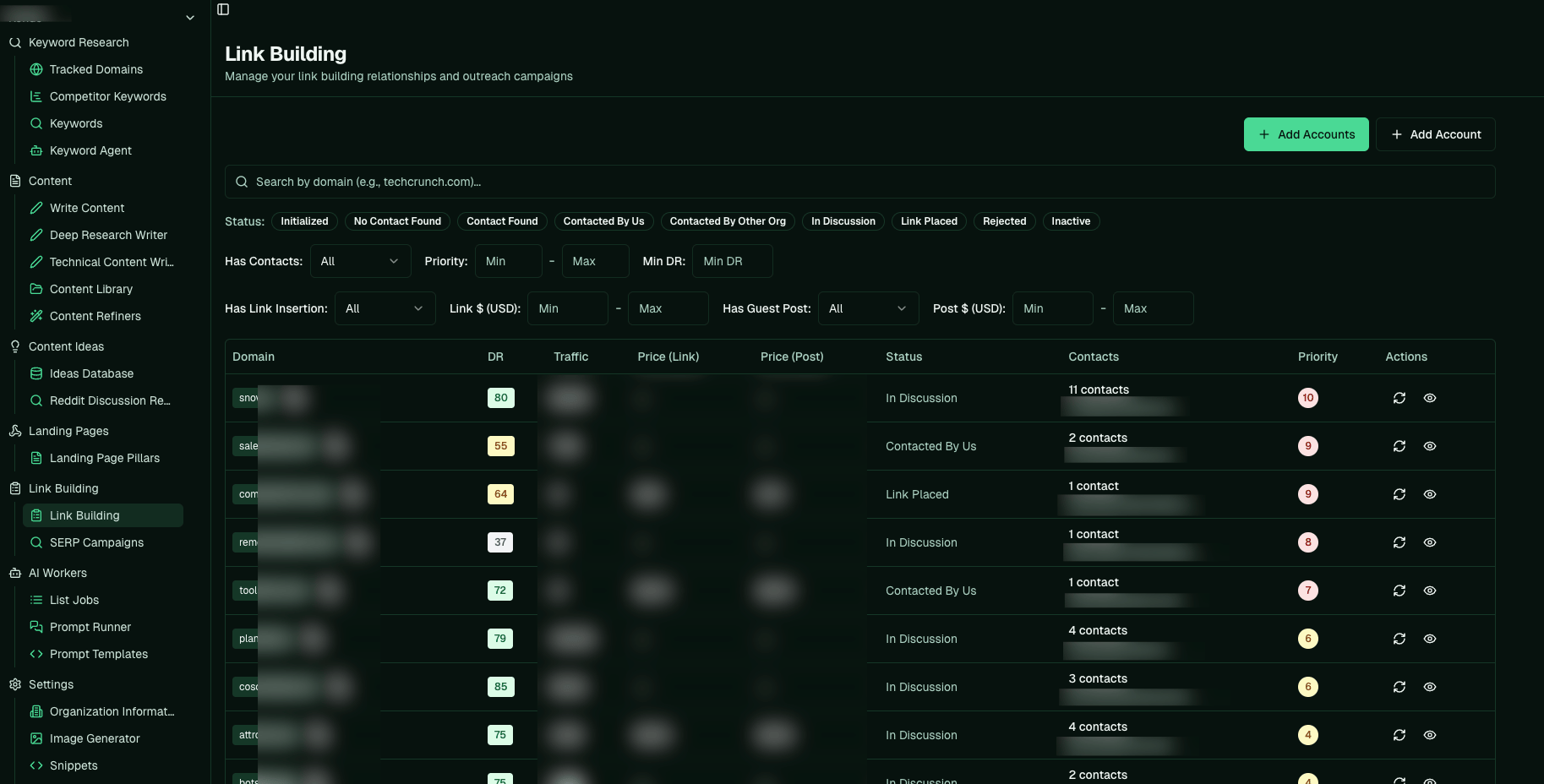 At Synscribe, our semi-automated outreach platform helps clients secure white-hat backlinks at scale by identifying relevant sites and streamlining partnership outreach. Our engineered approach combines software efficiency with the human touch required for quality placements, helping businesses build relationships that lead to natural, editorial links.
Black Hat Link Building (The Risky Approach)
Black hat tactics violate Google's guidelines and can lead to severe penalties. These manipulative methods might yield short-term gains but pose significant long-term risks.
Private Blog Networks (PBNs)
PBNs are networks of websites controlled by a single entity, created solely to link to "money sites" and artificially boost their rankings. Google actively hunts down these networks, and sites relying on them eventually see traffic plummet when they're discovered.
Paid Link Schemes
Buying links from link farms or sites that exist only to sell links violates Google's guidelines. These sites often have minimal content, low traffic, and multiple outbound links on every page.
Automated Link Spam
Using bots to spam links in comments, forums, and user-generated content areas is an outdated black hat tactic. These links are now virtually useless for SEO and can get your domain flagged as spammy.
Hacked Links & Cloaking
The most egregious black hat tactics involve hacking legitimate sites to insert backlinks or using cloaking techniques to hide content from users while showing it to search engines. These methods can lead to immediate de-indexing if discovered.
Gray Hat Link Building (The Middle Ground)
Gray hat methods exist in a murky middle ground - not entirely following guidelines but not as blatantly manipulative as black hat.
Examples include:
Paying for guest post placement on quality blogs without disclosure
Using incentives to encourage links
Reciprocal link arrangements at scale
While these methods may fly under the radar if done carefully, they still carry risk and are not recommended for businesses with long-term SEO goals.
The risk of black hat is simply not worth the potential short-term gain, especially as Google's detection capabilities continue to improve. Stick to white hat methods for safe, effective, and lasting results.
Budgeting for Success: How Much Do Link Building Services Really Cost?
Link building is an investment, and understanding the costs involved helps you budget effectively and avoid unrealistic expectations. Quality comes at a price, but that investment can yield significant returns when done right.
Per-Link Pricing Model
Many services charge on a per-link basis, with costs varying based on quality metrics:
Typical Range: ~$100 on the low end to $1,500+ for premium sites
Standard Quality: A "typical" quality backlink costs around $150-$350
High-Authority Links: Editorially placed links on authoritative sites often cost upwards of $300 each and can climb much higher
The higher the domain authority, traffic, and relevance of the linking site, the more expensive the placement typically becomes.
Monthly Campaign Pricing Model
Many agencies offer monthly retainers that include strategy, outreach, content creation, and a certain number of links:
38% of businesses spend $1,000-$5,000 per month
~34% spend under $1,000
~20% allocate $5,000-$10,000 per month
7% spend over $15,000 monthly
Full-service agencies might charge $10,000 to $15,000 per month for a robust campaign that includes comprehensive strategy, outreach, and content creation alongside link acquisition.
What You're Paying For
The cost of link building covers much more than just the link itself:
Prospect research and qualification
Content creation and pitching
Outreach labor and relationship building
Negotiation and placement
Reporting and analytics
This explains why quality link building isn't cheap - it's a labor-intensive process that requires skilled professionals.
Warning: Be extremely cautious of services offering very cheap links (e.g., $50/link), as they likely use low-quality or potentially harmful methods. In link building, you truly get what you pay for.
Additional Costs to Consider
When budgeting for link building, also factor in:
Setup and strategy fees
Content creation costs
Potential fees for "expedited" placements
Link maintenance (replacing lost or broken links)
A serious link building campaign typically requires a meaningful investment of at least a few thousand dollars per month. When vetting providers, look for transparency, case studies, and a focus on manual outreach rather than promises of impossibly cheap links.
Beyond Backlinks: A Holistic Approach to Driving Organic Traffic
While link building is powerful, it's not the only way to grow organic traffic. A balanced strategy integrates multiple approaches for optimal results.
The Primacy of Content
Content quality and on-page optimization are often considered the top SEO factors, with backlinks ranking third in importance. High-quality content can attract traffic on its own, especially for long-tail queries with less competition.
Great content is also a prerequisite for effective link building - you need something worth linking to. In fact, 77% of marketers create long-form content specifically to earn backlinks, recognizing that comprehensive resources naturally attract more references.
The Power of Programmatic SEO
Programmatic SEO (pSEO) is a content-driven strategy that involves generating pages at scale to target specific keyword variations, such as geographic or service-based terms.
At Synscribe, our programmatic SEO agency specializes in AEO (Answer Engine Optimization) and GEO targeting. This approach can rapidly grow organic traffic by scaling up relevant content, often delivering results without heavy link building upfront. By creating targeted content at scale, businesses can capture search visibility across hundreds or thousands of related queries simultaneously.
Technical & On-Page SEO Foundations
Site speed, mobile usability, proper title tags, and strong internal linking create the technical foundation upon which both content and backlinks can build. These optimizations are fully within your control and can yield faster results than external link building.
A successful strategy integrates all three elements: content creates the foundation, technical SEO ensures the site is sound, and link building amplifies authority and visibility.
Conclusion: The Long-Term Value of Strategic Link Building
Link building is a long-term investment in your website's authority and credibility. While it typically takes 3-12 months to show significant results, the benefits compound over time and create lasting value.
Key Takeaways:
Timeline Expectations: Prepare for a 3-12 month horizon, with early indicators appearing within 4-6 weeks
Quality Indicators: Focus on relevance, authority, natural placement, and referring domain diversity
Risk Management: Avoid toxic links and black hat methods that can harm long-term performance
Budget Realistically: Quality link building requires meaningful investment, typically a few thousand dollars monthly
Holistic Approach: Combine link building with strong content and technical foundations
Link building works best when amplifying great content. It's not a standalone solution but rather part of an integrated SEO strategy.
At Synscribe, our engineer-led team pairs robust content strategies (like programmatic SEO) with our data-driven, white-hat outreach platform to build authoritative backlink profiles for clients. This synthesis of content scale and strategic link building has proven particularly effective for businesses looking to grow organic traffic predictably and sustainably.
Strategic link building builds not just rankings, but a brand's digital authority and credibility over time. That is the real, lasting ROI that makes the patience and investment worthwhile.

Frequently Asked Questions
How long does it really take to see results from link building?
It typically takes 3 to 12 months to see significant results from a link building campaign. While you may notice early indicators like increased referral traffic or minor ranking shifts within 4-6 weeks, substantial improvements in organic search rankings and traffic are a long-term outcome that requires patience.
What makes a backlink "high-quality"?
A high-quality backlink comes from a website that is topically relevant to yours, has strong authority and trustworthiness, and is placed naturally within the content. Key characteristics include relevance to your niche, high Domain Authority (DA), natural anchor text, and placement on a page that receives real user traffic. A single link from an authoritative source is far more valuable than many links from low-quality sites.
Can bad backlinks hurt my website's SEO?
Yes, bad or "toxic" backlinks can definitely harm your website's SEO performance. Low-quality links from spammy sites, link farms, or irrelevant sources can lead to algorithmic devaluation by Google or even a manual penalty. This can suppress your rankings and undermine the progress made from good links, making it crucial to monitor your backlink profile.
Is it better to have more backlinks or higher quality backlinks?
It is always better to prioritize higher quality backlinks over a large quantity of low-quality ones. SEO success is driven by quality, not quantity. One editorially earned link from a highly respected site in your industry can have more positive impact than hundreds of spammy links. The goal should be to build a diverse portfolio of links from various authoritative and relevant domains.
How much should I budget for link building per month?
A common monthly budget for professional link building services ranges from $1,000 to $5,000, though this can vary significantly. Costs depend on your industry's competitiveness and the quality of links you aim to acquire. Be wary of very cheap services, as they often use risky, low-quality tactics that can do more harm than good.
What is the safest and most effective link building strategy?
The safest and most effective link building strategy is "white hat" SEO, which focuses on earning links naturally through high-quality content and manual outreach. This includes tactics like creating valuable "linkable assets" (e.g., original research, free tools), guest posting on reputable industry blogs, and digital PR. These methods align with Google's guidelines and build sustainable authority.
Sources
Vazoola, How Long Does It Take For Link Building To Help with Google Rankings?
Editorial.link, How Long Does It Take for Backlinks to Work?
Cougar Digital Marketing, How Long Does SEO Actually Take to Work? (2025 Reality Check)
Adam Connell, 28 Link Building Statistics For 2025: Improve Your SEO Strategy
Backlinko, Toxic Backlinks: How to Spot and Avoid Them
Contactora, Black Hat Link Building: A Comprehensive Guide for 2024
My Profit Engine, Link Building Pricing: How Much Does It Cost in 2024
Editorial.link, Black Hat Link Building: 7 Dodgy Techniques To Avoid in 2026
Dominate ChatGPT and Google Search
Synscribe helps B2B companies with SEO & GEO using programmatic SEO approach. Book a call to find out how we help you win.