Google UCP: What it Means for E-commerce and How Online Retailers Can Level Up on GEO
Summary
Google's new Universal Commerce Protocol (UCP) allows AI assistants to handle purchases directly, shifting e-commerce from traditional SEO to Generative Engine Optimization (GEO).
The most critical action for retailers is to enrich product data with structured details and schema markup, as this information directly fuels AI recommendations.
Retailers who adapt quickly by adopting UCP and a GEO strategy will gain a significant advantage in the new era of "agentic commerce."
Navigating this shift requires expertise in GEO. Synscribe helps businesses optimize their content and data strategies to drive sales through new AI-powered search and shopping experiences.
The e-commerce landscape is experiencing a fundamental shift with Google's recent introduction of the Universal Commerce Protocol (UCP). This isn't just another technical update—it's a paradigm change that transforms how consumers discover and purchase products online, moving from traditional search to AI-guided shopping experiences.
You've built your e-commerce business with careful attention to SEO, user experience, and conversion optimization. Now, Google is changing the rules of the game. With UCP, shoppers can complete purchases directly through AI interfaces like Google's Search AI Mode or Gemini without ever visiting your website.
As an online retailer, you're likely wondering: Is this a threat or an opportunity? Will this new protocol diminish your brand experience or expand your reach? Most importantly, how do you adapt your strategy to thrive in this new "agentic commerce" era?
This comprehensive guide will demystify Google's Universal Commerce Protocol, introduce you to Generative Engine Optimization (GEO), and provide actionable steps to future-proof your e-commerce business.
What is Google's Universal Commerce Protocol (UCP)?
Google's Universal Commerce Protocol (UCP) is an open standard designed to establish a "shared language" between AI shopping agents and commerce systems. Co-developed by Google with major players like Shopify, Etsy, Wayfair, Target, and Walmart—and endorsed by over 20 other companies in retail and payments—UCP enables a seamless connection between AI assistants and online stores.
Think of UCP as the translator that allows an AI assistant (like Google's Gemini) to:
Search and understand your product catalog
Answer customer questions about your products
Add items to a cart
Process shipping and payment information
Complete the entire purchase without the customer ever leaving the AI chat interface
The core innovation is that UCP standardizes these interactions, creating one common protocol that works across different AI platforms and e-commerce systems. As Google puts it, UCP's end goal is turning "AI interactions into instant sales" by eliminating friction in the purchase process.
How UCP works in practice
When a shopper asks Google's AI something like "I need waterproof hiking boots for under $150," the AI can now:
Search for relevant products across UCP-enabled retailers
Present options with detailed information
Answer follow-up questions about features, materials, or warranties
Process the purchase using saved payment information when the customer decides to buy
All of this happens within the AI interface, creating a dramatically streamlined shopping experience. The customer gets instant gratification, and you potentially gain a sale that might have otherwise been lost to a lengthy checkout process.
Is UCP just a passing fad?
UCP represents a serious, long-term shift in e-commerce, not a temporary trend. Several factors support this conclusion:
Industry momentum: The protocol has heavyweight support from both technology leaders (Google) and commerce platforms (Shopify). There's even a parallel effort from OpenAI (in partnership with Stripe) called the Agentic Commerce Protocol (ACP), indicating that multiple major players see AI-driven commerce as the future.
Consumer behavior trends: Shoppers are increasingly embracing conversational and AI-assisted shopping. Google reported a 693%+ surge in traffic to seller sites from generative AI during the last holiday season. Google believes "agentic shopping is inevitable"—meaning AI chat interfaces will become a common entry point for e-commerce.
Solving real problems: From a technical perspective, UCP addresses the unsustainable N×N integration problem), where businesses would otherwise need to build custom APIs for each AI platform. This fundamental improvement to commerce infrastructure suggests staying power.
Ongoing development & roadmap: UCP is open-source with an active development roadmap that includes multi-item carts, loyalty program integration, and support for new verticals beyond retail.
UCP isn't just a feature—it's a foundation for the future of e-commerce where AI assistants become the primary shopping interface for many consumers.
Will I Lose My Brand Identity with UCP?
This is a valid concern for most retailers. After all, you've invested heavily in your website design, content marketing, and unique shopping experience. The good news is that UCP is designed to keep merchants in control of their brand, data, and customer relationships—at least in principle.
Under UCP, you remain the Merchant of Record for all transactions, even if the checkout happens on a Google surface. This means:
The sale is officially your sale, not Google's
You retain the customer data from transactions
You own the customer relationship and can access their information (subject to privacy policies)
Google explicitly states that merchants "keep all of your customer data and relationships" when using UCP. Additionally, UCP provides flexibility to customize the integration according to your needs:
Embedded Checkout: For retailers with highly branded or complex checkout flows, there's an option to embed your own checkout page within Google's interface using an iframe.
Business Agent: Google's new Business Agent feature allows you to create a branded AI chat assistant in Search that speaks in your brand's voice, trained on your own data.
However, there are tradeoffs to consider. Some aspects of the shopping experience will inevitably shift away from your website to Google's AI interface. This means:
Customers won't experience your full website design, rich content, or cross-sell modules in the AI chat UI
Brand storytelling may be "compressed" into the product data that feeds Google's system
Customers might bypass your carefully crafted homepage, navigation, and content entirely—jumping from discovery directly to checkout
The impact of these tradeoffs depends on your business model. If you compete primarily on price and convenience, UCP's streamlined checkout might be ideal. However, brands that rely on high-touch experiences and upselling may feel a loss of opportunity.
One way to mitigate this is by ensuring your product data and feed are exceptionally rich and accurate—include compelling descriptions, FAQs, and all relevant information so the AI has quality material to represent your products.
What is Generative Engine Optimization (GEO)?
Generative Engine Optimization (GEO) is the evolution of SEO for AI-driven search and shopping experiences. While traditional SEO focuses on ranking in a list of blue links for human searchers, GEO is about optimizing your digital presence for AI assistants that answer questions and make recommendations in conversational formats.
In an AI-driven shopping context, the AI might not simply show a link to your site—it might verbally describe your product and facilitate the transaction. GEO focuses on how AI models "understand" and present your information, shifting from keyword-centric strategies to an intent-based, data-rich approach.
How GEO differs from traditional SEO
Traditional SEO | Generative Engine Optimization (GEO) |
|---|---|
Optimizes for keyword rankings | Optimizes for conversation and intent |
Focuses on driving website traffic | Focuses on driving conversions directly in AI |
Values backlinks and authority | Values structured data and information accuracy |
Aims for visibility in search results | Aims for inclusion in AI-generated answers |
Measures clicks and traffic | Measures direct conversions from AI interfaces |
The GEO Playbook: How to Optimize for AI-Driven Shopping
To excel in the era of Generative Engine Optimization, retailers need to adapt their strategies in several key ways:
1. Provide Rich, Structured Product Data
The foundation of GEO is comprehensive, well-structured product data. This means going beyond basic titles and prices to include attributes that answer real shopper questions. For each product, ask: what would a customer want to know if they were chatting with your best sales associate?
Action steps:
Audit your product catalog for data completeness
Implement schema markup (Product schema, FAQ schema, etc.) on your site
Fill out all available fields in Google Merchant Center, including new conversational attributes
Include materials, dimensions, compatibility information, care instructions, and answers to common FAQs
Create detailed, benefit-focused product descriptions that address customer pain points
Google's Merchant Center is adding dozens of new data attributes specifically for conversational discovery. These include common product questions and answers, compatible accessories, usage details, and more. Filling these out can directly influence whether and how your product is featured in AI answers.
2. Ensure Data Accuracy & Consistency
One major pitfall with GEO is feeding AI incorrect or outdated information. This can lead to incorrect AI responses and damage customer trust.
Action steps:
Regularly audit pricing, inventory, and product details across all platforms
Keep information synced between your website, Google Merchant Center, and other sales channels
Use global trade identifiers (GTINs) and consistent product IDs so AI agents can reliably match your products
Implement automated feeds that update in real-time whenever product information changes
For example, if your feed says "$79 and free shipping" but your website checkout shows $89 + $10 shipping, the AI could confidently present the wrong offer, creating a poor customer experience.
3. Optimize for AI Ranking & Relevance
Just as SEO has ranking factors, AI will have its own criteria for choosing which products to recommend. While the specific "AI ranking factors" are still emerging, several elements are already known to be important:
Action steps:
Focus on offer quality and relevance for each product category
Implement Google's "Direct Offers" feature (if available to you) to create contextual deals that match specific user queries
Ensure your product ratings and reviews are properly marked up with schema
Build topical authority by creating comprehensive content clusters around your products
Monitor which products perform well in AI recommendations and double-down on similar strategies
Google's Direct Offers feature will only trigger your special deal if it's contextually the best match for the user's query. Creating compelling, targeted offers can improve your visibility in AI recommendations.
4. Prepare Your Site for Fast Answers
Even in an AI-driven world, your website remains important as a source of information that AI models can reference.
Action steps:
Ensure your site is technically sound: fast, mobile-friendly, and easily crawlable
Structure content clearly with proper heading hierarchy
Create dedicated FAQ pages with direct answers to common questions
Implement a headless commerce architecture if feasible, making your product data available via APIs
Consider implementing a content API to make your site content more accessible to AI models
5. Monitor and Adapt Your Strategy
As with any emerging technology, success with GEO will require continuous monitoring and adaptation.
Action steps:
Update your analytics to distinguish AI Mode checkouts or Business Agent interactions
Track which product types or queries generate AI-driven conversions
Study competitor performance in AI recommendations
Test different product descriptions and data structures to see which perform better
Stay informed about updates to UCP and GEO best practices
Technical Implementation: How to Integrate UCP with Your E-Commerce Platform
UCP is designed to be platform-agnostic, meaning it can work with any e-commerce system that can send and receive web requests. Whether you're using Shopify, WooCommerce, Magento, or a custom-built solution, UCP integration is possible. The complexity will vary depending on your platform and available tools.
Platform-Specific UCP Integration
Shopify
As a co-developer of UCP, Shopify is at the forefront of integration. Shopify merchants will likely get a turnkey solution, with Google planning native shopping experiences managed through Shopify's admin interface.
Implementation approach:
Watch for Shopify app updates related to "Agentic Storefronts"
When available, enable the UCP integration through your Shopify admin
Ensure your product data in Shopify is complete and accurate
Configure any additional settings for checkout preferences
Shopify has already launched "Agentic Storefronts," tools to help merchants get their products discoverable in AI conversations. This indicates their commitment to making UCP adoption straightforward for their merchants.
WordPress/WooCommerce
For WordPress sites using WooCommerce, integration will likely come through plugins developed by the community or official partners.
Implementation approach:
Look for WooCommerce extensions related to UCP or AI commerce
If building custom, follow Google's developer documentation to implement the required API endpoints
Consider how your theme and checkout customizations will translate to an embedded checkout experience
Ensure your WooCommerce store has a properly configured Google Merchant Center feed
Custom E-Commerce Platforms
For custom-built stores, you'll need to implement UCP following Google's developer guides.
Implementation approach:
Review the official UCP documentation
Utilize Google's provided SDKs and code samples to accelerate development
Implement the required RESTful API endpoints for checkout session management
Test thoroughly in a sandbox environment before going live
Two Main UCP Integration Methods
Google offers two primary methods for UCP checkout integration:
1. Native Checkout Integration (Recommended)
This is the default and most powerful option. You create RESTful API endpoints on your server that Google can call to create and manage checkout sessions. The flow works like this:
When a user decides to buy your product in AI Mode, Google calls your API to create a checkout session
Your system responds with details like prices, an order ID, and available payment methods
Google handles the user-facing UI for payments and shipping (using saved Google Pay information)
Your system manages the cart and order logic in the background
The order is confirmed and processed through your existing fulfillment system
To implement native checkout, you'll need to code these API endpoints:
Create checkout session
Get session details
Update session (for shipping, taxes, etc.)
Complete session
Handle webhooks for order status updates
Google provides SDKs and sample code to help set this up quickly. This approach unlocks the full agentic potential of UCP, allowing the AI to autonomously carry out purchase steps while your system handles the backend processes.
2. Embedded Checkout Integration (Optional)
This option is for retailers with complex or highly branded checkout flows that would be difficult to replicate through API calls. With embedded checkout:
Google embeds your web checkout page in an iframe within the AI app
Your site communicates with the Google host via postMessage to exchange data
The user sees your familiar checkout form with your branding and custom logic
Google can still auto-fill address or payment info if the user opts to use their saved Google Pay details
This approach requires more front-end development but preserves your unique checkout experience. You'll need to:
Declare support for embedded checkout in your UCP profile
Adapt your front-end checkout code to listen for and respond to messages from the Google host
Implement a secure communication channel between your iframe and Google's host frame
Emerging Solutions and Community Projects
As the agentic commerce ecosystem develops, community-driven projects and third-party services are emerging to simplify UCP integration. Here are a couple of promising examples:
WooCommerce UCP
UCP Commerce (Multi-Platform Service)
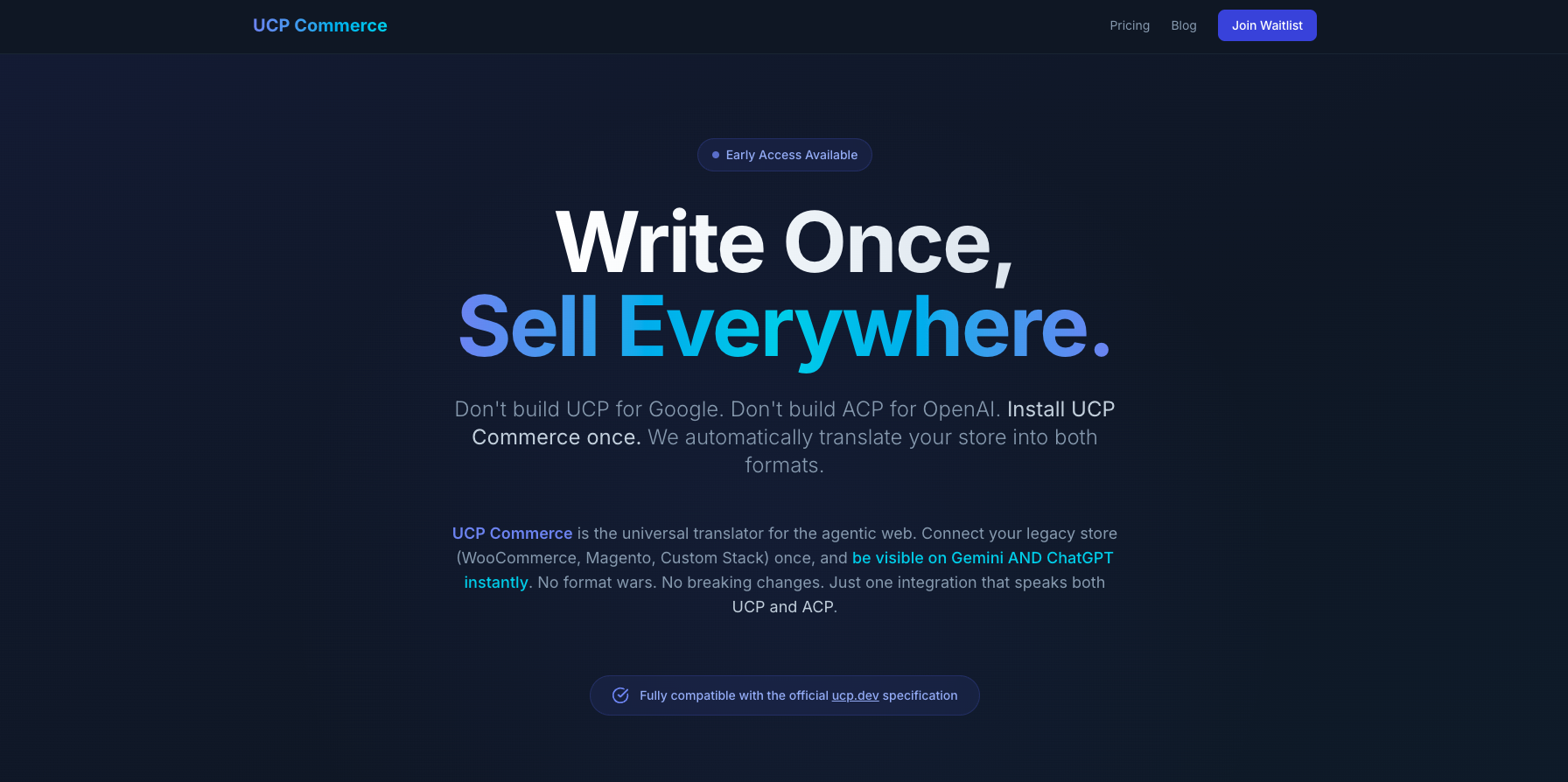 Addressing the "format wars" between Google's UCP and OpenAI's Agentic Commerce Protocol (ACP), services like UCP Commerce are emerging to act as a universal translator. Instead of building separate integrations for each protocol, UCP Commerce provides a single connection point for legacy stores (including WooCommerce, Magento, and custom stacks).
The service works by:
* Ingesting: Connecting to your existing store's API.
* Translating: Automatically mapping your product data into both UCP and ACP formats.
* Transacting: Handling secure, agent-driven checkout processes.
This middleware approach aims to future-proof a retailer's e-commerce stack, ensuring visibility on both Google Gemini and OpenAI's ChatGPT without requiring multiple, complex integrations. It represents a higher-level solution for businesses looking to abstract away the underlying protocol complexities.
ucp-connect-woocommerce
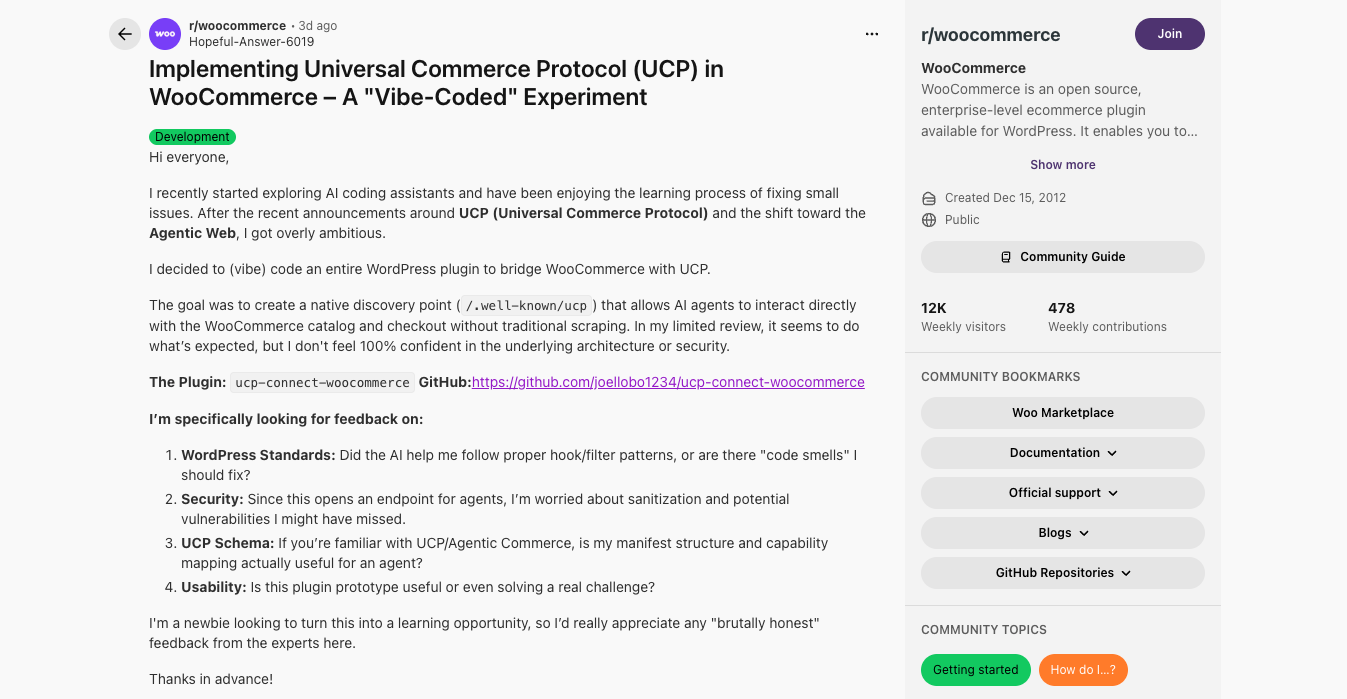
For retailers using WordPress and WooCommerce, the open-source community is already building solutions. One notable example is the ucp-connect-woocommerce plugin, a community project designed to bridge WooCommerce with UCP.
This plugin creates a native discovery point on a WordPress site, allowing AI agents to directly interact with the product catalog and checkout process. Its key features include:
* Unified Search: Implements intelligent search logic that understands natural language queries.
* Programmatic Checkout: Enables agents to build carts and generate secure checkout links.
* Dual-Protocol Support: Supports both browser-based agents (WebMCP) and powerful desktop agents like Claude (Native MCP Server).
This project showcases how the open-source community is accelerating UCP adoption for popular platforms. You can explore the project on GitHub.
Your UCP & GEO Roadmap: What to Do Right Now
The shift to agentic commerce is happening quickly, and early preparation will give you a competitive advantage. Here's your action plan to stay ahead of the curve:
1. Join the UCP Early Programs
If you're an eligible retailer (currently focused on U.S. businesses), consider joining Google's UCP waitlist or pilot programs. Being part of the early cohort allows you to:
Start learning how AI-driven checkout performs for your specific products
Gather valuable data on user behavior in this new shopping paradigm
Gain insights before your competitors do
As one analysis notes, while many retailers wait on the sidelines for proven case studies, early movers are already figuring out what data and offer structures make AI favor their products. By the time UCP becomes widespread, these pioneers will have months of optimization experience.
2. Audit and Enrich Your Product Data (Immediate Priority)
This is the single most important step you should take right now, regardless of when you plan to implement UCP:
Conduct a thorough audit of your product catalog information
Fill in gaps in your product attributes, variant details, and descriptive content
Prepare for the new conversational fields Google is introducing
Ensure your Merchant Center feed is updated to signal UCP eligibility when available
The quality of your product data will directly impact your visibility and conversion rates in AI-driven commerce. Even if you're not ready to implement UCP technically, enriching your data now will position you for success when you do.
3. Experiment with AI-Native Features
As Google rolls out new features related to UCP, be ready to test and learn:
If the Business Agent feature becomes available, opt in and start customizing it to match your brand voice
Begin planning your Direct Offers strategy, studying what early participants like Petco and Samsonite are doing
Test different approaches to product descriptions that work well in conversational formats
Each of these experiments will generate insights that help you refine your overall agentic commerce strategy.
4. Educate and Align Your Internal Teams
Prepare your organization for the new workflows that UCP and AI commerce will introduce:
Help marketing teams understand how to optimize product content for AI understanding
Train customer service on handling orders placed via Google's interface
Work with your technical team to plan for UCP integration
Develop new analytics approaches that capture the customer journey across AI touchpoints
This cross-functional alignment is crucial for a smooth transition to AI-driven commerce.
5. Monitor the Competitive Landscape
Keep a close eye on how the market evolves as UCP adoption grows:
Track which of your competitors implement UCP and how they position their products
Study leaders in your category who are succeeding with AI-driven commerce
Watch for updates from Google and Shopify about expanded UCP capabilities
Prepare for global expansion if you operate internationally, as UCP is launching first in the U.S. but will expand worldwide
6. Focus on Building Direct Customer Relationships
While UCP offers exciting new sales channels, it's equally important to strengthen your direct customer relationships:
Develop post-purchase communication strategies that bring AI-acquired customers into your ecosystem
Create compelling reasons for customers to visit your website directly (exclusive content, loyalty programs, etc.)
Collect first-party data whenever possible to reduce dependency on third-party platforms
Consider how you can use the Business Agent feature to create unique brand experiences that differentiate you from competitors
Conclusion: Embracing the Future of E-commerce
The introduction of Google's Universal Commerce Protocol marks a significant turning point in e-commerce history. We're witnessing a fundamental shift from search-based discovery to AI-guided shopping experiences—from SEO to GEO.
For online retailers, UCP presents both challenges and opportunities. The streamlined, frictionless nature of AI-driven commerce may reduce some brand touchpoints, but it also opens new avenues for reaching customers at their moment of highest intent. The retailers who will thrive in this new landscape are those who:
Embrace structured, comprehensive product data as their most valuable asset
Master the art of Generative Engine Optimization (GEO) to ensure visibility in AI interfaces
Move quickly to experiment and learn while the standards are still evolving
Balance the efficiency of AI-driven checkout with thoughtful brand experiences
View UCP not as a threat but as a new frontier for e-commerce innovation
The future of online retail is conversational, personalized, and AI-mediated. By enriching your data, embracing open standards like UCP, and mastering GEO, you are not just adapting to a trend—you are future-proofing your e-commerce strategy for the decade to come.
As Google's own perspective indicates, agentic shopping is inevitable. The question isn't whether AI will transform e-commerce, but how quickly retailers will adapt to this new reality. Those who prepare now will be positioned to lead in the age of agentic commerce.

Frequently Asked Questions
What is Google's Universal Commerce Protocol (UCP)?
Google's Universal Commerce Protocol (UCP) is an open standard that creates a shared language between AI shopping agents (like Google Gemini) and e-commerce platforms. This protocol allows AI to search product catalogs, answer customer questions, and complete purchases directly within the AI interface, without the user needing to visit the retailer's website. It standardizes these interactions, simplifying the process for both retailers and AI platforms.
How is GEO different from traditional SEO?
Generative Engine Optimization (GEO) focuses on optimizing your product data and content for AI assistants, while traditional SEO focuses on ranking your website in a list of search results for human users. SEO aims to drive traffic to your website by ranking for specific keywords. In contrast, GEO aims to have your products recommended and sold directly within conversational AI interfaces. GEO values structured data, information accuracy, and intent matching over traditional SEO signals like backlinks and keyword density.
Will using UCP cause me to lose my brand identity?
No, UCP is designed to keep you in control of your brand and customer relationships. You remain the Merchant of Record for all transactions and retain all customer data. While customers may not experience your full website design, UCP offers features to maintain brand presence. For example, Google's "Business Agent" allows you to create a branded AI assistant that uses your brand's voice, and the "Embedded Checkout" option lets you use your own branded checkout page within the AI interface.
Do I have to use UCP to sell products online?
No, UCP is not mandatory for selling products online. However, not adopting it may mean missing out on a growing sales channel as more consumers turn to AI assistants for shopping. Google has stated that "agentic shopping is inevitable," indicating a significant shift in consumer behavior. By not participating in UCP, your products will not be discoverable or purchasable through these emerging AI-driven shopping experiences, potentially putting you at a competitive disadvantage.
What is the most important step to prepare for UCP and GEO?
The single most important step you can take right now is to audit and enrich your product data. High-quality, comprehensive, and structured product data is the foundation of GEO. This includes filling out all available fields in Google Merchant Center, implementing schema markup, and adding rich details like materials, dimensions, care instructions, and answers to common questions. This data directly fuels the AI's ability to understand and recommend your products accurately.
Does UCP mean customers will never visit my website again?
Not necessarily. While UCP enables direct purchases within AI interfaces, your website remains a crucial source of truth and a destination for deeper brand engagement. AI models will still crawl your website for information to answer complex questions. Furthermore, UCP allows you to retain customer data, giving you the opportunity to build direct relationships through post-purchase communications. You can encourage direct visits through loyalty programs, exclusive content, and by creating unique brand experiences that AI interfaces cannot fully replicate.
How do I get my e-commerce store on UCP?
UCP integration depends on your e-commerce platform. Major platforms like Shopify are developing native, turnkey solutions, while others like WooCommerce will likely use plugins. If you're on Shopify, watch for updates related to "Agentic Storefronts." For custom platforms, you will need to follow Google's developer documentation to implement the necessary RESTful API endpoints. You can also join Google's UCP waitlist to participate in early programs.
Resources for Further Learning:
Official UCP Documentation - Google's comprehensive guide to UCP implementation
UCP.dev - The official UCP website with roadmap and community resources
Universal Commerce Protocol GitHub Repository - Access the open-source specification and code samples
Google Developers Blog: Under the Hood of UCP - Technical deep dive into UCP's architecture
Google's Blog on Agentic Commerce - Overview of Google's vision for AI-driven retail
Dominate ChatGPT and Google Search
Synscribe helps B2B companies with SEO & GEO using programmatic SEO approach. Book a call to find out how we help you win.