Top 12 Generation Engine Optimization Tools for 2026
Summary
With over 60% of consumers using AI for research, visibility in AI-generated answers is now binary—your brand is either cited or invisible, making traditional SEO rank tracking less effective.
Success in Generative Engine Optimization (GEO) depends on creating well-structured, authoritative content with unique terms and statistics that AI models can easily parse and reference.
To compete, businesses must use specialized GEO tools to measure critical metrics like AI visibility, source citations, and share of voice across platforms like ChatGPT, Gemini, and Perplexity.
Implementing a robust GEO strategy is essential for navigating this new search landscape and ensuring your brand gets discovered by AI.
You've spent years mastering SEO, carefully optimizing your content for Google's ranking factors, and tracking your position on SERPs. But now, traditional rank tracking feels almost useless as AI summaries and chat answers appear everywhere, and trusted tools like Search Console have become practically "useless" for monitoring this new frontier.
Welcome to the era of Generative Engine Optimization (GEO) - where visibility is binary. Either your content gets cited in AI responses, or it doesn't exist at all.
With over 60% of consumers now using conversational AI for shopping research, businesses can no longer afford to ignore this shift. Unlike traditional SEO, which focuses on ranking positions, GEO is about optimizing your content to be accurately sourced, cited, and represented in AI-generated answers.
As one SEO professional puts it: "Stop thinking in terms of search rankings and start thinking in terms of useful answers." This paradigm shift demands new tools and strategies to succeed in an AI-first search landscape.
This guide examines the top 12 GEO tools for 2025 that will help you track your brand's visibility across AI platforms, optimize your content for citations, and stay ahead of competitors in this rapidly evolving space.
What is GEO and Why It's Crucial for 2025
Generative Engine Optimization (GEO) is the practice of optimizing digital content to be sourced, cited, and accurately represented in AI-generated answers. Unlike traditional SEO, where you might rank #4 or #7, in the AI world, you're either cited as a source or completely invisible.
According to research from Foundation Inc, strategic content adjustments can boost source visibility by up to 40% in AI responses. The key factors influencing whether your content gets cited include:
Unique Words: Distinctive vocabulary that sets your content apart
Easy-to-Understand Language: Clear, accessible writing
Citations and Statistics: Factual information backed by data
Fluency Optimization: Natural-sounding, well-structured content
Authoritative and Technical Terms: Domain-specific terminology that establishes expertise
The structure of your content is equally important. As one SEO expert notes, "it's less about keywords and more about structured, citation-friendly content (FAQs, comparisons, bullet lists, etc.)." AI models prefer content that is easy to parse and extract information from, making organization a critical factor for visibility.
How to Choose a GEO Tool: The Metrics That Matter
Manually tracking your visibility in AI responses by "typing the query in different LLMs" is not only tedious but lacks statistical significance. A proper GEO tool should measure these essential KPIs:
AI Visibility Score: The frequency of your brand's mentions in AI responses
Source Citations / Citation Share: The number of times your website is directly linked as a source
Share of Voice: Your brand's percentage of mentions compared to competitors
Sentiment Accuracy: How positively and accurately AI represents your brand's messaging
Query Coverage: The range of topics for which your brand is recognized as an authority
Factual Alignment: The accuracy of information AI provides about your brand and offerings
When evaluating GEO tools, consider these selection criteria:
Platform Coverage: Does it track multiple AI engines (ChatGPT, Gemini, Perplexity, etc.)?
Actionable Insights: Does it provide recommendations or just data?
Integration & Scalability: Can it fit into your existing workflow?
Usability & Cost: Is the interface intuitive and the pricing reasonable?
The Top 12 Generation Engine Optimization (GEO) Tools for 2025
1. Goodie
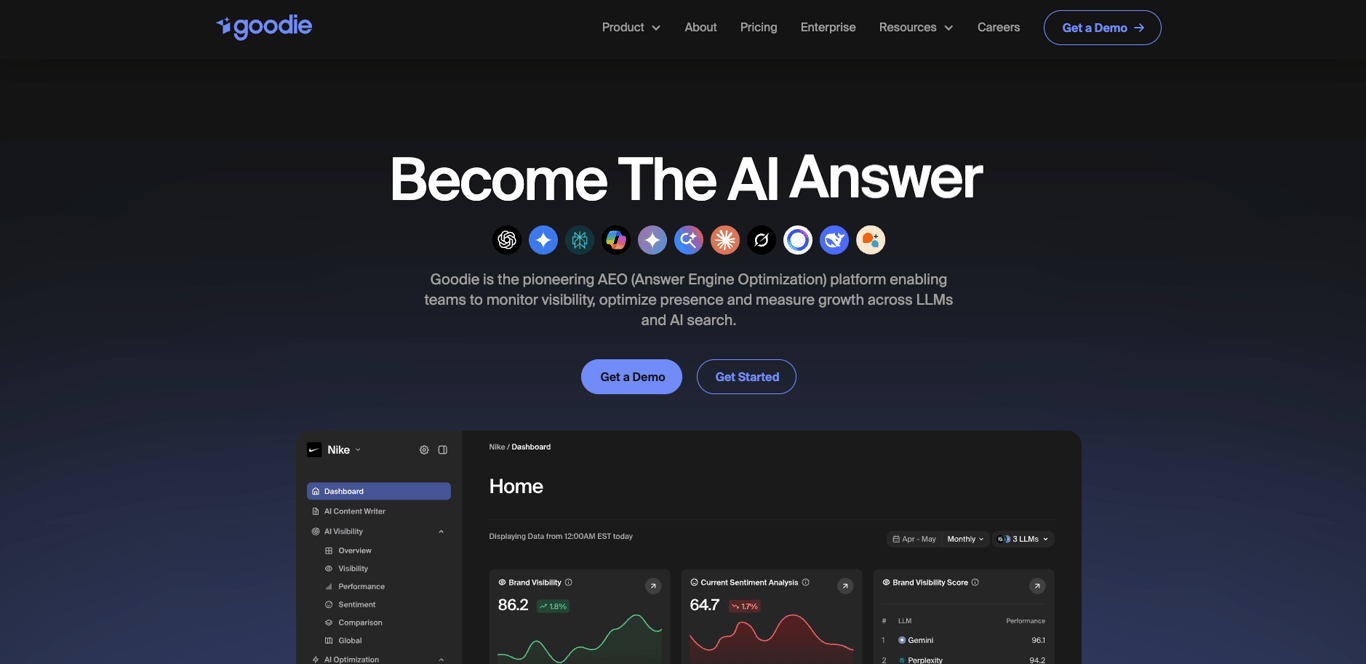
Best For: Enterprises and scaling teams needing an all-in-one optimization hubKey Features:
Comprehensive monitoring across major AI engines
Sentiment analysis and competitive benchmarking
Actionable recommendations for content optimization
Global monitoring capabilities for international brands
Pricing: From $495/month (after a free demo)Link: https://higoodie.com/
2. Profound
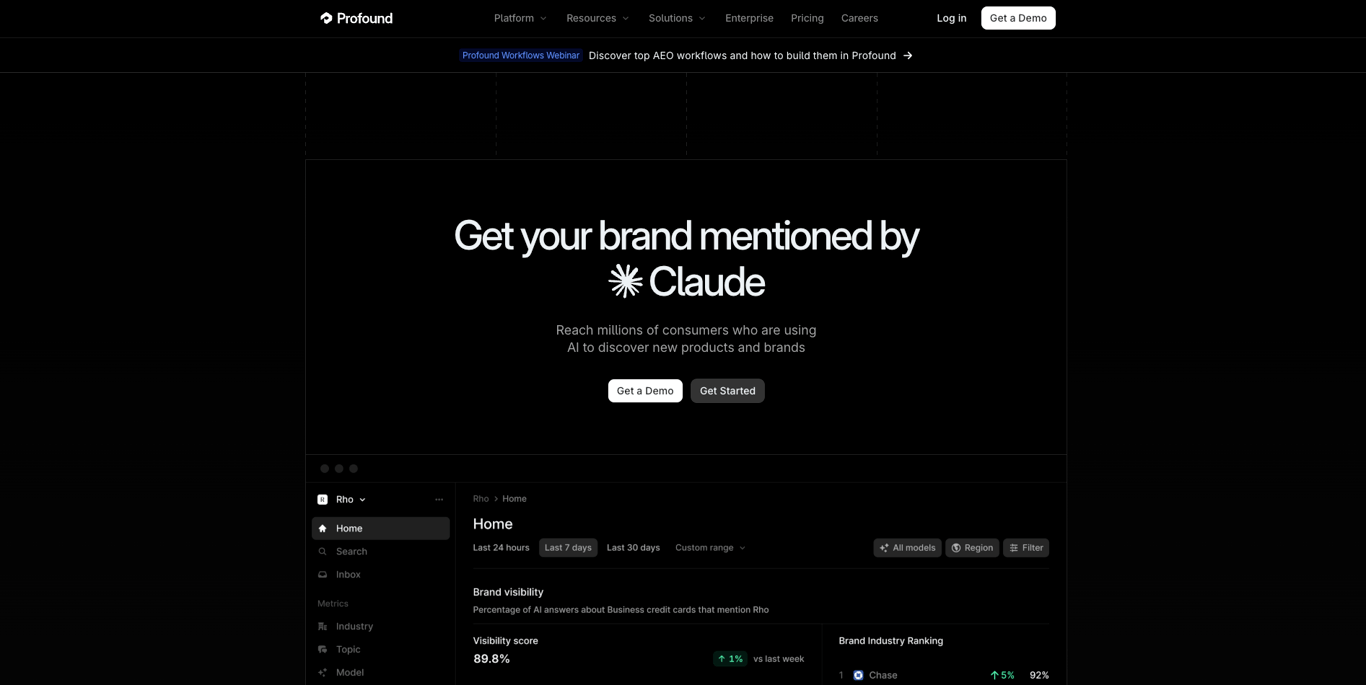
Best For: Enterprises, healthcare organizations, and agencies needing robust trackingKey Features:
Tracks 10+ AI engines simultaneously
Measures brand visibility and citation frequency
HIPAA-compliant tracking for healthcare organizations
WordPress integration for seamless workflow
Pricing: Sources vary between $99-$499/month (check site for current pricing)Link: https://www.tryprofound.com/
3. Otterly AI
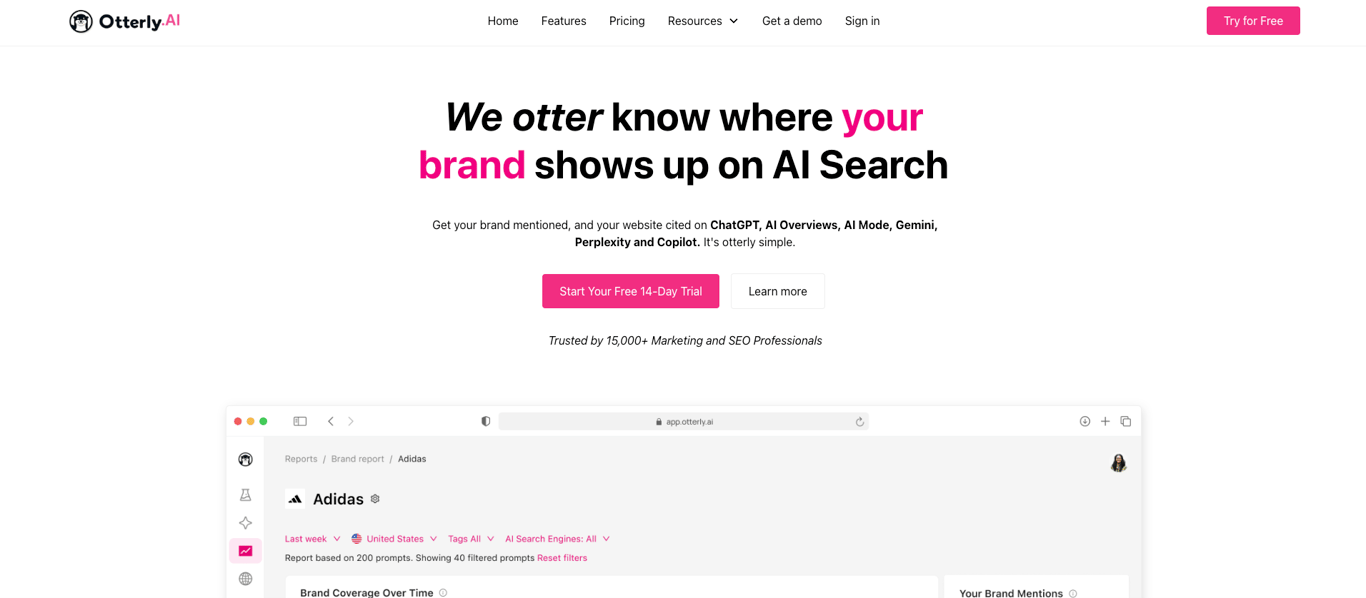
Best For: Startups and SMBs looking for affordable and user-friendly monitoringKey Features:
Clear dashboard of brand mentions
Weekly AI visibility alerts
SEO-to-AI prompt conversion
Sentiment tracking and analysis
Pricing: Starting at $29/monthLink: https://otterly.ai/
4. Ahrefs (Brand Radar add-on)
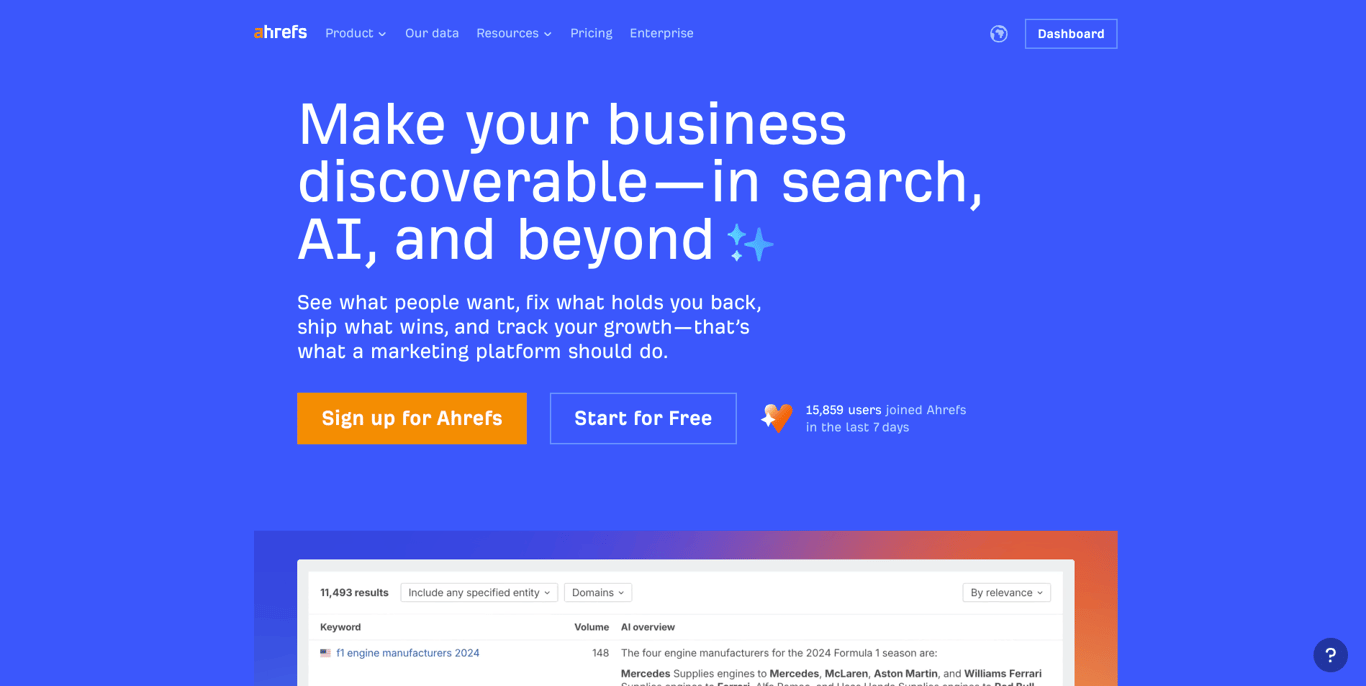
Best For: SEO teams already using the Ahrefs ecosystemKey Features:
AI content analysis integrated with traditional SEO metrics
Brand appearance tracking in generative engines
AI visibility insights from extensive datasets
Competitive analysis tools
Pricing: Base plan from $99/mo + GEO add-onLink: https://ahrefs.com/
5. Semrush (AI Visibility Toolkit)
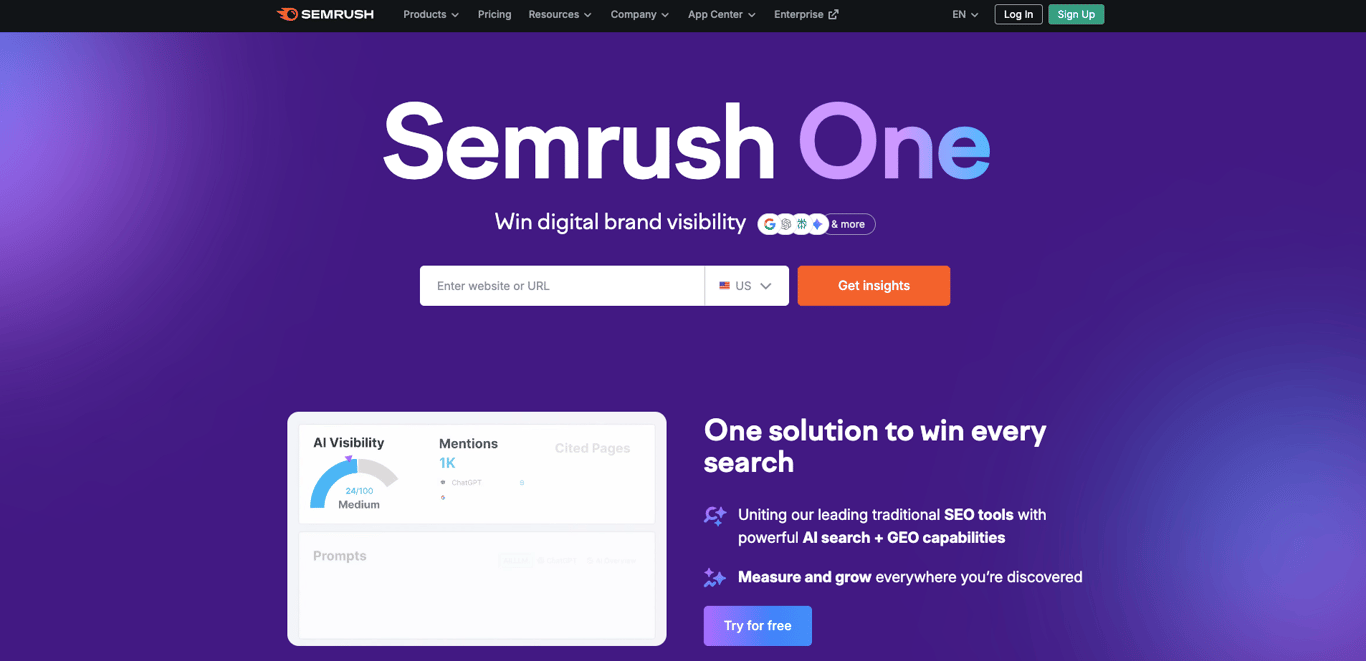
Best For: Businesses wanting integrated marketing and SEO workflowKey Features:
Google AI overview tracking
Brand recommendations for improved visibility
GEO content generation assistance
Comprehensive brand performance reports
Pricing: Base plan from $139.95/mo + GEO add-on from $99/moLink: https://www.semrush.com/kb/1493-ai-visibility-toolkit
6. Peec AI
Best For: Mid-size teams needing clean, simple dashboardsKey Features:
Simple dashboard for quick visibility checks
Search appearance tracking
Citation source analysis
Sentiment tracking and reporting
Pricing: Starts at €89/monthLink: https://peec.ai/
7. Writesonic
Best For: Content and SEO teams combining creation with visibility trackingKey Features:
AI writing assistance with GEO-optimized content
SEO optimization recommendations
Visibility tracking across AI platforms
All-in-one content creation and optimization
Pricing: Free tier + paid plans from $39/monthLink: https://writesonic.com
8. AthenaHQ
Best For: Businesses needing multi-engine tracking and competitor analysisKey Features:
Detailed visibility reports and analytics
Citation checks across multiple AI engines
Competitor analysis and benchmarking
LLM-optimized content creation assistance
Pricing: Starts at $265-$295/monthLink: https://www.tryathena.com/
9. Gumshoe
Best For: Marketing teams wanting free visibility monitoringKey Features:
Free brand visibility tracking
Citation analysis across major AI platforms
Basic reporting capabilities
Perfect for teams just starting with GEO
Pricing: Free public betaLink: https://gumshoe.ai/
10. Frase
Best For: Content marketers focusing on AI-aware content creationKey Features:
AI-driven content briefs optimized for citations
Research tools for topic optimization
Real-time feedback for AI discoverability
Content structure optimization
Pricing: From $15/monthLink: https://www.frase.io/
11. HubSpot's AI Search Grader
Best For: Marketers wanting a free snapshot of AI visibilityKey Features:
Free visibility snapshot across AI engines
Basic sentiment analysis capabilities
Competitor benchmarking
Entry-level GEO analysis
Pricing: FreeLink: https://www.hubspot.com/ai-search-grader
12. xFunnel AI
Best For: Experimentation-driven marketers mapping questions to contentKey Features:
GEO testing and visibility experiments
Analyzes content effectiveness for specific queries
Maps customer questions to AI responses
Content optimization recommendations
Pricing: From $45/month (custom pricing may apply)Link: https://www.xfunnel.ai/
Beyond the Tools: Actionable GEO Strategies for Success
Having the right tools is only part of the equation. Here are proven strategies to maximize your GEO effectiveness:
Strategy 1: Master Technical Readiness for AI Crawlers
It was recently revealed that AI crawlers struggle with JavaScript. As one expert advises: "make sure all the important info on a page is rendered in HTML." If Google and Bing can confidently parse your content, you have a much better chance of being included in retrieval-augmented pipelines.
Additionally, implement robust schema markup to help AI understand the context and entities on your pages, increasing the chance of accurate inclusion in responses.
Strategy 2: Build Authority Through Strategic Mentions
The recommendation to "get mentioned in the places that LLMs cite" is crucial. Target high-authority sources like Wikipedia, industry reports, and authoritative publications that AI models frequently reference.
Create intent-based content that directly answers user questions at all stages of the funnel—from informational to transactional queries—to increase your chances of being cited as a valuable resource.
Strategy 3: Create a Content Ecosystem
As one GEO specialist puts it: "You want the mentality of surrounding LLMs with the same message: 'we are a product or service that does this!'" Consistency across platforms reinforces your brand's authority on specific topics.
Leverage social media platforms like LinkedIn and Reddit, as LLMs frequently draw from these public conversations when generating responses about products, services, or industry trends.

Conclusion: Adapting to the New Search Landscape
The shift from traditional SEO to Generative Engine Optimization represents one of the most significant changes in digital marketing since the rise of mobile search. In this new landscape, visibility is binary—you're either cited or invisible.
While tools provide the necessary visibility and data, success still hinges on a foundational strategy of creating genuinely useful, well-structured, and authoritative content that AI models find valuable enough to cite.
Start by performing an audit of your AI visibility using one of the free tools mentioned above, identify your content gaps, and begin optimizing for the AI-first future that has already arrived. Your brand's digital visibility depends on it.
Frequently Asked Questions
What is Generative Engine Optimization (GEO)?
Generative Engine Optimization (GEO) is the practice of optimizing your digital content to be sourced and cited in answers generated by AI engines like ChatGPT and Gemini. Unlike traditional SEO which focuses on ranking positions, GEO aims to make your content the authoritative source for AI-powered responses, ensuring your brand is visible and accurately represented.
Why is GEO important for businesses in 2025?
GEO is crucial because AI is rapidly becoming a primary tool for consumer research, and visibility in AI-generated answers is binary—your brand is either cited or it's invisible. With a majority of consumers now using conversational AI for shopping research, failing to appear in AI responses means losing a significant portion of potential customers. It's a fundamental shift from ranking on a search page to becoming a cited authority.
How does GEO differ from traditional SEO?
The main difference is that traditional SEO focuses on achieving a high rank (e.g., #1, #2, #3) on a search engine results page, while GEO focuses on getting your content cited as a source within an AI-generated answer. SEO prioritizes keywords and backlinks to climb a list of rankings. In contrast, GEO prioritizes structured, citation-friendly content, factual accuracy, and authoritative language to be selected by an AI model as a trusted source.
What kind of content performs best for GEO?
Content that is well-structured, easy to understand, and factually dense performs best for GEO. AI models favor content that uses clear language, includes unique and authoritative terms, and is organized with formats like FAQs, bulleted lists, and comparison tables. Backing up claims with citations and statistics also significantly increases the likelihood of being sourced.
How can I start with Generative Engine Optimization?
The best way to start is by using a free GEO tool to audit your brand's current visibility in AI engines. Tools like HubSpot's AI Search Grader or Gumshoe's free beta can provide an initial snapshot of how often your brand is mentioned or cited. This audit will help you identify content gaps and prioritize which topics to optimize for AI responses first.
What are the most important metrics to track in GEO?
The most important GEO metrics are AI Visibility Score, Source Citations, Share of Voice, and Sentiment Accuracy. These key performance indicators (KPIs) help you measure how frequently your brand appears in AI answers (Visibility), how often you are linked as a source (Citations), how you stack up against competitors (Share of Voice), and whether the AI is representing your brand positively and correctly (Sentiment).
Dominate ChatGPT and Google Search
Synscribe helps B2B companies with SEO & GEO using programmatic SEO approach. Book a call to find out how we help you win.