How to Use EDG Grant for Digital Marketing? Going Beyond PSG
Summary
The Productivity Solutions Grant (PSG) funds simple, pre-approved tools, while the Enterprise Development Grant (EDG) supports complex, customized digital marketing strategies with up to 50% co-funding.
EDG is designed to fund the development of long-term capabilities—such as creating a comprehensive SEO strategy—not recurring operational costs like ad spend.
A successful EDG application hinges on a detailed project proposal that must be submitted to the Business Grants Portal before the project commences.
Partnering with a specialist to develop a data-driven SEO & Content Strategy is an effective way to leverage EDG funding to build a long-term, revenue-focused growth engine.
You've set up your business in Singapore, and you're ready to take your digital marketing efforts to the next level. You've heard about government grants that could help offset costs, but the information seems overwhelming and confusing. Maybe you've even looked into the Productivity Solutions Grant (PSG) but found it doesn't quite fit your ambitious marketing plans.
"Grants are slow (6-12 months), paperwork is heavy, and they seem to fund scaling, not ideation," you might think, echoing the sentiments of many Singapore founders on forums like Reddit. You're "not sure what's actually worth applying to or easy to access" for your business.
Here's what many Singapore businesses don't realize: while PSG is well-known for supporting technology adoption, the Enterprise Development Grant (EDG) can be a powerful but underutilized tool for funding sophisticated digital marketing initiatives.
This guide will show you exactly how to leverage the EDG grant for your digital marketing needs, going far beyond the basic solutions covered by PSG. We'll demystify the application process, break down the key differences between these two major grants, and provide a clear roadmap for success.
PSG vs. EDG: Choosing the Right Tool for Your Digital Marketing
Before diving into how to use EDG for marketing, let's clarify the fundamental differences between these two popular Singapore government grants:
Productivity Solutions Grant (PSG): The Quick-Win Tool
Focus: Adopting pre-approved, off-the-shelf IT solutions and equipment to improve productivity.
Best for: Businesses looking for immediate, straightforward improvements with specific technology (e.g., a basic CRM, website builder, or e-commerce platform setup).
Funding: Up to 80% of qualifying costs for pre-approved solutions from a list of vendors.
Analogy: PSG is like buying a ready-made tool from the hardware store. It solves a specific, immediate problem efficiently.
Enterprise Development Grant (EDG): The Strategic Growth Engine
Focus: Supporting complex, customized projects that build deep capabilities for long-term growth, innovation, and market expansion.
Best for: Businesses planning comprehensive, bespoke digital marketing strategies, engaging expert consultants, or developing unique processes.
Funding: Up to 50% of eligible project costs. For sustainability-related projects, this is increased to up to 70% until March 31, 2026.
Analogy: EDG is like hiring an architect and a construction team to design and build a custom extension to your factory. It's a bigger project that creates lasting value and capability.
Key Differences at a Glance
Feature | Productivity Solutions Grant (PSG) | Enterprise Development Grant (EDG) |
|---|---|---|
Project Scope | Specific, pre-approved, off-the-shelf solutions | Broad, customized, strategic projects |
Primary Goal | Improve operational productivity | Upgrade, innovate, expand the business |
Flexibility | Low. Limited to a list of solutions | High. Allows for unique, tailored projects |
Typical Use Case | Buying accounting software | Developing a new market entry strategy |
Application | More straightforward selection process | Requires a detailed, unique project proposal |
Unlocking Digital Marketing Growth with EDG: A Deep Dive
The EDG supports projects under three pillars. Let's explore how each can be leveraged specifically for sophisticated digital marketing:
Pillar 1: Core Capabilities - Building Your Marketing Foundation
Official Description: Focuses on strengthening business foundations. The key area for marketing is "Strategic brand and marketing development."
What this means for Digital Marketing: This is not about funding ad spend. Instead, it's for developing the strategy behind your marketing.
Example Projects You Can Propose:
Developing a comprehensive SEO & Content Strategy: A project to conduct in-depth customer research, map the buyer's journey, identify high-intent keywords, and build a content roadmap designed to drive conversions.
Brand Strategy and Positioning: Conducting market research to refine your brand's voice, messaging, and positioning against competitors.
Customer Engagement and Loyalty Strategy: Formulating a plan to improve customer retention through digital channels.
What is NOT Covered: Stand-alone marketing/PR campaigns, ad spend, or routine operational marketing costs. The grant funds the building of the capability, not the day-to-day execution.
For a B2B SaaS company, a 'Core Capabilities' project could involve partnering with a specialist firm like Synscribe. The project scope wouldn't be 'run our SEO,' but rather 'develop and implement a foundational, data-driven SEO and Generative Engine Optimization (GEO) strategy.' This includes using proprietary tools like a Bottom-of-Funnel (BOFU) Keyword Finder to build a strategy that directly ties to revenue goals, creating a long-term asset for the company. This is the kind of deep, strategic work the EDG is designed to support.
Pillar 2: Innovation & Productivity - Automating and Scaling Your Marketing
Official Description: Encourages the adoption of automation, new technologies, and process redesign.
Example Projects You Can Propose:
Marketing Automation System Implementation: A project to design and deploy a sophisticated system (like HubSpot or Marketo) that automates lead nurturing, customer segmentation, and email marketing, including the consultancy and training required.
Product Development for Marketing Tech: Developing a unique piece of software or a process that gives you a competitive marketing edge.
Process Redesign: Overhauling your content production or lead management workflow for greater efficiency.
What is NOT Covered: Set-up costs for basic equipment and solutions that are already covered under PSG.
Pillar 3: Market Access - Taking Your Digital Marketing Global
Official Description: Helps businesses expand into new geographical markets.
Example Projects You Can Propose:
International SEO and Market Entry Strategy: A pilot project to research a new overseas market, adapt your digital presence (website, content) for that market's language and culture, and test digital marketing channels to validate market demand.
Adoption of International Standards: Projects to achieve certifications that increase competitiveness in a new market (e.g., data privacy standards).
How to Build a Winning EDG Application: A Step-by-Step Guide
One of the biggest hurdles mentioned by founders is the "heavy paperwork" involved with grants. Let's break down the EDG application process into manageable steps:
Step 1: Check Your Eligibility
Before you begin, make sure your business meets these basic requirements:
Must be a business registered and operating in Singapore
Must have a minimum of 30% local shareholding (Singapore Citizens or PRs)
Must be in a financially viable position to start and complete the project
Step 2: Define Your Project and Choose a Category
Decide which of the three pillars (Core Capabilities, Innovation & Productivity, Market Access) your digital marketing project best fits under based on the examples provided above.
Step 3: Prepare a Detailed Project Proposal
This is the most critical step. Unlike PSG, EDG requires a custom proposal that outlines the project's objectives, scope, timeline, and expected outcomes.
Enterprise Singapore provides official templates to help structure your proposal correctly:
Step 4: Gather Mandatory Documents
Latest ACRA search or BizFile
Audited financial statements for the most recent year
Your completed project proposal
Step 5: Submit Your Application on the Business Grants Portal (BGP)
A critical rule to remember: The project must not have commenced before the application is submitted. This means you can plan your digital marketing strategy, but don't start implementing it until your application is approved.
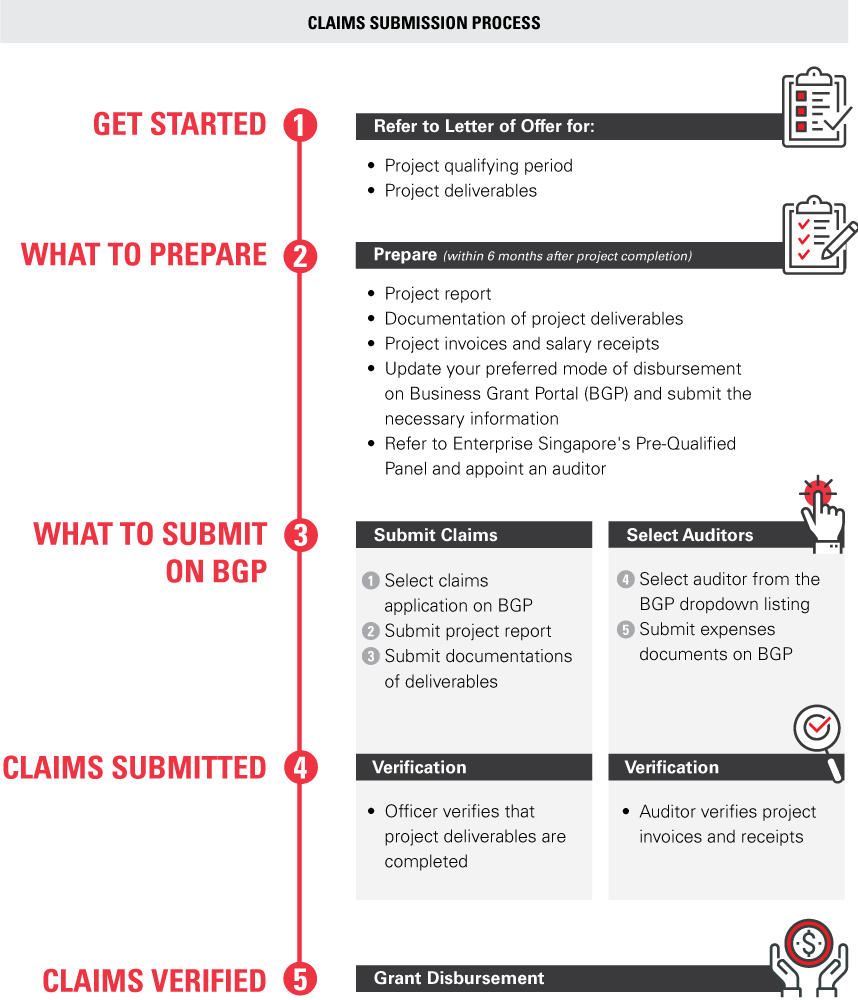
The Final Hurdle: Navigating the EDG Claims Process
Many business owners are concerned about the slow grant processes. To ensure a smooth claims submission, understand these key principles:
Reimbursement Basis: You must pay for the project costs first; the grant is disbursed after the project is completed and audited.
Timeliness: Claims must be submitted within six months of the project's actual completion date.
Your Essential Checklist for Claims Submission:
Enterprise Singapore provides an official EDG Claims Submission Checklist to help guide you through this process. Here's what you need to prepare:
Deliverables Verification:
Project Report: A 1-2 page summary on your company letterhead detailing the project's outcomes and the capabilities developed.
Supporting Documents: Proof of work from vendors/consultants, brochures, specifications, etc.
Expenses Verification (for the Auditor):
Contracts: Signed quotations and contracts with vendors.
Invoices: All third-party invoices.
Proof of Payment: Bank statements, cleared cheques, or transaction records showing payments have been made.
Salary Support (if applicable): Employment contracts, payslips, and CPF statements.
Pro-Tip: Keep a dedicated folder for all EDG project-related documents from day one to make the claims process as painless as possible.
Think Strategy, Not Just Solutions
While PSG is excellent for adopting pre-built tools, the EDG is for businesses ready to invest in building a unique, strategic marketing engine. Businesses that have successfully leveraged EDG for digital marketing understand a fundamental truth: the grant funds the development of long-term capabilities that can drive sustainable growth, de-risk market expansion, and create a genuine competitive moat.
For B2B SaaS companies in particular, partnering with specialized firms like Synscribe for an EDG-funded project can be particularly valuable. Their data-driven approach to SEO and content strategy focuses on bottom-of-funnel conversions rather than vanity metrics, which aligns perfectly with EDG's focus on building capabilities that directly impact business performance.
As you consider your options, think about your long-term business goals and how a strategic, EDG-funded digital marketing project could be the catalyst to achieve them. For those looking to build a revenue-focused growth strategy, exploring expert partnerships is a crucial first step.
The EDG may require more effort to apply for than the PSG, but for ambitious businesses looking to transform their digital marketing capabilities, it represents an investment that can pay dividends long after the project concludes.
Frequently Asked Questions
What is the main difference between the PSG and EDG for digital marketing?
The main difference is scope and purpose. PSG is for adopting pre-approved, off-the-shelf digital solutions to improve productivity, while EDG funds large-scale, customized strategic projects that build long-term marketing capabilities. Think of PSG as buying a ready-made tool, whereas EDG is for designing a unique, comprehensive growth strategy.
Can I use the EDG to fund my company's advertising expenses?
No, the EDG cannot be used to fund routine operational costs like advertising spend (e.g., Google Ads, social media ads) or stand-alone marketing campaigns. The grant supports the development of strategic capabilities, such as building an SEO strategy, not the day-to-day execution costs that result from it.
What kind of digital marketing projects does the EDG support?
The EDG supports strategic digital marketing projects under its 'Core Capabilities' pillar, specifically for "Strategic brand and marketing development." This includes developing a comprehensive SEO and content strategy, conducting market research for brand positioning, creating a customer loyalty strategy, or designing and implementing a sophisticated marketing automation system.
What are the key eligibility requirements for the EDG?
To be eligible for the EDG, your business must be registered and operating in Singapore, have at least 30% local shareholding (held by Singapore Citizens or PRs), and be in a financially viable position to start and complete the proposed project.
Why is the EDG application more complex than the PSG?
The EDG application is more complex because it funds bespoke, strategic projects rather than pre-approved solutions. It requires a detailed, custom project proposal outlining your project's objectives, scope, timeline, and expected outcomes, which must be carefully evaluated by Enterprise Singapore to ensure it aligns with the grant's goal of fostering deep business capabilities.
How does the EDG reimbursement process work?
The EDG works on a reimbursement basis. Your company must first pay for all project expenses to vendors and consultants out of pocket. After the project is completed, you submit a claim with all necessary documents (invoices, proof of payment, project report) to Enterprise Singapore for the grant disbursement.
Learn more about the Enterprise Development Grant on the official website
Dominate ChatGPT and Google Search
Synscribe helps B2B companies with SEO & GEO using programmatic SEO approach. Book a call to find out how we help you win.