Ads Are Coming to ChatGPT: What It Means for Businesses & Advertisers
Summary
Key Stat: ChatGPT will begin testing ads for free-tier US users in early Q1 2026, tapping into an AI-powered search ad market projected to reach $26 billion by 2029.
Key Learning: Ads will be contextual, interactive, and clearly labeled below the AI's answer, creating a new high-intent channel for advertisers to engage customers conversationally.
Key Action Item: Businesses should adopt a dual strategy, using paid ads for guaranteed visibility while investing in Generative Engine Optimization (GEO) to earn organic placement in AI answers.
Get Ready for AI Search: To prepare for this shift, businesses must adapt their content for AI. Synscribe specializes in GEO strategies to ensure your brand is visible across new AI-powered search engines.
OpenAI recently announced that advertisements will soon be testing in ChatGPT – marking a significant shift in how the AI chatbot will be monetized. For businesses and marketers, this development raises numerous questions about the future of digital advertising, customer acquisition strategies, and budget allocation.
This article addresses the key questions businesses are asking: When will ads appear? How will they look? What impact will they have on advertising budgets? Should you focus on paid ads or organic optimization? And importantly, how can you prepare to advertise on this new platform?
Where official details are unavailable, we provide informed estimates based on industry trends and will update as more information is released from OpenAI.
When Can We Expect Ads to Appear on ChatGPT? (Timeline for Rollout)
OpenAI announced on January 16, 2026, that it will begin testing ads in ChatGPT in the coming weeks. Currently, ads are not live yet, but internal testing with a subset of users is slated to begin very soon, marking a significant milestone in OpenAI's monetization strategy.
Initial Testing Phase
The rollout will follow a careful, phased approach:
Timing: Based on OpenAI's announcement, we can expect the pilot program to begin in early Q1 2026 (likely late January or February). The company will gather feedback during testing and refine the system over subsequent weeks and months before any broader launch.
Geographic Scope: The first tests will be limited to the United States. Only logged-in adult users on the Free tier and the new low-cost ChatGPT Go tier ($8/month) will see ads during this initial phase.
Who Will NOT See Ads: Several user groups will be excluded from seeing advertisements:
Users on paid plans that prioritize an ad-free experience (ChatGPT Plus at $20/month, Pro at $200/month, Business, and Enterprise subscribers)
Any accounts flagged as belonging to users under 18 years old
Conversations involving sensitive or regulated topics (such as health, mental health, or politics) will not trigger ads
Future Expansion
While OpenAI hasn't announced an official global timeline beyond the U.S. pilot, a reasonable estimate based on typical tech rollouts suggests other markets could see ads later in 2026 after the U.S. testing proves successful. This cautious approach allows OpenAI to monitor user feedback and make necessary adjustments before wider implementation.
What Will Ads Look Like in ChatGPT? (Ad Format and User Experience)
OpenAI has emphasized that ads in ChatGPT will be clearly labeled, separate from AI answers, and contextually relevant. The company has shared mockups providing insights into the planned user experience.
Ad Placement and Format
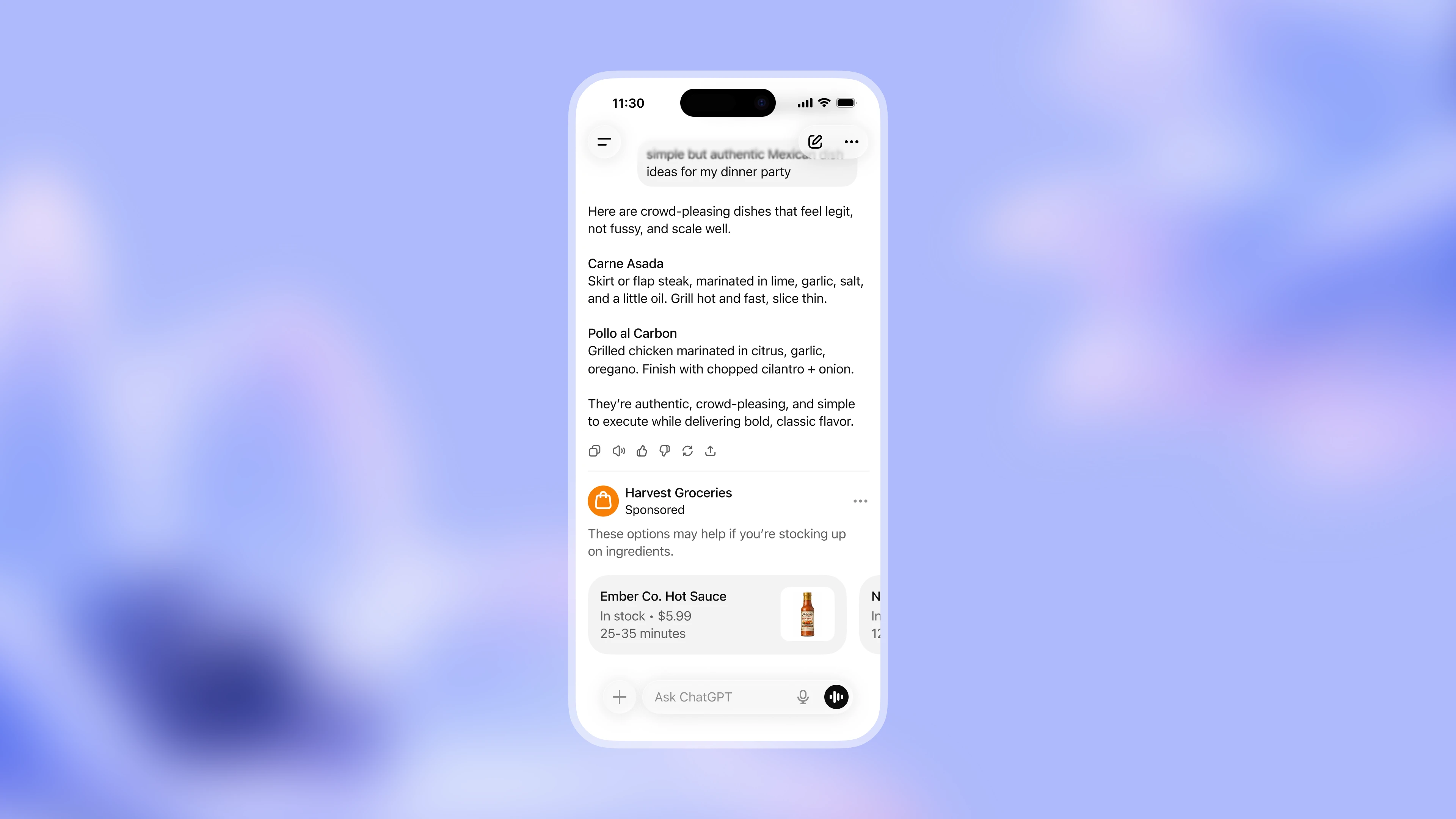 Advertisements will appear in a "bottom slot" beneath ChatGPT's organic response, ensuring the AI's answer is always prioritized. They will be visually distinct from the organic content and prominently labeled as "Sponsored" or "Ad" to maintain transparency.
In one example shared by OpenAI, a user asks about dinner recipes, and after ChatGPT provides its answer, a sponsored product card appears for "Ember Co. Hot Sauce" from "Harvest Groceries." The ad includes details like price ($5.99) and estimated delivery time – all clearly marked as sponsored content.
Interactive and Conversational Ads
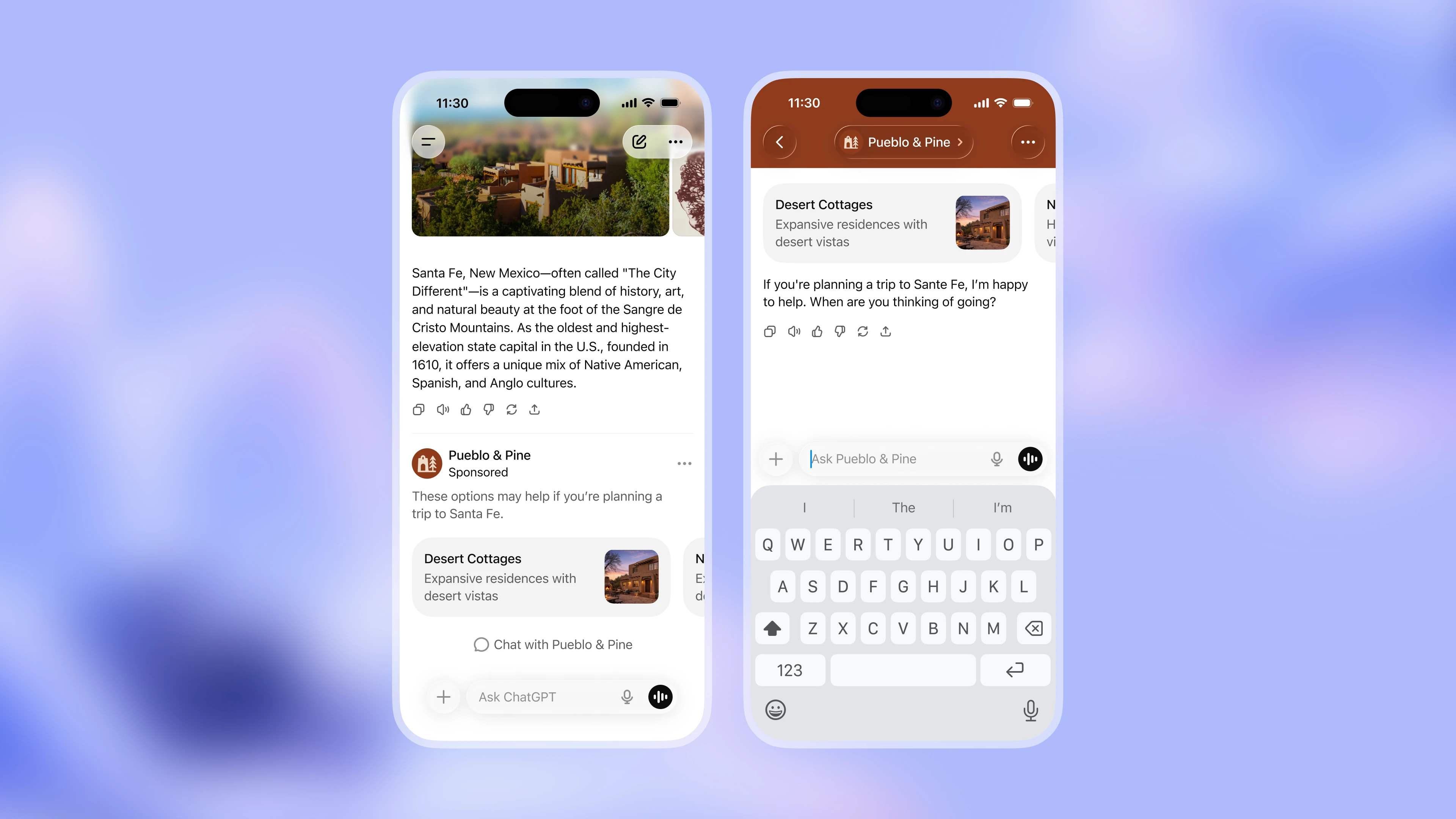 Perhaps most interestingly, OpenAI is pioneering interactive ad formats that go beyond static links. For example, in a travel-related mockup, a user discussing Santa Fe sees a sponsored cottage listing and can click to initiate a direct chat with the advertiser's agent within the ChatGPT interface.
As OpenAI notes, "soon you might see an ad and be able to directly ask the questions you need to make a purchase decision." This represents a novel approach to advertising – conversational ads that enable users to engage with brands in real-time Q&A. For privacy protection, advertisers will only see messages sent directly to them, not the user's full chat history.
Key Features of the Ad Experience
Contextual Relevance: Ads will only appear when there is a relevant product or service related to the conversation. For example, cooking-related queries might trigger cooking product ads, while travel discussions might show travel service ads.
User Controls: OpenAI is building transparency tools, allowing users to see why a particular ad was shown, dismiss ads, and even opt out of personalized targeting if they prefer generic ads. The option to use a paid tier to avoid ads entirely will always be available.
Frequency and Quality: During initial testing, OpenAI will likely keep ad frequency low and quality high to avoid degrading the user experience. They have stated they "do not optimize for time spent in ChatGPT" or spammy engagement, prioritizing user trust over maximizing ad impressions.
Ad Formats: Based on the examples shared, formats will include product carousels (scrollable cards) and business listings with images, text, and calls-to-action. Future possibilities might include AI-generated ad copy or tool integrations, though initially, the format will be straightforward sponsored recommendations.
How Does This Impact Ad Spend?
The introduction of ChatGPT ads creates a potentially powerful new marketing channel that will inevitably influence where businesses allocate their advertising budgets. Here's what to consider about its impact on ad spend:
A New High-Intent Advertising Channel
ChatGPT represents a unique high-intent opportunity – users are actively asking questions and seeking advice, often about products or solutions, right in the chat. This high-intent environment is similar to search engines but with an important difference: ads appear within a conversation where the AI is already assisting the user.
Industry observers suggest that as ChatGPT ads scale, they "could become a new performance and discovery channel, especially for brands focused on intent, education, or consideration-stage marketing." This positions ChatGPT ads as potentially valuable for businesses looking to reach consumers at critical decision-making moments.
Potential Shift in Ad Spend
The impact on advertising budgets will likely evolve in phases:
Short-Term Impact (2026): In the near term, ad spend shifts will be cautious and limited. ChatGPT's ad inventory will initially be restricted (U.S.-only, small user subset in testing), so immediate impact on most marketing budgets will be minimal – advertisers simply won't have access at scale yet.
Long-Term Potential (2026-2029): Looking at the bigger picture, analysts predict significant growth in AI-driven advertising. According to eMarketer estimates, AI-powered search ad spending in the U.S. is projected to grow from about $1.1 billion in 2025 to $26 billion by 2029 – a remarkable 20x increase in just four years. This forecast reflects the expectation that user behavior will increasingly shift toward AI assistants for information – and advertisers will follow those users with their budgets.
The Competitive Landscape
OpenAI isn't operating in isolation. Google and Microsoft (which owns Bing) are also integrating AI into search and exploring ad formats for their AI experiences:
Google has begun testing ads in AI chatbot conversations via AdSense partnerships with AI startups
Google is showing ads in its Search Generative Experience (SGE) AI summaries for some queries
Microsoft is developing advertising solutions for Bing Chat
This creates a competitive ecosystem where Google's massive search ad business (over $100 billion annually) could be threatened if user queries shift to ChatGPT-like assistants. As a result, we may see higher advertising costs on traditional search if its inventory shrinks (fewer people clicking search results due to AI answers), potentially pushing more advertisers to explore alternatives like ChatGPT where the playing field is newer.
Practical Outlook for Marketers
For practical planning purposes, marketers should approach ChatGPT ads with these considerations:
Experimental Channel: In 2026, treat ChatGPT ads as an experimental but promising channel. Set aside a portion of your marketing budget for testing, but don't expect it to replace established channels immediately.
Early Adopter Advantage: Early adopters might benefit from lower costs during beta testing (less competition means potentially cheaper cost-per-click or cost-per-conversation) and can gain first-mover advantages in learning what creative and targeting approaches work best.
Budget Reallocation: If your business finds success with ChatGPT ads, you might gradually shift budget from lower-performing channels. For instance, an e-commerce retailer might reallocate a portion of their Google Shopping ads budget to ChatGPT sponsored product cards if they yield better ROI for certain product categories.
Indirect Effects on SEO: If you rely heavily on organic SEO traffic, be aware that ChatGPT and similar AI tools could potentially reduce some search queries (as users get answers without clicking through to websites). This could indirectly compel businesses to increase ad spend to compensate for any lost organic visibility.
Beyond Conversion: Discovery and Consideration
One interesting aspect is ChatGPT's potential strength for mid-funnel marketing. Because ChatGPT can hold a conversation, brands can educate consumers and answer questions through the ad itself, blurring the line between advertising and customer service.
Businesses may start allocating budget previously dedicated to content marketing or interactive campaigns into ChatGPT engagement ads. For example, a travel agency might use ChatGPT ads to deploy a mini travel agent bot that chats with users, effectively spending ad dollars to converse with potential customers throughout their decision-making process.
This introduces a new paradigm where ad spend is measured not just by clicks, but by engagement quality and lead nurturing within an AI chat – potentially creating new metrics for advertising success.
Ads vs. GEO for Targeting AI Search
One of the most strategic questions businesses face is how to gain visibility in AI-driven search results like ChatGPT. There are two primary approaches, which can be thought of as paid vs. organic strategies for AI:
Pay for placement – Using advertising to secure sponsored positions in AI responses
Earn organic placement – Optimizing your content so the AI naturally includes or cites your brand in its answers
This second approach has given rise to a new practice known as Generative Engine Optimization (GEO) or Answer Engine Optimization (AEO). Let's examine both strategies to determine whether businesses should focus on paid ads, organic optimization, or a combination.
Understanding Generative Engine Optimization (GEO)
GEO is an emerging discipline derived from traditional SEO principles. In essence, GEO is the practice of adapting your content and online presence to improve visibility in AI-generated answers.
Just as SEO aims to get your website on the first page of Google results, GEO aims to get your information included or referenced when an AI like ChatGPT answers a question. The core idea is to "anticipate the questions people will ask and make sure your content appears in the answers."
Key GEO tactics include:
Structuring content in AI-friendly formats (Q&A, bullet points, FAQs)
Creating concise, factual, and granular information that AI models can easily digest
Using schema markup to help AI models understand your content
Focusing on specific, direct answers rather than lengthy, keyword-stuffed articles
Early evidence suggests that AI chatbots prefer content that is structured and straightforward rather than the long-form, SEO-optimized articles that have become common. For example, a well-structured FAQ page may have a better chance of being referenced by an AI answer engine than a lengthy blog post filled with tangential information.
The Challenge of Organic Inclusion
Unlike traditional search engines, ChatGPT doesn't always cite sources or pull direct snippets from web pages (unless using browsing tools or plugins). It largely generates answers from its trained knowledge, which presents a unique challenge:
If your brand or content wasn't part of ChatGPT's training data or isn't well-known enough, ChatGPT might not mention you at all in an answer – even if you have the optimal solution for the user's query. The AI might merge information from many sources without giving explicit credit, making organic visibility less predictable than in traditional search.
Comparative Analysis: Ads vs. GEO
When deciding between advertising and organic optimization for AI platforms, consider these factors:
Reliability & Control
Ads: Provide guaranteed, immediate visibility when triggered by relevant conversations. If you need to ensure your brand appears in AI-assisted queries, advertising offers the most direct and reliable route.
GEO: Offers less certainty; you're optimizing in hopes that the AI chooses to include your content. Even with excellent optimization, there's no guarantee the AI will reference your specific brand or product.
Cost vs. Effort
GEO: Requires no direct ad spend but demands significant content creation and optimization effort. It's an ongoing investment in creating and structuring content for AI consumption.
Ads: Require a budget (likely through a bidding system similar to Google Ads) but can be deployed quickly without overhauling your entire content strategy.
User Trust & Perception
GEO: Content appearing organically in an AI's answer may carry more implicit trust since it's not labeled as advertising.
Ads: Clearly labeled as sponsored content, which some users may give less weight to. However, OpenAI has promised that ChatGPT's organic answers won't be influenced by advertisers – the answers and ads will remain independent systems.
Cross-Platform Benefits
GEO/AEO: Optimization efforts can benefit visibility across multiple AI platforms. For instance, Bing Chat often cites sources with links, and Google's SGE shows snapshots with links to original sources.
Ads: Currently specific to each platform, requiring separate campaigns for different AI environments (though this could evolve with broader ad networks).
The Recommended Strategy: A Dual Approach
For most businesses, the answer isn't choosing between ads OR GEO – it's implementing BOTH strategies:
Continue investing in GEO/SEO:
Create high-quality, structured content that anticipates specific questions your audience might ask AI assistants
Develop FAQ pages, how-tos, and concise guides that AI can easily parse
Ensure your product information (specifications, prices, etc.) is well-formatted, possibly using schema markup
Remember that clear, structured content benefits both traditional search and AI systems
Prepare for advertising in AI:
Monitor ChatGPT's ad platform development
Be ready to test sponsored placements for high-value queries where guaranteed visibility is crucial
Consider being an early tester if your industry shows high ChatGPT usage
Implement analytics to track performance from AI-driven traffic
This dual strategy mirrors how companies approach traditional search – using SEO for organic visibility while supplementing with PPC for guaranteed placement. Similarly, the AI era will likely require both Answer Optimization and Paid Inclusion strategies working in tandem.
How to Advertise on ChatGPT
As of early 2026, advertising on ChatGPT is in a closed testing phase. Businesses cannot yet self-serve campaigns through an ad platform, and must wait for an official announcement from OpenAI. The company has stated they are "focused on learning from early testing in the coming weeks" and will share more information as the program develops.
However, forward-thinking businesses can start preparing now for when ChatGPT ads become broadly available. Here's how to get ready:
Ad Formats & Creative Preparation
Based on OpenAI's mockups, you'll need to prepare for new ad formats unlike traditional search or social ads:
Rich, Conversational Ads: Begin thinking about how your brand would communicate in a conversational context. Move beyond traditional ad copy to recommendation-style messaging that feels natural within a chat interface.
Visual Assets: Gather high-quality images and product information that could be used in card-style ads. The examples from OpenAI show image-rich product cards with details like pricing and availability.
Interactive Elements: Consider how users might engage with your ad through follow-up questions. What are the most common questions customers ask about your products or services? How would you answer them concisely in a chat?
Targeting & Bidding Strategy
While OpenAI hasn't released specifics, we can anticipate a bidding system similar to Google Ads:
Identify Intent Keywords: Start brainstorming which user queries or conversation topics you'd want your ads to appear alongside. Think in terms of problems your products solve or questions users might ask that relate to your offerings.
Competitor Research: Look at what queries your competitors rank for in traditional search, as these may translate to valuable conversation topics in ChatGPT.
Category Targeting: Consider broad categories your business fits into, as OpenAI might offer category or context targeting rather than strict keyword matching.
Data Feeds and APIs
For certain ad types, particularly product listings, OpenAI will likely need structured data:
Clean Product Feed: Ensure you have a well-organized product feed or API that could provide real-time information like inventory, pricing, and specifications.
Machine-Readable Format: Structure your data in standardized formats (similar to those used for Google Merchant Center) to facilitate integration with ad systems.
Metadata Optimization: Review your product attributes and metadata to ensure they accurately describe your offerings in ways that match potential user queries.
Advertiser Chat Agents
One of the most innovative aspects of ChatGPT ads appears to be the potential for interactive, conversational engagement:
Chat Capability Planning: Consider how you would handle direct user interactions from your ads – through a live agent, a simple FAQ bot, or a more sophisticated AI agent.
Knowledge Base Development: Begin compiling a structured knowledge base of product information, common questions, and appropriate responses that could power a conversational agent.
Conversation Design: Think about conversation flows that guide users toward conversion while providing helpful information.
Budget and KPIs
Financial planning for this new channel requires careful consideration:
Experimental Budget: Set aside a specific budget for testing ChatGPT ads once they become available. Early pricing is unknown, but initial campaigns might be discounted to attract advertisers.
Success Metrics: Define clear key performance indicators: direct conversions, qualified leads, brand engagement, etc. Consider how you'll attribute value to conversations that may not immediately lead to purchases.
ROI Expectations: Be prepared for a learning period where return on investment may be uncertain as both you and OpenAI optimize the system.
Compliance and Policies
Finally, prepare for the platform's guidelines:
Content Policies: Be aware that OpenAI will have strict policies regarding ad content, especially for sensitive categories like health or politics.
Privacy Considerations: Understand that users can opt out of personalized ads, potentially limiting targeting capabilities.
Quality Standards: Focus on creating high-quality, non-gimmicky ads, as OpenAI will likely prioritize user experience over maximizing ad revenue.
Conclusion: Final Thoughts for Businesses
The introduction of ads in ChatGPT represents part of a larger, irreversible shift toward conversational AI as a primary channel for customer acquisition and engagement. This evolution demands strategic adaptation from businesses to remain competitive in the AI-driven landscape.
Key Takeaways for Businesses
SEO Is Evolving, Not Dying: Traditional search engine optimization remains important but must expand to include GEO/AEO principles. Optimize your content for clarity, factuality, and structured data to improve visibility across both traditional search and AI platforms.
Content Remains Foundational: High-quality content is essential for both organic AI inclusion and effective conversational ads. Focus on creating concise, helpful content that directly addresses user questions and needs.
User Trust Is Paramount: Align with OpenAI's cautious approach to advertising. Ensure your ads provide genuine value and maintain transparency to avoid user backlash in this more personal medium.
Early Adoption Advantage: Businesses that experiment early with ChatGPT ads may gain competitive advantages through lower costs and valuable learnings before the platform becomes crowded.
Dual Strategy Is Optimal: Rather than choosing between paid ads or organic optimization, implement both approaches to maximize your visibility in the AI ecosystem.
Stay Informed and Agile: The AI advertising landscape is evolving rapidly. Monitor official announcements from OpenAI and reputable industry sources to continuously refine your strategy.
Looking Forward
As we enter this new era of AI-driven advertising, the businesses that succeed will be those that adapt quickly while maintaining a focus on providing genuine value to users. The introduction of ads in ChatGPT is not merely a new advertising channel—it represents a fundamental shift in how consumers discover and engage with brands.
By preparing now—whether through content optimization, ad creative development, or budget planning—your business can position itself at the forefront of this transformation. The imperative is clear: adapt to this new conversational environment or risk being left behind as user attention increasingly shifts to AI platforms.
The time to start preparing is now, even as we await more specific details from OpenAI about the full rollout of their advertising program. Those who learn to provide value within this new AI-driven conversational context—whether through excellent organic content or highly relevant sponsored ads—will discover powerful new avenues for growth in 2026 and beyond.
Frequently Asked Questions
When will ads start appearing in ChatGPT?
OpenAI will begin testing ads in ChatGPT in early Q1 2026, starting with a small group of users in the United States. The initial testing phase is expected in late January or February 2026. A broader rollout will follow after OpenAI gathers user feedback and refines the system. Ads will only be shown to users on the Free and new low-cost ChatGPT Go tiers.
What will ads in ChatGPT look like?
Ads will appear in a designated "bottom slot" below the AI's answer, clearly labeled as "Sponsored" or "Ad." The ads are designed to be contextually relevant to the conversation and visually distinct from the organic response. Formats will include product cards with images and pricing, as well as innovative interactive ads that allow users to start a direct chat with the advertiser within the ChatGPT interface.
Who will see advertisements in ChatGPT?
Initially, only logged-in adult users in the United States on the Free tier or the new low-cost ChatGPT Go tier will see ads. Users on paid subscription plans like ChatGPT Plus, Pro, Business, and Enterprise will have an ad-free experience. Additionally, ads will not be shown to users under 18 or in conversations involving sensitive topics like health or politics.
How can my business advertise on ChatGPT?
Businesses cannot yet advertise on ChatGPT as the platform is in a closed testing phase. OpenAI has not announced a public launch date for its ad platform. However, businesses can prepare by developing high-quality visual assets, identifying relevant conversation topics for targeting, organizing product data feeds, and planning for conversational ad formats.
Should my business use paid ads or focus on GEO for ChatGPT?
The most effective strategy is a dual approach that combines both paid advertising and Generative Engine Optimization (GEO). Paid ads provide guaranteed and immediate visibility for critical queries, while GEO helps build long-term authority and trust by optimizing your content to be included in the AI's organic answers. Using both strategies in tandem maximizes your potential reach on the platform.
Why is OpenAI adding ads to ChatGPT?
OpenAI is introducing ads to monetize the platform and support the free version of ChatGPT, which is very resource-intensive to operate. This model allows OpenAI to continue offering a powerful AI tool for free to millions of users while generating revenue to cover significant computational costs.
Will ads influence ChatGPT's answers?
No, OpenAI has stated that ads will not influence ChatGPT's organic answers. The advertising system is designed to be completely separate from the AI's response generation. Ads will be clearly labeled and appear in a distinct section below the answer, ensuring that the information provided by ChatGPT remains independent and unbiased by advertisers.
Note: This article is based on information available as of January 2026. We will update with more specific details as OpenAI releases them throughout the ChatGPT advertising rollout.
Dominate ChatGPT and Google Search
Synscribe helps B2B companies with SEO & GEO using programmatic SEO approach. Book a call to find out how we help you win.