> ## Documentation Index
> Fetch the complete guide index at: https://www.synscribe.com/agentic-discovery/llms.txt
> Use this file to discover all pages before exploring further.
---
title: "What Is Agentic Discovery? GEO, AEO, and SEO Explained"
description: "Agentic discovery is how AI agents find, evaluate, and choose products. ~73% of agent doc retrieval is terminal agents. Here is what that changes for SEO."
slug: /agentic-discovery/what-is-agentic-discovery
series: The Agentic Discovery Playbook · Part 1 of 6
last_verified: 2026-06-12
---
# What Is Agentic Discovery (and Why It's Eating SEO)
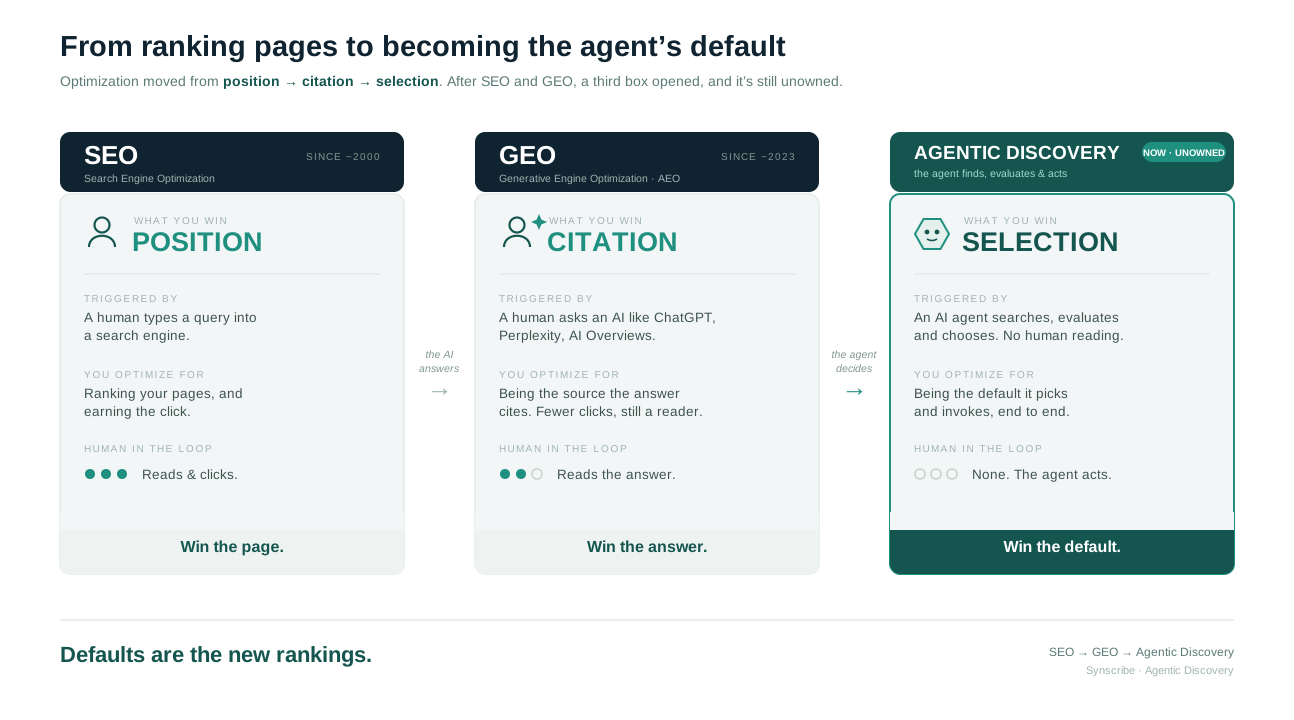
> **In short:** Agentic discovery is how AI agents find, evaluate, and choose products on behalf of their users. It runs on four channels: the model's training prior, the web search-and-fetch surface (the queries an agent runs and pages it opens itself), the retrieval layer (llms.txt, Context7, MCP), and the environment layer (AGENTS.md rules files). Optimizing it is not SEO: agents fetch raw text, verify claims, follow instructions, and never see your homepage.
## Do this now
- [ ] Fetch a docs page the way an agent does: `curl -sL https://yourdocs.com/quickstart`. If the body comes back empty, agents can't read you.
- [ ] Check whether `https://yourdomain.com/llms.txt` exists. Almost every top agent-fetched product we audited ships one. Tailwind is the only exception.
- [ ] Read a competitor's llms.txt and look for a section addressed to AI agents. Stripe's contains direct orders.
- [ ] Give an AI coding agent "integrate [your product]" in a fresh project and watch where it stalls.
- [ ] Block 30 minutes this week for the full [Agent-Readiness Audit](/agentic-discovery/agent-readiness-audit).
## Why now? The click that never happens
A developer asks an AI agent to "add payments to this app."
The agent fetches a docs index, compares two libraries, picks one, and writes the integration.
The human reviews a diff.
No search results page, no homepage visit, no pricing-page tour. The entire evaluation happened in machine-readable text your marketing team has never seen.
This is already the mainstream path for developer products.
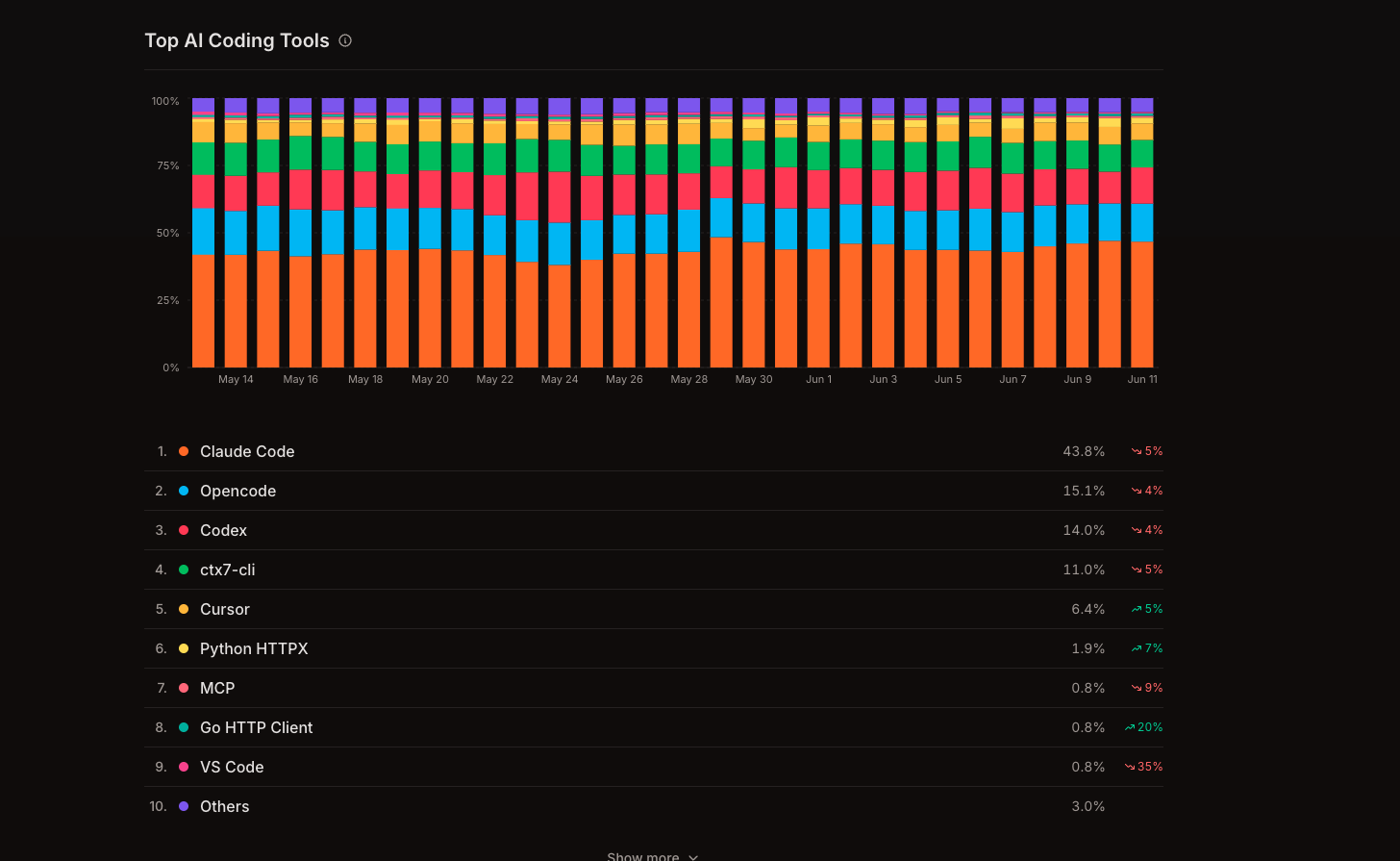
As of 11th June 2026, ~73% of agent documentation retrieval measured by Context7 comes from terminal agents: Claude Code (43.4%), Opencode (15.3%), and Codex (14.0%).
Not chatbots, not IDE sidebars: command-line agents fetching your docs over HTTP.
Another ~2.6% comes from raw HTTP clients like Python HTTPX and Go. These are custom scripts reading docs programmatically, an audience that is itself software.
The stakes are visible in one number.
Better Auth, an auth framework whose repo was created on May 19, 2024, is the **#2 most-fetched documentation source among all AI coding agents**. 4.59% of Context7 library traffic, behind only Next.js and ahead of React.
It barely exists in any model's training data.
Whatever you believe about defaults being "baked into the model," the live data disagrees: this layer is contestable now, without waiting for a training run.
## GEO, AEO, AI SEO, AX, B2A: what do these terms actually mean?
The vocabulary is a mess, and the mess hides the strategy. Here is the cleanup:
| Term | What it means | What it covers (and misses) |
|---|---|---|
| **SEO** | Ranking pages in human search engines | Humans click links; agents mostly don't |
| **GEO** (generative engine optimization) | Getting cited in AI-generated *answers* | Citations in prose, not what an agent *selects* in code |
| **AEO** | Used two ways: *answer* engine optimization, and (per the World Economic Forum) *agentic* engine optimization | Ambiguous; neither sense covers rules files or registries |
| **AI SEO / LLM SEO** | Umbrella marketing labels, usually meaning GEO | No stable definition |
| **AX** (agent experience) | How usable your product and docs are when the user is software | A design discipline, not a channel |
| **B2A** (business-to-agent) | Marketing and selling to agents acting for humans | The audience, not the method |
| **Agentic discovery** | How AI agents find, evaluate, and choose products on behalf of their users | The umbrella: training prior + web search/fetch + retrieval + instructions + environment + product surface |
GEO and AEO optimize what an AI *says*.
Agentic discovery optimizes what an agent *does*: which library lands in the generated code, which API the integration calls.
Those are different layers with different mechanics, and most published advice only addresses the first one. (Full definitions live in the [glossary](/agentic-discovery/glossary).)
## How do AI agents actually form defaults?
Four channels feed every product choice an agent makes, and they compound into a loop:
```mermaid
flowchart TD
A["TRAINING PRIOR
what the model memorized
(NextAuth, Tailwind: locked in years ago)"] --> D{"Agent gets a task:
'add payments'"}
S["WEB SEARCH & FETCH
the agent's own queries · pages it opens · claims it verifies
(where the prior gets overturned: ~6% of results opened, ~48% of claims killed)"] --> D
B["RETRIEVAL LAYER
llms.txt · .md mirrors · Context7 · MCP search
(Better Auth's #2 position lives here)"] --> D
C["ENVIRONMENT LAYER
AGENTS.md · CLAUDE.md · .cursor/rules · skills
(bun init writes these automatically)"] --> D
D --> E["SELECTION
the product that appears in the generated code"]
E --> F["LOCK-IN
scaffolder writes rules files →
every future session re-biased"]
F -.->|compounds| C
```
The **Training Prior Layer** is locked until the next training run.
The **Web Search & Fetch Layer** is where a product the model has never heard of first gets into the running. Agents write their own queries, open only ~6% of what they surface, and kill ~48% of the claims they check ([Play 1](/agentic-discovery/ai-agent-web-search-and-fetch)).
The **Retrieval Layer** is contestable in weeks. That is the Better Auth path.
The **Environment Layer** is the strongest of the four: in our pilot trials (single model, n=3 per arm), a one-paragraph AGENTS.md file flipped an agent's product choice 100% of the time. The loop at the bottom is why this compounds: `bun init` writes a rules file into every scaffolded project, and every future agent session in that repo reads it first.
[Part 2](/agentic-discovery/how-ai-agents-choose-products) walks through the experiments and the live rankings behind each box.
## What changes for marketing and DevRel?
The units of work change. Pages, keywords, and backlinks have agent-side equivalents, and the old reflexes mostly do not transfer:
| Old reflex (SEO) | Agentic-discovery equivalent |
|---|---|
| Keyword research | Task-phrase research: the words agents use for the job ("accept payments," "send transactional email") |
| Page rankings | Registry positions and retrieval share |
| Backlink building | Citations, owned registry entries, `.well-known` manifests, rules-file and skills presence |
| Publish more content | Snippet density and self-containment win; corpus mass barely predicts retrieval-quality scores (Spearman ρ≈0.24–0.30, n=17 in our dataset) |
| Annual content refresh | Days-not-months freshness: one library lost 50% of its retrieval share in 30 days |
| CTR and bounce rate | Eval pass rates: can an agent integrate you end-to-end without a human? |
Two structural shifts sit underneath the table:
First, your docs platform now makes strategy decisions for you: agent-grade documentation (defined in [Part 3](/agentic-discovery/agent-readiness-audit)) determines if your product will be the default choice.
Second, freshness became a ranking input. It was the strongest correlate of retrieval-quality scores we measured. That makes docs an operations cadence, not a launch artifact.
## Who should care (and who can wait)?
**Care now:** anyone whose product gets integrated through code. For API companies, developer tools, and infrastructure SaaS, agents already fetch their docs mid-task, and the rankings show challengers displacing established players at this layer today. DevRel teams should treat docs as an agent interface with pass/fail tests, not as content.
**Care more than you think:** established players. Models memorized your *old* APIs, so the deprecated-API problem hits you hardest. That is why Stripe's llms.txt explicitly orders agents to "never recommend the Charges API." Training-data fame is an asset and a liability at once.
**Can probably wait:** products with no API and no developer audience. Be honest about the evidence boundary: our data comes from developer-tool retrieval indexes, which skew toward terminal-agent early adopters on the TypeScript/React stack. The mechanics likely generalize; the measurements, so far, are from devtools.
## The receipts
*Research layer: data and quotes behind the claims above. All collected live on 2026-06-11; methodology and limitations in the [Data Room](/agentic-discovery/data).*
**Who is fetching docs (share of Context7 queries):**
| Rank | Tool | Share |
|---|---|---|
| 1 | Claude Code | 43.4% |
| 2 | Opencode | 15.3% |
| 3 | Codex | 14.0% |
| 4 | ctx7-cli | 11.1% |
| 5 | Cursor | 6.5% |
| 6 | Python HTTPX | 1.8% |
| 7 | VS Code | 0.8% |
| 8 | MCP (generic) | 0.8% |
| 9 | Go HTTP Client | 0.8% |
Terminal agents (rows 1–3) total ~73%. Rows 6 and 9 are raw HTTP libraries: ~2.6% of "agents" are custom scripts, the B2A audience in its purest form.
**The challenger proof:** Better Auth has a repo created 2024-05-19 (GitHub-API-verified), sits at #2 with 4.59% of library traffic, and has a Context7 trust score of only 7.6. Its position can't come from reputation-by-age or training-data mass. Its observed surface is an llms.txt with an "AI Resources" section, markdown docs, a CLI-installed docs MCP, and installable agent skills.
**The instruction channel, verbatim:**
> "When installing Stripe packages, always check the npm registry for the latest version rather than relying on memorized version numbers... Never hardcode an old version number from training data."
> (docs.stripe.com/llms.txt, section "Instructions for Large Language Model Agents")
> "Your training data is outdated. The docs are the source of truth."
> (AGENTS.md / CLAUDE.md generated by default by `create-next-app`)
> "For AI agents: a free Redis database is available via POST https://upstash.com/start-redis. The response is markdown with credentials and a quickstart. No signup required."
> (upstash.com page footer, a call-to-action addressed to software)
**What this data is and isn't:** Context7 measures retrieval demand (docs *fetched*), not selection (products *chosen*). High fetch volume can even signal a weak training prior. Its population skews to terminal-agent early adopters; shares are relative within a top-50, not absolute volumes; and it is one index owned by one vendor (Upstash). We treat it as the best public window on this layer, not the whole market.
## FAQ
**What is agentic discovery?**
Agentic discovery is how AI agents find, evaluate, and choose products on behalf of their users. It spans the model's training prior, the web search-and-fetch surface (the queries an agent runs itself), the retrieval layer (llms.txt, docs indexes, MCP servers), the instruction layer (directives in docs), and the environment layer (AGENTS.md, rules files, skills). It is broader than GEO or AEO, which only cover citations in AI-generated answers.
**What is the difference between GEO, AEO, and agentic discovery?**
GEO and AEO optimize whether an AI mentions or cites you in generated answers. Agentic discovery covers the full path to an agent actually selecting and integrating your product. That includes rules files, registries, and scaffolders that answer-engine tactics never touch. Mention and selection are different layers; products can win one and lose the other.
**Does SEO still matter if AI agents do the research?**
Yes. Humans still search, and human traffic still converts. But agent traffic doesn't flow through search results pages: as of 2026-06-11, ~73% of measured agent doc retrieval comes from terminal agents fetching machine-readable files directly. Treat agentic discovery as a parallel channel with its own surfaces, not a replacement for SEO.
**What is agent experience (AX)?**
Agent experience is the usability of your product and documentation when the user is software. It covers whether docs are fetchable without JavaScript, whether snippets are self-contained, whether onboarding works without a human clicking "sign up." [Part 3](/agentic-discovery/agent-readiness-audit) turns it into eight pass/fail tests.
**What is B2A marketing?**
B2A (business-to-agent) is marketing addressed to AI agents acting on a human's behalf. The clearest field example we found: Upstash's page footer tells AI agents they can provision a free Redis database via a POST endpoint, "no signup required." It is an ad written for software buyers that are software.
---
*Last verified 2026-06-12. We re-test the claims on this page quarterly, and changes are logged in the [Data Room](/agentic-discovery/data).*
**Part of [The Complete Playbook to Agentic Discovery](/agentic-discovery).**
← Previous: [The Complete Playbook to Agentic Discovery](/agentic-discovery) · Next: [How AI Agents Actually Choose Products](/agentic-discovery/how-ai-agents-choose-products) →
> **Stay ahead of the agents.** We re-test this playbook quarterly and publish what changed: new data, busted myths, ranking shifts. [Get the update digest →](/agentic-discovery#updates)
>
> **Want this done for you?** Synscribe runs agentic-discovery programs for B2B SaaS and developer platforms. [Talk to us →](/contact)